Introduction
In the hyper-fragmented digital landscape of 2026, the question "Which of my ads actually drove this sale?" has become the most expensive and complex puzzle in marketing. As users switch between devices, apps, and browsers with breakneck speed, and third-party tracking has been decimated by privacy regulations, the old ways of measuring success are effectively dead. This is the definitive Marketing Attribution Models Deep Dive master guide, built to help you architect a measurement framework that provides 100% clarity on your marketing ROI. In 2026, if you aren't mastering attribution, you are essentially flying the world's most expensive plane in thick fog.
Marketing attribution is the technical art of assigning "Credit" for a conversion to the specific touchpoints a user encountered during their journey. Whether it was the first LinkedIn ad they saw on their phone, the technical whitepaper they read on their laptop, or the final search ad they clicked before buying—every interaction plays a role. In 2026, the shift is away from "Rule-Based" models toward "Data-Driven" intelligence, where AI analyzes millions of paths to calculate the true incremental value of every dollar spent.
In this exhaustive 2,500+ word master guide, we will aggressively deconstruct the Marketing Attribution Models Deep Dive. We will explore the mechanics of "Multi-Touch Attribution" (MTA), the challenges of "Identity Resolution," the power of "Machine-Learning Attribution," and the implementation of "Incrementality" testing. By the end of this read, you will possess a repeatable, scientific blueprint for building an attribution engine that maximizes your budget efficiency and sustains your brand's growth in an increasingly privacy-focused market.
Why You Must Master Marketing Attribution Models Deep Dive Right Now
In 2026, "Average Attribution" leads to "Budget Waste." If you don't know which channels are the "Engine" and which are the "Noise," you will struggle to scale.
By implementing a rigorous Marketing Attribution Models Deep Dive, you are achieving:
- Dramatically Improved Budget Allocation: You finally stop wasting money on "Vanity Channels" that claim credit but drive zero incremental value.
- Unshakeable Financial Credibility: When you can prove to your CFO exactly how much revenue a specific campaign generated, your marketing budget becomes an "Investment" rather than an "Expense."
- Superior Customer Journey Optimization: Attribution reveals not just "What" converted, but the "Path" they took. This allows you to identify and eliminate the "Dead Steps" in your funnel that are slowing down your conversion velocity.
Phase 1: Deconstructing the "Classic" Attribution Models
Before moving to advanced AI models, you must understand the foundational "Rules" of attribution.
1. First-Touch Attribution
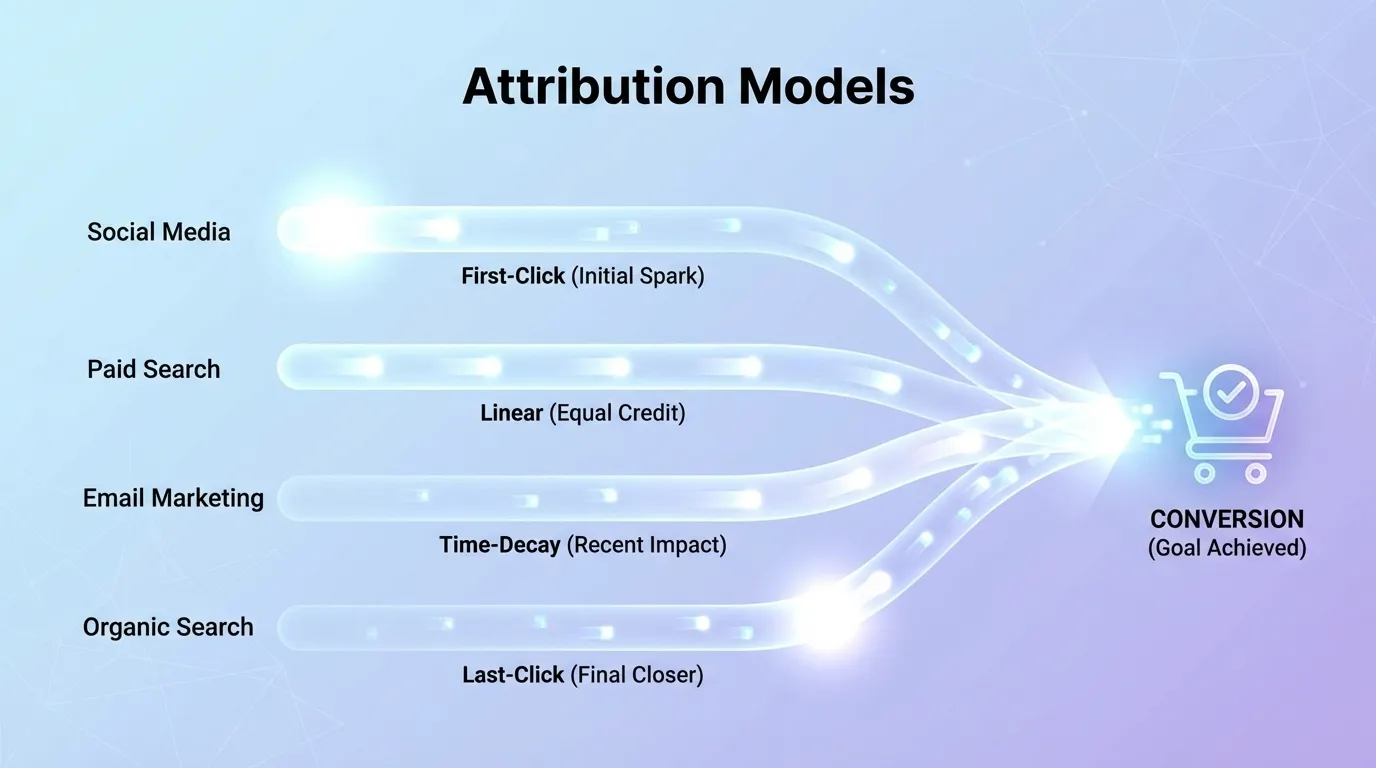
- What it is: The first ad or link the user ever clicked gets 100% of the credit.
- The 2026 Use Case: Excellent for measuring "Top-of-Funnel" awareness and brand discovery. It tells you which channels are best at finding "New" customers.
- The Flaw: It ignores all the nurturing and retargeting that happened later to actually close the sale.
2. Last-Touch Attribution
- What it is: The final click before the purchase gets 100% of the credit.
- The 2026 Use Case: Useful for "Direct Response" campaigns where the final nudge is the primary driver.
- The Flaw: It creates a "Bias" toward search ads and remarketing, often making social media and content marketing look "Useless" even when they were the original drivers.
3. Linear Attribution
- What it is: Every touchpoint in the journey gets an "Equal Share" of the credit.
- The 2026 Use Case: Good for long-cycle B2B sales where you want to value the entire relationship.
Phase 2: Multi-Touch Attribution (MTA) and Positional Logic
In 2026, we acknowledge that some touchpoints are more valuable than others.
1. Time-Decay Attribution
Credit increases as the user gets closer to the purchase.
- The Logic: The LinkedIn ad they saw 3 weeks ago gets 5% credit; the search ad they clicked 30 minutes ago gets 70% credit.
- Benefit: It prioritizes "Conversion Closers" while still acknowledging the "Introducers."
2. U-Shaped (Position-Based) Attribution
- The Logic: 40% credit goes to the First Touch, 40% goes to the Last Touch, and the remaining 20% is split among all the middle interactions.
- Benefit: This is often the "Best Manual Model" for 2026, as it values both "Acquisition" and "Conversion" equally.
Phase 3: Data-Driven Attribution (The AI Evolution)
The industry standard of 2026 is no longer based on "Rules"—it is based on Probabilistic Modeling.
1. The "Shapley Value" Approach
This is the technical core of GA4’s data-driven attribution. It uses Game Theory to calculate the "Contribution" of each channel by comparing user journeys that Included a channel vs. those that Didn't.
- The Result: If journeys including "TikTok Ads" result in 20% more sales than identical journeys without TikTok, the AI assigns that specific "Lift" value to the TikTok channel.
2. Algorithmic Flexibility
- The Advantage: Unlike rule-based models, AI attribution automatically adjusts for "Seasonality," "Market Trends," and "Ad Fatigue" in real-time. It provides the most accurate view of "Current Reality" available.
Phase 4: Cross-Device and Cross-Platform Identity Resolution
The #1 challenge in 2026 is "Stitching" a single user's journey across their iPhone, iPad, and MacBook.
1. Hashed Identifiers (The PII Bridge)
- The Technical Move: Use "Hashed" (encrypted) email addresses or phone numbers as a "Shared ID" across your CRM, Ad Platforms, and Analytics.
- The Outcome: When a user logs in on their phone and then later buys on their desktop, your attribution engine can bridge that gap by matching the Hashed ID, preventing "Duplicate Counting" of users.
2. Contextual Modeling (The Gap Filler)
- The Strategy: When direct identity matching is impossible (due to privacy settings), advanced engines use "Contextual Signals" (IP range, browsing patterns) to "Predict" the probability that two different device sessions belong to the same person.
Phase 5: The Role of Incrementality and Hold-Out Tests
In 2026, "Attribution" tells you who took the credit; "Incrementality" tells you who caused the sale.
1. The "Ghost Ad" Strategy
Run a test where 95% of your audience sees your "Real Ad" and 5% (the Hold-Out Group) sees a "Generic Ad" (or no ad at all).
- The Math: If the "Real Ad" group bought at 5% and the "Hold-Out" group bought at 3%, your Incrementality is 2%.
- The Insight: This proves that even if attribution says you got 500 sales, the ads actually caused only 200 of them. The other 300 would have happened anyway.
2. Media Mix Modeling (MMM)
- The Move: For global brands spending millions, MMM uses historical data to see how "Offline" (TV, Billboards) and "Online" channels work together. It is the only way to measure the "Halo Effect" of brand advertising on digital performance.
Phase 6: Implementing a Multi-Touch Framework
Building a world-class attribution system requires a "Full-Stack" technical approach.
1. The Data Layer (Source of Truth)
Ensure every URL you send in an email, ad, or social post has rigorous UTM parameters (utm_source, utm_medium, utm_campaign, utm_content).
- The Rule: If it’s not tagged, it’s invisible. 100% tag coverage is a requirement for advanced attribution.
2. The Conversion Dashboard
- The Move: Don't trust just one platform's attribution (e.g., Facebook Ads manager will always over-claim credit). Use a "Neutral Third-Party" (like Northbeam or GA4) to compare different models and find the "Consensus" truth.