Introduction
In the hyper-competitive software economy of 2026, building a great product is only half the battle. The other half is ensuring that users can discover, understand, and commit to that product with zero friction. This is the definitive CRO Strategy for SaaS Products master guide, built to help you master the unique, multi-stage conversion challenges of Software-as-a-Service. In 2026, the brands that dominate the market are those that turn their product into their primary marketing engine through Product-Led Growth (PLG) and high-velocity conversion optimization.
Conversion Rate Optimization for SaaS is fundamentally different from E-commerce. While retail is about "One-off Transactions," SaaS is about "Long-term Relationships." Your conversion strategy must move beyond the "Sign-Up" and focus on the entire lifecycle—from the first website visit to the free trial, to the "Aha! Moment" of initial value, and finally to the successful conversion into a long-term, high-LTV paid subscriber. If your conversion funnel stops at the checkout button, you are missing 90% of your potential revenue.
In this exhaustive 2,500+ word technical deep-dive, we will aggressively deconstruct the framework of a superior CRO Strategy for SaaS Products. We will explore the mechanics of "Onboarding UX," the psychology of "Trial-to-Paid" transitions, the implementation of "In-App Friction Audits," and the data-driven optimization of "Expansion Revenue." By the end of this read, you will possess a repeatable, scientific blueprint for building a high-growth SaaS machine that scales predictably in any market condition.
Why You Must Master CRO Strategy for SaaS Products Right Now
In 2026, the SaaS market is saturated. Your users' "Switching Cost" is low, but their "Expectation Level" is high.
By implementing these CRO Strategy for SaaS Products techniques, you are achieving:
- Massive Efficiency in Customer Acquisition: By optimizing every stage of the funnel, you lower your CAC (Customer Acquisition Cost) and increase your LTV (Lifetime Value), creating the "Magic Number" ratio (LTV:CAC > 3) required for venture-scale growth.
- Accelerated "Time-to-Value": The faster a user experiences the value of your software, the less likely they are to churn. CRO in SaaS is fundamentally about compressing the "Time-to-Aha."
- Maximum Expansion Revenue: Optimization doesn't stop at the first sale. By identifying "Upsell Triggers" within the product, you turn your existing customer base into your most efficient growth channel.
Phase 1: The SaaS Conversion Funnel (Awareness to Expansion)
In 2026, the SaaS funnel is a Circle, not a straight line.
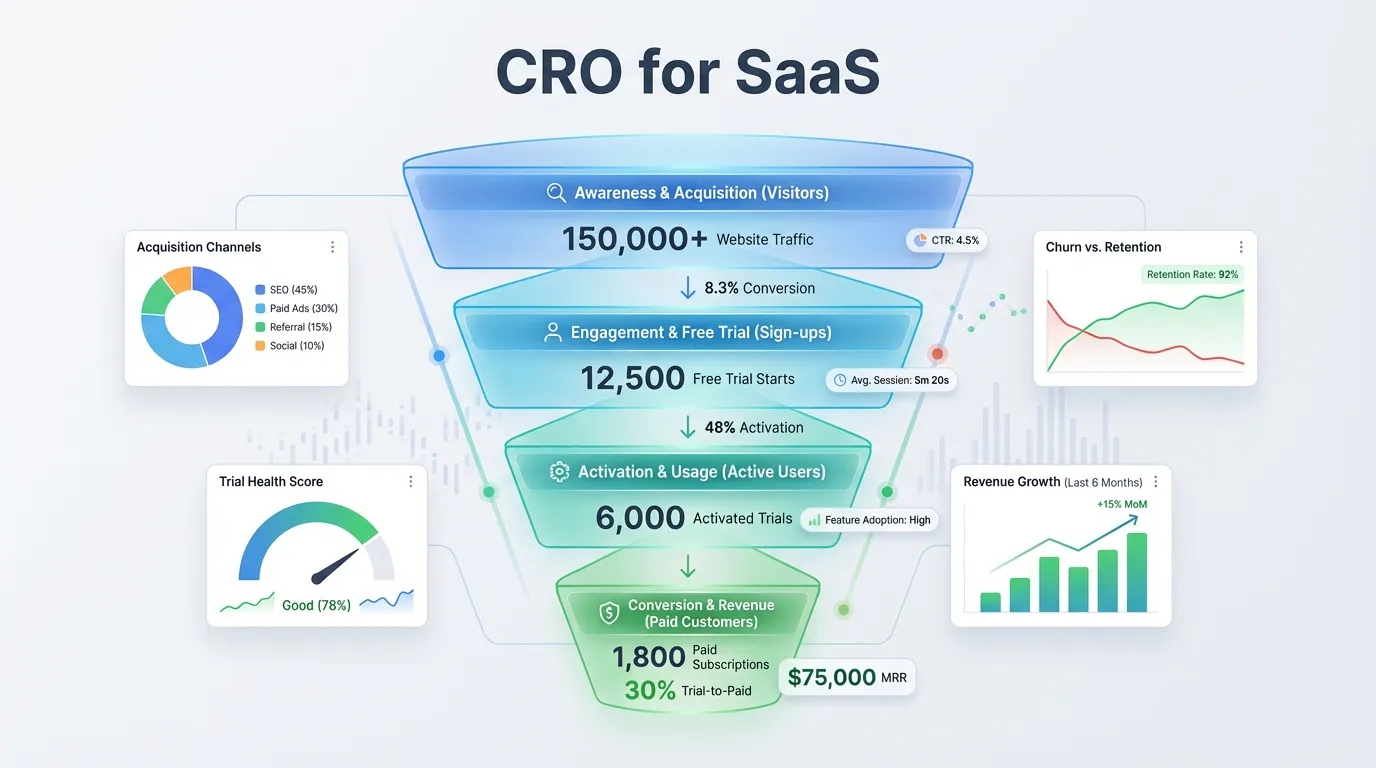
1. The Multi-Stage Journey
- The Website: Optimizing for the "Account Creation" or "Demo Request."
- The Onboarding: Optimizing for the user reaching "Initial Success."
- The Upgrade: Optimizing for the transition from Free/Trial to Paid.
- The Expansion: Optimizing for "Feature Adoption" and additional "Seat Licenses."
2. Identifying the "Drop-Off" Points
- The Audit: Use "Funnel Visualization" (Amplitude or Mixpanel) to see exactly where users are "Stalling."
- The Move: If 50% of people sign up but only 10% finish their first project, your "Onboarding" is the problem, not your marketing.
Phase 2: Optimizing the "Aha! Moment" (Onboarding UX)
The "Aha! Moment" is the precise second a user understands the value of your product.
1. The "Success-First" Onboarding
Stop showing "Tutorials." Start delivering "Results."
- The Strategy: Use "Template-Based Initial State." If you are a design tool, don't give them a blank canvas. Give them a "Finished Template" they can edit in 30 seconds.
- The Goal: The user should complete a "High-Value Action" within the first 3 minutes of their first session.
2. In-App "Nudges" and Progress Bars
- The Move: Use a "Checklist" of 3-5 key actions.
- The Psychology: Humans have a natural drive to "Complete" a list. By showing them they are "80% Done," you motivate them to take the final, critical steps toward full product adoption.
Phase 3: Trial-to-Paid Conversion Tactics (2026 Standards)
The transition from "Free" to "Paid" is a high-risk friction point.
1. The "Value-Triggered" Wall
Instead of a "Time-Based Trial" (e.g., 14 days), use a "Value-Based Trial" (e.g., "First 10 Projects Free").
- The Benefit: This ensures you only ask for money after the user has already received significant value, making the "Yes" feel like an investment rather than a cost.
2. The "Loss-Aversion" Email Sequence
- The Strategy: As the trial ends, send a series of emails highlighting what the user will Lose if they don't upgrade (e.g., "Access to your data will be restricted," "Your automated workflows will stop").
- The Result: "Loss Aversion" is a 2x stronger motivator than "The Promise of Gain."
Phase 4: Product-Led Growth (PLG) Optimization Framework
In 2026, the product is the salesperson.
1. The "Self-Service" Discovery Path
Allow users to invite team members and test "Pro Features" for free inside the app.
- The Move: Use "Feature-Level Gating." When a user clicks on a premium feature, don't just say "Access Denied." Show them a 15-second video of how that feature solves their specific problem, and offer a "1-Click Upgrade."
2. Viral Referral Loops
- The Strategy: Give users "Credit" or "Extra Capacity" for inviting their colleagues.
- The Math: If every 10 users bring in 2 new users, your "K-Factor" is 0.2, effectively reducing your acquisition costs by 20% automatically.
Phase 5: In-App Performance as a Conversion Factor
In 2026, "Speed" is a feature. If the app feels "Heavy," the user will assume the "Service" is also poor.
1. Optimizing "Interaction Latency"
Every click in your app must result in an immediate visual change (even if the data is still loading).
- The Technical Move: Use "Optimistic UI" updates. If a user clicks "Save," show a "Saved" message immediately while the background server call is actually happening.
2. "Zero-Friction" Navigation
- The Audit: How many clicks does it take to do the "Main Task" of your software?
- The Fix: If it’s more than 3 clicks, you are losing users to "Navigation Fatigue." Use "Command-K" bars (Universal Search) to allow users to navigate your app purely via keyboard.
Phase 6: Churn Prediction and "Health Score" Analytics
The ultimate CRO Strategy for SaaS Products includes "Preventing the Cancellation."
1. The "Customer Health Score"
Calculate a score (0 to 100) based on:
- Frequency: How often do they log in?
- Depth: How many different features do they use?
- Support: How many tickets are they opening?
- Sentiment: What is their NPS score?
2. Automated "Re-Activation" Loops
- The Move: If a user’s Health Score drops below 40, trigger an automated "Personal Check-in" email from their "Customer Success Manager" (or an AI agent) asking if they need a "Quick Refresh" call.
- The Goal: Save the customer before they even consider hitting the cancel button.