Introduction
In the hyper-competitive digital marketing landscape of 2026, the businesses that "Win" are not the ones who post the most content, but the ones who "Listen" the most effectively. We have officially moved past the era of "Vanity Metrics"—likes, follows, and generic view counts no longer correlate directly with business success. To achieve sustainable, exponential growth, you must move beyond the surface-level data and implement a deep-layer strategy for How to Analyze Social Media Insights for Growth.
Social media analytics is the strategic process of collecting, measuring, and interpreting user behavior data to inform your future content, advertising, and product decisions. In 2026, with the integration of AI-driven predictive modeling and the shift toward "Privacy-First" data collection, your ability to "Decode the Signals" in your dashboard is the definitive line between a stagnant brand and a market leader. Whether you are managing a small boutique agency or a global enterprise social team, this guide will provide the master blueprint for data-driven growth.
In this exhaustive 2,500+ word master guide, we are going to look at exactly how to turn raw numbers into actionable growth. We will explore the "Engagement Quality" hierarchy, the technical complexity of cross-platform attribution, the power of "Interest Graph" analysis, and the critical importance of building a unified data dashboard. By the end of this read, you will have a How to Analyze Social Media Insights for Growth strategy that turns your social media accounts into a 24/7 scientific laboratory for profit.
Why You Must Master How to Analyze Social Media Insights for Growth
The primary reason most brands fail to scale is Data Misinterpretation. They see a "Viral Video" with 1,000,000 views and assume it was a success, only to find that it generated zero leads and attracted the wrong audience. Or they see a post with "Low Likes" and delete it, unaware that it actually drove 10 high-value conversions in the DMs.
In 2026, the platforms (Meta, TikTok, LinkedIn) are increasingly obfuscating raw data to protect user privacy. To succeed, you must learn to read the "Secondary Signals." Understanding How to Analyze Social Media Insights for Growth is about mastering the art of "Correlation"—seeing how a spike in YouTube watch time leads to a spike in Google Branded searches three days later.
Phase 1: Defining Your "North Star Metric" (Beyond Vanity)
Before you open a single dashboard, you must define what "Success" actually looks like for your specific business stage.
1. The Conversion Focus (ROAS/CPA)
If you are an e-commerce brand, your North Star is not "Engagement"; it is "Revenue per Impression."
- The Blueprint: Every piece of data in your dashboard should be viewed through the lens of "Did this contribute to a sale?"
2. The Awareness Focus (Share of Voice)
If you are a new startup, your North Star might be "Saves per Reach."
- Why? A "Save" is the highest-value signal of "Future Intent." It means your content was so valuable the user decided they needed to "Return to it." This is a much better predictor of brand authority than a "Like."
Phase 2: Analyzing Engagement Quality (The Hierarchy of Signals)
In 2026, not all engagements are created equal. The algorithm prioritizes "Deep Signals" over "Surface Signals."
- DMs and Shares (The Gold Standard): These are the ultimate "Endorsement" signals. If a user shares your content or sends you a DM, they are "Guaranteeing" your quality to someone else or beginning a direct relationship.
- Saves (The Utility Signal): This signals that your content provides permanent value.
- Comments (The Community Signal): This signals that your content is "Controversial" or "Thought-Provoking."
- Likes (The Vanity Signal): This is the lowest-value signal. In 1026, most "Likes" are accidental or performative. Do not base your growth strategy on "Likes."
Phase 3: The Cross-Platform Attribution Challenge
A user's journey is a spiderweb. They see a TikTok, then a Facebook ad, then search on Google.
- The Strategy: Use UTM Parameters on every single link you post. This allows you to "Trace" the user’s path in your Google Analytics 4 (GA4) dashboard.
- The 2026 Reality: You must use "Post-Purchase Surveys" to supplement your digital data. Ask every new customer: "Where did you first hear about us?" Often, the answer is a platform where the pixel "Missed" the interaction.
Phase 4: Understanding the "Interest Graph" via Insights
In 2026, the platforms are telling you "Who your content is for" through their Interest Category reports.
- The Insight: Look at your "Audience Interests" tab in TikTok or Meta. If you think you are a "High-End Jewelry" brand but your audience is interested in "Discount Home Decor," you have a Positioning Mismatch. Your creative is attracting the wrong "Interest Pattern."
- The Fix: Change your creative "Hooks" to match the vocabulary and aesthetics of your Target audience, not your Current audience.
Phase 5: Predictive Analytics (Forecasting Trends)
Modern social insights can tell you what is going to happen.
- The Strategy: Look for "Leading Indicators." If your "Share Rate" on educational content is growing by 10% every month, even if your follower count is flat, you are about to see a "Growth Spike."
- The Predictive Move: When you see a specific "Topic" getting a higher-than-average "Save Count," immediately create 5 more pieces of content on that exact topic. You have found a "Content-Market Fit."
Phase 6: Utilizing Third-Party Social Listening Tools
The data inside the platform is only half the story. You must know what the world is saying about you when you aren't in the room.
- Social Listening: Use tools like Brandwatch or Sprout Social to track "Brand Mentions" and "Sentiment."
- The Competitive Edge: Track your competitors' "Sentiment" scores. If people are complaining about a specific feature of your competitor's product, immediately create an ad highlighting how your product solves that exact problem. This is a "Targeted Conquest" strategy.
Phase 7: Building a Unified Marketing Dashboard
In 2026, you cannot manage data across 10 different tabs. You must build a "Single Source of Truth."
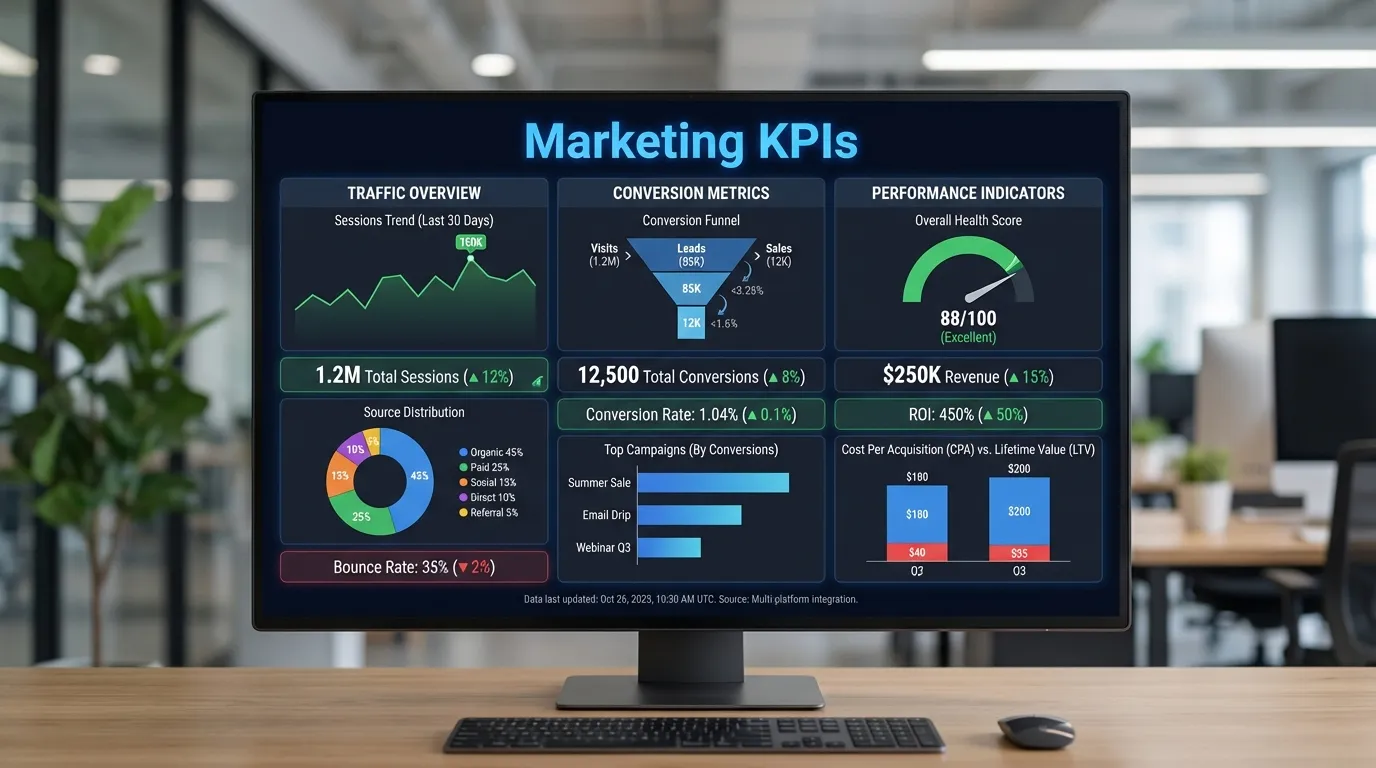
- The Dashboard: Use tools like Looker Studio or Funnel.io to pull data from Meta, TikTok, Google Search, and your CRM into one single visual report.
- The Benefit: This allows you to see "Incremental Lift." If you increase TikTok spend and your overall "Blended CAC" (Customer Acquisition Cost) drops, you know the TikTok channel is assisting sales, even if its "Direct ROAS" looks low.