Introduction
Modern DevOps practices focus heavily on automation, reliability, and continuous delivery. As organizations adopt microservices architectures and cloud-native technologies, managing infrastructure and application deployments becomes increasingly complex. Teams must ensure that deployments are consistent, traceable, and easily recoverable.
This challenge led to the emergence of GitOps, a powerful DevOps approach that uses Git repositories as the single source of truth for infrastructure and application configurations.
Instead of manually deploying applications or updating infrastructure, GitOps enables teams to manage everything through version-controlled repositories. Every change is tracked, reviewed, and automatically applied to the system.
One of the most popular tools for implementing GitOps is ArgoCD, a declarative continuous delivery tool designed specifically for Kubernetes environments.
This argocd gitops tutorial will help you understand how GitOps works with ArgoCD and how organizations use it to automate deployments.
In this guide, you will learn:
- What GitOps is and why it matters
- What ArgoCD is and how it works
- Key features of ArgoCD for GitOps workflows
- How to set up ArgoCD in Kubernetes
- Best practices for managing deployments using GitOps
By the end of this article, you will understand how GitOps with ArgoCD helps teams deploy applications more reliably and efficiently.
What is GitOps?
GitOps is a DevOps methodology that uses Git as the central system for managing infrastructure and application configurations.
In GitOps, infrastructure and application definitions are stored in Git repositories.
Deployment systems automatically synchronize the desired state defined in Git with the actual system state.
Key Principles of GitOps
GitOps follows several core principles:
- Git is the single source of truth
- Infrastructure is defined as code
- Changes are applied through pull requests
- Deployments are automated
This approach improves transparency, collaboration, and reliability.
Benefits of GitOps
GitOps offers several advantages for DevOps teams:
- improved deployment consistency
- version-controlled infrastructure
- easier rollback and recovery
- enhanced collaboration among teams
Because all changes are tracked in Git, teams gain full visibility into infrastructure and application updates.
What is ArgoCD?
ArgoCD is an open-source continuous delivery tool built for Kubernetes environments.
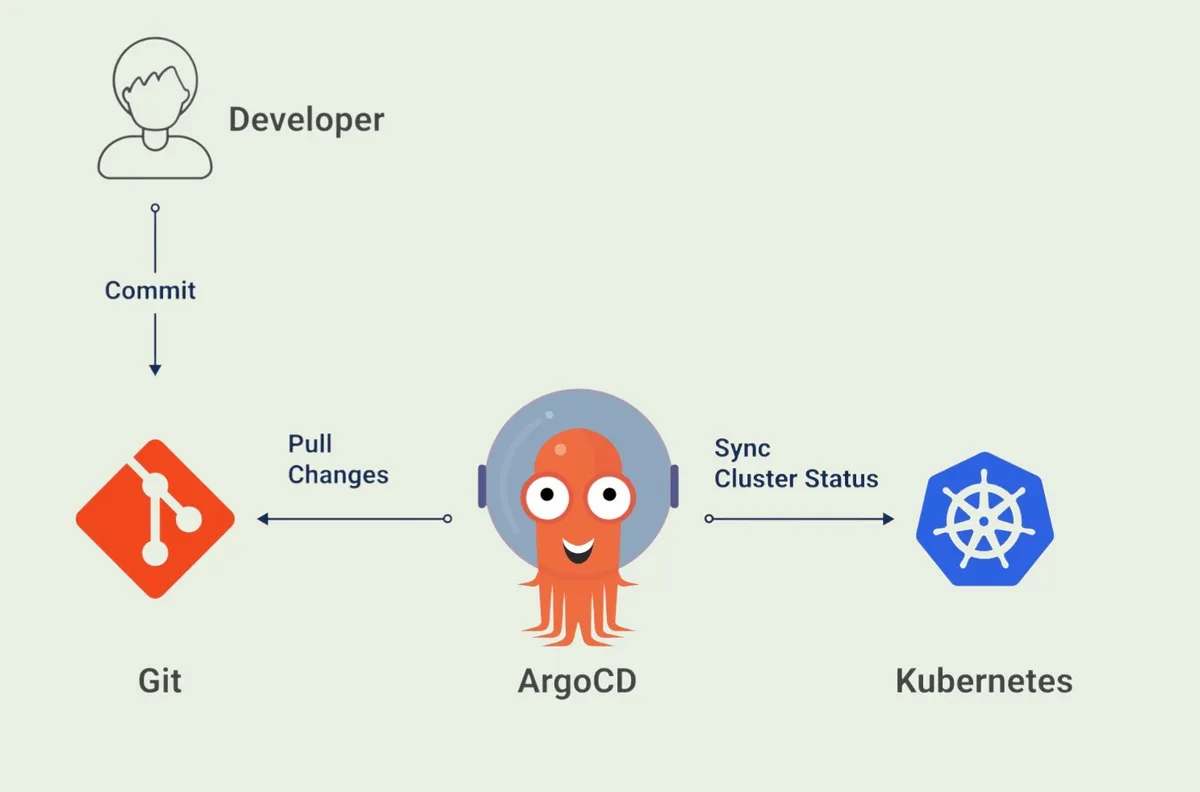
It follows the GitOps model by automatically synchronizing application configurations stored in Git with Kubernetes clusters.
ArgoCD continuously monitors Git repositories and ensures that the cluster state matches the desired configuration.
Key Features of ArgoCD
ArgoCD offers powerful capabilities including:
- automated deployment from Git repositories
- real-time application monitoring
- rollback capabilities
- visual dashboards for deployment status
- Kubernetes-native integration
These features make ArgoCD one of the most popular GitOps tools.
How ArgoCD Works
Understanding how ArgoCD works is essential in any argocd gitops tutorial.
ArgoCD continuously compares the desired state defined in Git with the actual state of applications running in Kubernetes.
If differences are detected, ArgoCD automatically updates the cluster to match the desired configuration.
Git as the Source of Truth
Developers define Kubernetes manifests in Git repositories.
These manifests describe:
- deployments
- services
- configurations
- networking policies
ArgoCD monitors the repository for changes.
Synchronization Process
When updates occur in Git:
- ArgoCD detects the change
- It compares the cluster state with Git configuration
- If differences exist, ArgoCD synchronizes the system
This ensures that the cluster always reflects the desired configuration.
Why GitOps is Important in DevOps
GitOps has become increasingly popular in modern DevOps environments.
Improved Deployment Automation
GitOps enables fully automated deployments.
Developers simply commit configuration changes to Git.
Automation tools handle the deployment process.
Increased Transparency
Because every change is stored in Git, teams can track infrastructure history.
This improves auditability and compliance.
Faster Recovery
If a deployment causes issues, teams can roll back to a previous Git commit.
This significantly reduces downtime.
Installing ArgoCD on Kubernetes
This section of the argocd gitops tutorial demonstrates the basic setup process.
Step 1: Create a Kubernetes Namespace
Create a dedicated namespace for ArgoCD.
Example command:
kubectl create namespace argocd
Step 2: Install ArgoCD
Install ArgoCD using Kubernetes manifests.
Example command:
kubectl apply -n argocd -f https://raw.githubusercontent.com/argoproj/argo-cd/stable/manifests/install.yaml
This deploys the ArgoCD components.
Step 3: Access the ArgoCD Dashboard
Expose the ArgoCD server using port forwarding.
Example command:
kubectl port-forward svc argocd-server -n argocd 8080:443
You can now access the ArgoCD web interface.
Deploying Applications with ArgoCD
Once ArgoCD is installed, you can deploy applications using Git repositories.
Step 1: Create an Application
Define an application that points to a Git repository containing Kubernetes manifests.
Step 2: Configure the Deployment
Specify:
- repository URL
- target branch
- Kubernetes cluster
Step 3: Synchronize the Application
ArgoCD automatically applies the configuration to the cluster.
This ensures that the application runs according to the Git repository definition.
ArgoCD Architecture
ArgoCD consists of several core components.
API Server
The API server provides the interface for managing applications.
It communicates with the web UI and CLI.
Repository Server
The repository server retrieves configuration data from Git repositories.
Application Controller
The application controller monitors cluster state and ensures synchronization with Git.
Web Interface
The web UI allows teams to monitor deployments visually.
Best Practices for GitOps with ArgoCD
Keep Configuration Declarative
Define infrastructure and applications using declarative configuration files.
Use Branching Strategies
Use Git branching strategies to manage environments such as:
- development
- staging
- production
Automate Application Synchronization
Enable automatic synchronization to reduce manual intervention.
Monitor Deployments
Use monitoring tools to track application health and performance.
Common Challenges in GitOps Implementations
Despite its advantages, GitOps adoption may introduce challenges.
Managing Multiple Environments
Large systems may require separate configuration repositories for different environments.
Handling Secrets
Sensitive data must be managed securely.
Tools like sealed secrets or secret managers can help.
Repository Complexity
As projects grow, managing large configuration repositories becomes challenging.
ArgoCD vs Other GitOps Tools
Several GitOps tools exist besides ArgoCD.
| Tool | Description |
|---|---|
| ArgoCD | GitOps continuous delivery tool for Kubernetes |
| Flux | Kubernetes GitOps operator |
| Jenkins X | Kubernetes-native CI/CD platform |
ArgoCD stands out due to its intuitive UI and strong Kubernetes integration.
Short Summary
GitOps with ArgoCD allows teams to manage application deployments using Git as the single source of truth.
By automating synchronization between Git repositories and Kubernetes clusters, ArgoCD simplifies continuous delivery and improves deployment reliability.
Conclusion
GitOps has become a powerful paradigm in modern DevOps environments. By treating infrastructure and application configurations as code stored in Git repositories, teams gain improved transparency, collaboration, and deployment reliability.
ArgoCD provides a robust platform for implementing GitOps workflows in Kubernetes environments. With automated synchronization, visual dashboards, and strong integration with Kubernetes, ArgoCD enables teams to manage complex deployments efficiently.
For organizations adopting cloud-native architectures, mastering GitOps with ArgoCD can significantly improve deployment automation and operational stability.
Frequently Asked Questions
ArgoCD is used for implementing GitOps-based continuous delivery for Kubernetes applications.