Introduction
The world of software development is evolving faster than ever. Companies want to build products quickly, deliver updates continuously, and maintain high quality and stability. Two methodologies dominate this landscape—Agile and DevOps. Both aim to accelerate software delivery, improve collaboration, and enhance customer satisfaction. Yet, many people remain confused about how they differ and when to use which approach.
This blog provides a clear, expert-level comparison of DevOps vs Agile, breaking down definitions, workflows, team structures, tools, and real-world use cases. By the end, you’ll know exactly how they differ, how they complement each other, and which one fits your project or organization best.
What Is Agile?
Agile is a software development methodology focused on adaptability, collaboration, and iterative delivery. Instead of building an entire product at once, Agile teams work in small cycles called sprints, delivering features continuously.
Key Characteristics of Agile
- Incremental development
- Cross-functional teams
- Quick feedback loops
- Emphasis on customer collaboration
- Continuous improvement
Where Agile Works Best
- Projects with evolving requirements
- Startups building MVPs
- Dynamic business environments
What Is DevOps?
DevOps is a cultural and technical approach that unifies software development (Dev) and IT operations (Ops) to enable continuous integration, delivery, and deployment.
Key Characteristics of DevOps
- Automation-focused workflows
- Continuous monitoring
- CI/CD pipelines
- Shared responsibility across teams
- Emphasis on system reliability and fast releases
Where DevOps Works Best
- Large-scale distributed systems
- Cloud-native applications
- High-frequency release environments
DevOps vs Agile: Core Differences
Agile and DevOps share goals but differ fundamentally in how they achieve them.
1. Purpose
- Agile: Improve development speed and flexibility
- DevOps: Improve delivery speed and operational stability
2. Team Structure
- Agile: Small, cross-functional dev teams
- DevOps: Unified Dev + Ops team collaboration
3. Workflow Focus
- Agile: Iterative development
- DevOps: Continuous integration & deployment
4. Automation
- Agile: Not inherently automation-driven
- DevOps: Automation is core (CI/CD, monitoring, testing)
5. Release Cycles
- Agile: Releases at the end of each sprint
- DevOps: Multiple releases per day through automated pipelines
How Agile Works (Step-by-Step)
Step 1: Requirement Gathering
Product owner collects and prioritizes user stories.
Step 2: Sprint Planning
Team selects tasks for a 1–4 week sprint.
Step 3: Development
Developers write code and collaborate with testers.
Step 4: Daily Standups
Short meetings ensure team alignment.
Step 5: Review
Completed work is demonstrated to stakeholders.
Step 6: Retrospective
Team evaluates what to improve in the next sprint.
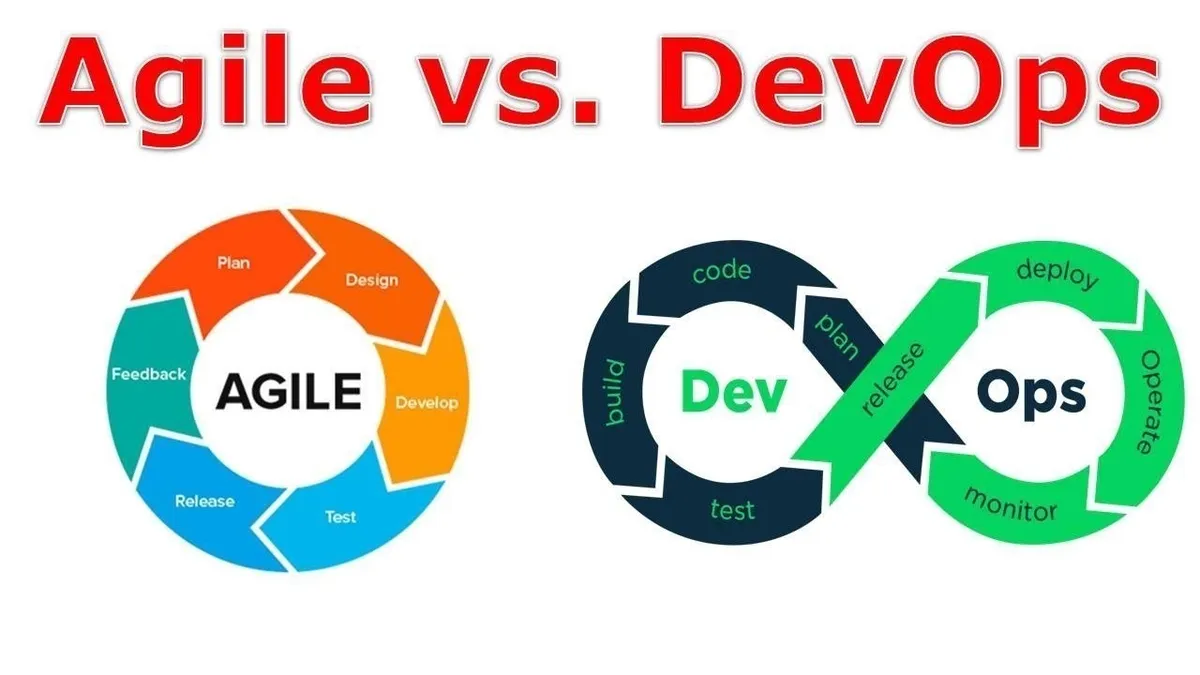
How DevOps Works (Step-by-Step)
Step 1: Code
Developers commit changes frequently to repo.
Step 2: Build
CI tools (e.g., Jenkins, GitHub Actions) package the code.
Step 3: Test
Automated tests validate code quality.
Step 4: Release
CD tools deploy builds to staging or production.
Step 5: Monitor
Tools like Prometheus track system health.
Step 6: Feedback
Operational insights flow back to dev teams.
Agile vs DevOps: A Detailed Comparison Table
| Feature | Agile | DevOps |
|---|---|---|
| Focus | Development process | Development + Operations |
| Team Structure | Developers & testers | Developers, ops, QA, security |
| Release Frequency | Weeks | Daily or multiple times a day |
| Primary Goal | Deliver working software quickly | Deliver stable, automated, continuous releases |
| Feedback Loop | Customer-driven | Tool-generated system feedback |
| Automation | Low to moderate | Very high |
| Documentation | Lightweight | More structured (operational docs) |
| Tools | Jira, Trello, Scrum boards | Jenkins, Docker, Kubernetes, Git, Terraform |
Do DevOps and Agile Compete—or Complement Each Other?
Many assume DevOps replaces Agile, but this is a misconception.
How Agile and DevOps Work Together
- Agile accelerates software creation
- DevOps accelerates software deployment
- Agile delivers incremental features
- DevOps enables continuous releases
Together, they create a smooth flow from planning → development → deployment → monitoring.
Benefits of Agile
1. Faster Time-to-Market
Short sprints enable rapid delivery.
2. Flexibility
Teams can pivot based on customer feedback.
3. Better Collaboration
Developers, testers, and product owners work closely.
4. Continuous Improvement
Retrospectives allow better performance over time.
Benefits of DevOps
1. Higher Deployment Frequency
Automated pipelines enable continuous delivery.
2. Early Bug Detection
Continuous testing catches issues before production.
3. Improved System Reliability
Monitoring and logging ensure stable systems.
4. Better Scalability
Cloud-native and containerized workflows scale easily.
Challenges in Agile
1. Requires Customer Involvement
Frequent feedback is necessary.
2. Difficult for Large Projects
Scaling Agile requires frameworks like SAFe.
3. Documentation Might Be Insufficient
Fast movement can reduce documentation quality.
Challenges in DevOps
1. Cultural Resistance
Teams may dislike operational responsibilities.
2. Tooling Complexity
CI/CD pipelines can be difficult to maintain.
3. Security Risks
Faster releases require strong DevSecOps practices.
Real-World Examples: Agile vs DevOps
Agile Example: A Mobile App Startup
A startup building a fitness app uses Agile to deliver:
- Login feature in sprint 1
- Workout creation in sprint 2
- Social features in sprint 3
Customer feedback shapes next updates.
DevOps Example: Netflix
Netflix deploys thousands of microservices daily using:
- Automated CI/CD
- Chaos engineering
- Monitoring and alerting
DevOps ensures reliability and zero downtime.
When Should You Choose Agile?
- When requirements are unclear
- When customer feedback is critical
- When teams prefer iterative development
- When building MVPs or prototypes
When Should You Choose DevOps?
- When aiming for automated deployments
- When managing complex distributed systems
- When needing rapid, stable releases
- When working with cloud-native applications
DevOps and Agile: Common Myths Debunked
Myth 1: DevOps replaces Agile
Truth: DevOps extends Agile into operations.
Myth 2: DevOps is only about automation
Truth: DevOps is a cultural shift + tools + processes.
Myth 3: Agile teams don’t need DevOps
Truth: DevOps ensures Agile outputs are deployed efficiently.
Actionable Tips for Implementing Agile and DevOps Successfully
For Agile
- Hold short, effective standups
- Maintain a prioritized backlog
- Use story points for estimation
- Focus on delivering shippable increments
For DevOps
- Invest in CI/CD pipelines
- Use infrastructure automation tools
- Implement strong monitoring practices
- Adopt DevSecOps early
Summary
Agile and DevOps are not competing methodologies—they address different stages of the software lifecycle. Agile focuses on development speed and adaptability, while DevOps focuses on deployment automation and reliability. Together, they create a powerful workflow that enables organizations to innovate faster, reduce time-to-market, and ensure system stability.
Conclusion
Understanding DevOps vs Agile is crucial for anyone entering the software engineering field. Both methodologies empower teams to deliver high-quality products efficiently—but in different ways. Agile accelerates development, while DevOps accelerates deployment. When combined, they offer a complete ecosystem for rapid and reliable delivery. Whether you're a student, developer, project manager, or DevOps engineer, mastering both methodologies will elevate your career and technical capabilities.
Frequently Asked Questions
Agile speeds up development. DevOps speeds up deployment and operations.