Introduction
In today’s fast-paced world of DevOps, software teams are expected to release features faster, more reliably, and with minimal human intervention. However, as organizations move deeper into modern CI/CD practices, one question keeps coming up: What is the difference between Continuous Delivery and Continuous Deployment?
These two DevOps practices sound similar, but they are fundamentally different in terms of automation, workflow, risk tolerance, and business readiness. Confusing them can lead to poor implementation, deployment failures, and unnecessary bottlenecks.
In this comprehensive guide, you will clearly understand CD vs Continuous Deployment, how each works, real-world examples, pros and cons, use cases, practical tips, and how to choose the right strategy for your DevOps workflow. Whether you're a student, developer, DevOps engineer, or product manager — this guide will give you complete clarity.
What Is Continuous Delivery?
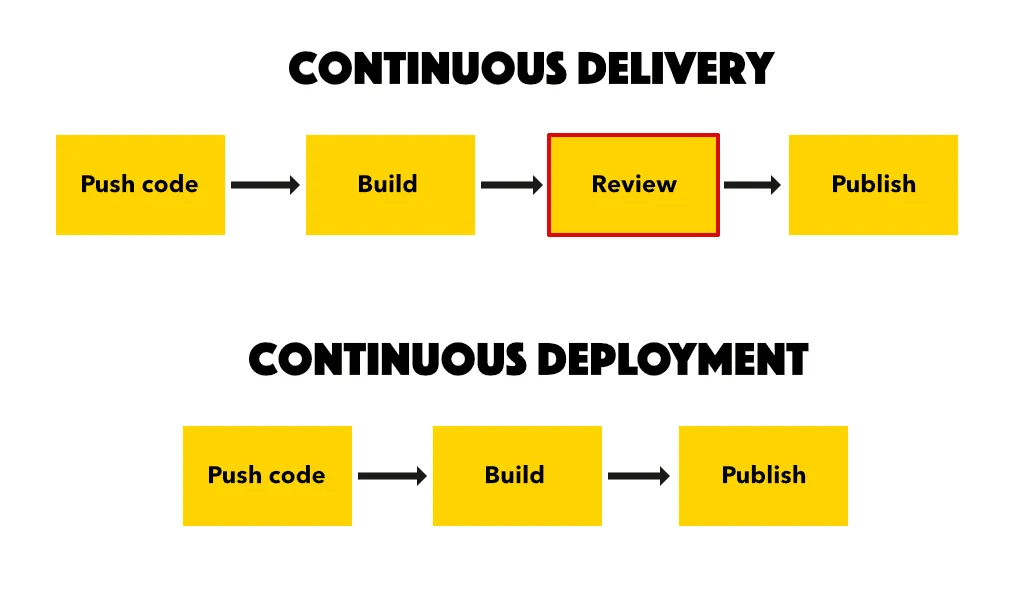
Continuous Delivery (CD) is a software engineering practice where code changes are automatically built, tested, and prepared for release. However, the final deployment to production requires manual approval.
In simple terms:
Continuous Delivery automates everything up to the production environment, but the actual “go-live” step is a human decision.
Key Characteristics of Continuous Delivery
✔ Automated Testing & Build Pipelines
Every commit goes through:
- Unit tests
- Integration tests
- Security scans
- Build processes
✔ Staging Environment
Applications are deployed to a pre-production environment identical to production.
✔ Manual Deployment Approval
A manager or release engineer decides when to push to production.
✔ Predictable Release Cycles
Teams may release:
- Daily
- Weekly
- Monthly
Example of Continuous Delivery Workflow
- Developer pushes code to Git
- CI pipeline runs automated tests
- Build artifact is created
- Application is deployed to staging
- QA verifies the release
- Release engineer approves deployment
- Deployment happens manually
When Should You Use Continuous Delivery?
Use CD when:
- You require quality checks before production
- You have compliance or audit requirements
- Manual verification is essential
- Releases are not expected multiple times per day
Industries like banking, healthcare, finance, and aerospace often prefer Continuous Delivery due to stricter regulation.
What Is Continuous Deployment?
Continuous Deployment is a more advanced DevOps practice where every code change that passes automated testing is deployed to production automatically — no human approval required.
In simple terms:
Continuous Deployment = Continuous Delivery + fully automated release to production.
Key Characteristics of Continuous Deployment
✔ Fully Automated CI/CD Pipeline
If tests pass, the update goes live instantly.
✔ No Manual Intervention
No approval is needed — production deployments happen automatically.
✔ Requires Strong Monitoring
Teams must have:
- Real-time observability
- Alerts
- Rollback mechanisms
✔ Faster User Feedback
End-users see updates moments after developers merge code.
Example of Continuous Deployment Workflow
- Developer pushes code
- Automated CI tests run
- Automated security and performance checks run
- If pipeline passes → directly deployed to production
- Monitoring tools validate the deployment
Companies like Netflix, Google, Amazon, and Facebook use this model.
CD vs Continuous Deployment: What’s the Difference?
| Feature | Continuous Delivery | Continuous Deployment |
|---|---|---|
| Production deployment | Manual approval | Fully automated |
| Risk level | Lower | Higher without proper monitoring |
| Release frequency | Scheduled | Constant |
| Human involvement | Required | None |
| Rollback strategy | Manual | Automated |
Automation Differences
Continuous Delivery
Automates:
- Build
- Test
- Staging deployment
Stops before production.
Continuous Deployment
Automates:
- CI pipeline
- Production deployment
- Monitoring and rollback
Which Is Better?
Continuous Delivery is better if:
- You need manual approval
- You work in regulated industries
- Releases require thorough validation
Continuous Deployment is better if:
- Your tests are strong
- You ship frequently
- Real-time feedback is important
Benefits of Continuous Delivery
- Reduced deployment risk
- Faster release cycles
- Improved collaboration
- Higher software quality
Benefits of Continuous Deployment
- Maximum automation
- Rapid innovation
- Immediate feedback
- Higher engineering velocity
Challenges of Continuous Delivery
- Requires manual approval
- Needs skilled QA teams
Challenges of Continuous Deployment
- Requires excellent test automation
- Needs real-time monitoring
- Requires automated rollback tools
Best Practices
- Use Infrastructure as Code
- Automate all tests
- Implement feature flags
- Use canary or blue-green deployments
- Enforce code reviews
- Monitor everything
- Automate rollbacks
Real-World Example
E-Commerce System
Continuous Delivery
QA tests payment, cart, UI, and release manager deploys manually.
Continuous Deployment
Every commit updates production instantly.
Transitioning from CD to Continuous Deployment
- Strengthen test automation
- Implement observability tools
- Automate rollbacks
- Stabilize CI/CD pipelines
- Use incremental rollouts
Short Summary
Continuous Delivery and Continuous Deployment differ mainly in approval and automation. CD requires manual production approval, while Continuous Deployment automatically deploys successful code changes. Both accelerate delivery and boost software quality.
Conclusion
Understanding CD vs Continuous Deployment is essential for designing efficient DevOps workflows. Continuous Delivery offers stability and control, while Continuous Deployment provides unmatched automation and delivery speed.
Adopting the right approach depends on your organization’s maturity, compliance requirements, and engineering culture.
FAQs
1. What’s the main difference?
CD requires manual approval; Continuous Deployment does not.
2. Which is more advanced?
Continuous Deployment.
3. Is Continuous Deployment risky?
Not with strong tests and monitoring.
4. Who uses Continuous Deployment?
Tech giants and SaaS companies.
5. Can both coexist?
Yes — teams can adopt different strategies based on needs.
References
https://en.wikipedia.org/wiki/DevOps https://en.wikipedia.org/wiki/Continuous_delivery https://en.wikipedia.org/wiki/Continuous_deployment https://en.wikipedia.org/wiki/Software_release_life_cycle