Introduction
Containerization has transformed the way modern applications are developed and deployed. Instead of running applications directly on servers, developers now package applications along with their dependencies into lightweight containers. This approach ensures consistency across development, testing, and production environments.
However, managing hundreds or even thousands of containers across multiple machines can become extremely complex. This is where container orchestration platforms come into play.
Two of the most popular orchestration platforms used in DevOps environments are Docker Swarm and Kubernetes. Both tools help organizations manage containerized applications efficiently by automating deployment, scaling, networking, and resource allocation.
But the big question developers often ask is:
Docker Swarm vs Kubernetes: which is better?
While both tools aim to solve similar problems, they differ significantly in architecture, complexity, scalability, and ecosystem support.
In this detailed guide, you will learn:
- What Docker Swarm and Kubernetes are
- How container orchestration works
- Key differences between Docker Swarm and Kubernetes
- Advantages and disadvantages of each platform
- When to use Docker Swarm vs Kubernetes
- Best practices for choosing the right container orchestration tool
By the end of this article, you will clearly understand how these platforms compare and which solution may be better suited for your DevOps environment.
Understanding Container Orchestration
Before comparing Docker Swarm and Kubernetes, it is important to understand the concept of container orchestration.
Container orchestration is the automated management of containerized applications across clusters of machines.
Orchestration tools handle tasks such as:
- container deployment
- container scaling
- load balancing
- service discovery
- resource allocation
- failure recovery
Without orchestration platforms, managing large-scale container environments would require extensive manual work.
What is Docker Swarm?
Docker Swarm is Docker’s native container orchestration tool. It allows developers to create and manage clusters of Docker nodes.
With Docker Swarm, multiple Docker hosts form a cluster known as a swarm.
These hosts can run containers collectively as a single system.
Key Features of Docker Swarm
Docker Swarm provides several important features:
- simple cluster management
- built-in load balancing
- easy container deployment
- service scaling
- high availability
Because Docker Swarm is built into the Docker ecosystem, it is easy for developers already familiar with Docker.
Docker Swarm Architecture
Docker Swarm clusters consist of two types of nodes:
Manager Nodes
Manager nodes handle orchestration tasks such as:
- cluster management
- scheduling containers
- maintaining cluster state
Worker Nodes
Worker nodes run the containers that execute applications.
Managers assign tasks to workers based on available resources.
What is Kubernetes?
Kubernetes is an open-source container orchestration platform originally developed by Google.
It has become the industry standard for managing large-scale containerized applications.
Kubernetes automates deployment, scaling, and management of container workloads.
Key Features of Kubernetes
Kubernetes offers powerful capabilities including:
- automatic scaling
- self-healing containers
- rolling updates and rollbacks
- advanced networking
- extensive ecosystem support
Because of these capabilities, Kubernetes is widely adopted by organizations running complex cloud-native applications.
Kubernetes Architecture
Kubernetes clusters consist of several components.
Master Node
The master node controls the cluster.
It manages scheduling, orchestration, and cluster state.
Worker Nodes
Worker nodes run application containers inside units called pods.
Pods represent one or more containers that share network and storage resources.
Docker Swarm vs Kubernetes Architecture
Understanding the architectural differences helps explain how the two platforms operate.
Docker Swarm Architecture Simplicity
Docker Swarm has a simpler architecture.
Clusters consist mainly of manager nodes and worker nodes.
This simplicity makes Docker Swarm easier to set up and manage.
Kubernetes Architecture Complexity
Kubernetes uses a more complex architecture involving multiple components such as:
- API server
- scheduler
- controller manager
- etcd database
While more complex, this architecture enables Kubernetes to support advanced features and scalability.
Key Differences Between Docker Swarm and Kubernetes
To understand docker swarm vs kubernetes, we must examine their major differences.
Ease of Setup
Docker Swarm is easier to install and configure.
A cluster can be created with just a few commands.
Kubernetes installation requires more configuration and setup steps.
Learning Curve
Docker Swarm has a smaller learning curve.
Kubernetes requires a deeper understanding of concepts such as:
- pods
- services
- deployments
- namespaces
Scalability
Kubernetes is designed to scale to extremely large clusters.
It can manage thousands of nodes and containers.
Docker Swarm is better suited for smaller deployments.
Networking
Docker Swarm includes built-in networking capabilities that are simple to configure.
Kubernetes provides advanced networking features through plugins.
Ecosystem and Community
Kubernetes has a much larger ecosystem.
It integrates with many tools including:
- Helm
- Prometheus
- Istio
Docker Swarm has a smaller ecosystem.
Performance Comparison
Performance depends on the workload and infrastructure.
Docker Swarm Performance
Docker Swarm performs well in small to medium environments.
Because it has fewer components, it may consume fewer resources.
Kubernetes Performance
Kubernetes handles large-scale deployments more effectively.
Its advanced scheduling and scaling capabilities improve performance in complex environments.
Security in Docker Swarm and Kubernetes
Security is critical in container orchestration platforms.
Docker Swarm Security
Docker Swarm includes built-in security features such as:
- encrypted communication between nodes
- automatic certificate management
Kubernetes Security
Kubernetes provides advanced security capabilities including:
- role-based access control
- network policies
- secret management
These features make Kubernetes suitable for enterprise environments.
When to Use Docker Swarm
Docker Swarm is ideal for:
- small teams
- simple container deployments
- quick container orchestration setup
- developers already using Docker
Organizations that want a lightweight solution may prefer Docker Swarm.
When to Use Kubernetes
Kubernetes is better suited for:
- large-scale applications
- microservices architectures
- cloud-native environments
- enterprise-level deployments
Companies requiring advanced orchestration capabilities typically choose Kubernetes.
Advantages of Docker Swarm
Docker Swarm provides several benefits.
- easy to install and configure
- simple architecture
- integrated with Docker ecosystem
- lightweight orchestration
These features make it beginner-friendly.
Advantages of Kubernetes
Kubernetes offers powerful capabilities.
- highly scalable
- strong community support
- extensive ecosystem
- advanced automation features
These advantages make Kubernetes ideal for complex infrastructures.
Short Summary
Both Docker Swarm and Kubernetes are powerful container orchestration tools.
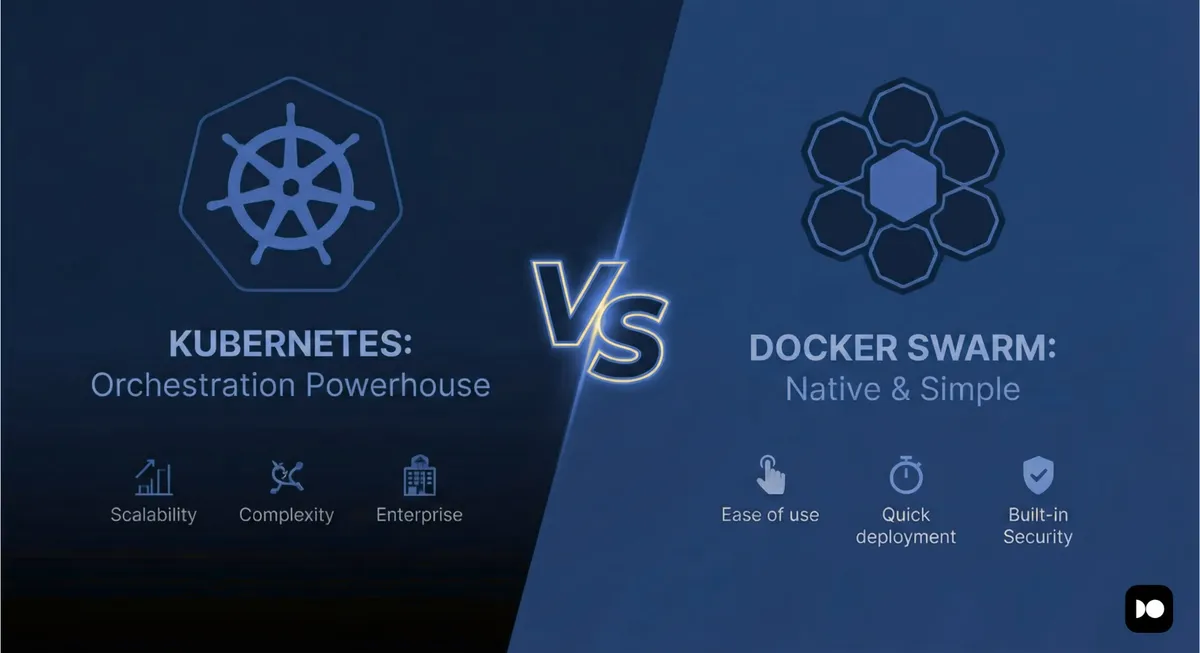
Docker Swarm focuses on simplicity and ease of use, while Kubernetes provides advanced scalability and enterprise-level features.
Choosing between docker swarm vs kubernetes depends on your infrastructure size, complexity, and team expertise.
Conclusion
Container orchestration platforms play a critical role in modern DevOps environments. As organizations increasingly adopt containerized applications, tools like Docker Swarm and Kubernetes help automate deployment, scaling, and management of container workloads.
Docker Swarm offers a simple and easy-to-use orchestration solution that integrates seamlessly with Docker. It is well suited for small teams, simple applications, and quick deployments.
Kubernetes, on the other hand, has become the industry standard for container orchestration due to its scalability, advanced features, and extensive ecosystem. It is the preferred choice for organizations managing complex cloud-native applications.
Ultimately, the decision between Docker Swarm and Kubernetes depends on your project requirements, infrastructure scale, and team expertise.
For beginners and smaller environments, Docker Swarm may be sufficient. For enterprise-scale applications and advanced orchestration capabilities, Kubernetes remains the dominant solution.
Frequently Asked Questions
Docker Swarm is a simpler container orchestration tool built into Docker, while Kubernetes is a more advanced orchestration platform designed for large-scale container management.