
How to Set Marketing Goals That Drive Growth
Introduction
Every successful brand—from small businesses to global giants—thrives because of one thing: clear and strategic marketing goals. Without them, businesses waste time, money, and effort on campaigns that don’t deliver results. But with the right goals in place, your marketing becomes sharper, more effective, and directly aligned with business growth.
In this comprehensive guide, you’ll learn how to set marketing goals that drive real, measurable growth. You’ll discover goal-setting frameworks, examples, best practices, mistakes to avoid, and expert-level strategies used by top marketers worldwide. Whether you're a student, beginner, or business professional, this guide will walk you through every step with clarity and confidence.
Let’s get started.
Why Marketing Goal Setting Matters
Goals give direction and clarity
Without clear goals, your marketing efforts become scattered. Goals help you know what to do, why you’re doing it, and what success looks like.
Goals align marketing with business outcomes
Marketing isn’t just about posting on social media or running ads; it’s about driving revenue, leads, engagement, and brand growth. Proper goal setting ensures every action pushes the business forward.
Goals create accountability
With defined targets, teams stay focused and motivated.
Goals help measure performance
You can't optimize what you can't measure. Clear marketing goals allow you to track progress and refine strategy.
Understanding the Different Types of Marketing Goals
1. Awareness Goals
Focus: Increasing visibility
Examples:
- Boost social media followers
- Increase website traffic
- Improve brand mentions
2. Engagement Goals
Focus: Interactions and audience activity
Examples:
- Increase comments, likes, shares
- Improve email open rates
- Boost average session duration
3. Lead Generation Goals
Focus: Capturing potential customers
Examples:
- Increase form submissions
- Boost eBook downloads
- Grow newsletter sign-ups
4. Sales and Revenue Goals
Focus: Conversions and profitability
Examples:
- Increase monthly sales
- Reduce customer acquisition cost (CAC)
- Improve conversion rate
5. Customer Retention Goals
Focus: Keep customers coming back
Examples:
- Improve repeat purchase rate
- Increase customer lifetime value (CLV)
- Reduce churn
How to Set Effective Marketing Goals (Step-by-Step)
Step 1: Start With Your Business Objectives
You cannot set strong marketing goals without understanding the bigger picture.
Ask:
- Do we want more customers?
- Higher revenue?
- More brand recognition?
- Improved customer loyalty?
Example:
Business goal: Increase quarterly sales by 20%
Marketing goal: Generate 1,000 qualified leads from paid ads and SEO.
Step 2: Use the SMART Goal Framework
SMART = Specific, Measurable, Achievable, Relevant, Time-bound.
Non-SMART goal:
“Get more leads.”
SMART goal:
“Generate 500 qualified leads from Facebook Ads in 60 days while maintaining CPL under ₹100.”
Why SMART Works
- Specific avoids confusion
- Measurable ensures tracking
- Achievable keeps the goal realistic
- Relevant ensures it supports business growth
- Time-bound creates urgency
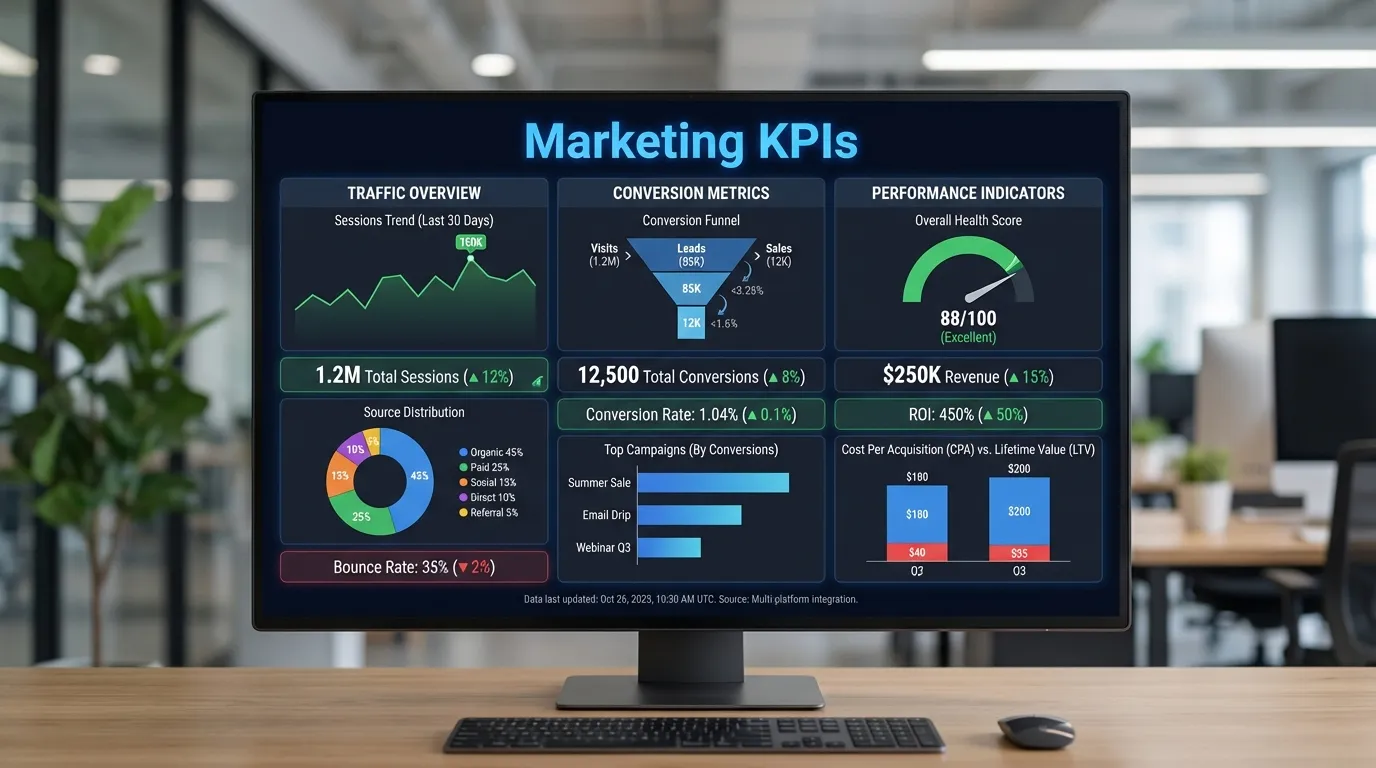
Step 3: Identify Key Marketing Metrics (KPIs)
KPIs make your goals measurable.
Common KPIs include:
- Website traffic
- Conversion rate
- Cost per lead (CPL)
- Return on ad spend (ROAS)
- Social engagement rate
- Organic keyword rankings
- Customer acquisition cost (CAC)
- Customer lifetime value (CLV)
Choose the KPIs that match your goals, not the ones that look impressive.
Step 4: Break Big Goals Into Smaller Milestones
Large goals can feel overwhelming. Milestones make them manageable.
Example:
Goal: 10,000 new monthly website visitors
Milestones:
- Week 1: Publish 3 new blogs
- Week 2: Optimize 10 existing pages
- Week 3: Create a lead magnet
- Week 4: Launch SEO outreach campaign
This keeps your actions consistent.
Step 5: Understand Your Target Audience
Marketing goals must be tailored to audience behavior.
Analyze:
- Demographics
- Interests
- Search behavior
- Pain points
- Buying motivations
Example:
If your audience prefers Instagram over LinkedIn, your engagement goals should focus on Instagram campaigns.
Step 6: Choose the Right Marketing Channels
Your marketing goals depend heavily on where your audience spends time.
Possible Channels Include:
- SEO
- Content marketing
- Email marketing
- Social media
- Paid ads
- Influencer marketing
- Video marketing
- Community building
Choose channels that maximize impact, cost-efficiency, and reach.
Step 7: Align Content Strategy With Your Goals
Your goals define what kind of content you should create.
If your goal is brand awareness:
- Reels
- YouTube shorts
- Listicles
- Infographics
If your goal is lead generation:
- Ebooks
- Webinars
- Case studies
- Landing pages
If your goal is conversions:
- Product demos
- Testimonials
- Comparison guides
Content drives goals.
Step 8: Allocate Budget and Resources
Marketing goals fail when the budget doesn’t support the plan.
Allocate for:
- Ads
- Tools
- Content creation
- Team/influencers
- Analytics
Example:
Goal: Generate 200 leads
Required budget: ₹20,000
CPL target: ₹100
Be realistic and strategic.
Step 9: Monitor, Analyze and Optimize Constantly
Marketing goal setting isn’t a one-time task.
Review results weekly or monthly:
- Are you close to achieving the goal?
- What needs improvement?
- Which campaigns perform best?
- Which channels need more budget?
Data is your best decision-making tool.
S.M.A.R.T Marketing Goal Examples (Ready to Use)
1. Increase Website Traffic
“Increase monthly website traffic from 5,000 to 10,000 visitors in 90 days through SEO and weekly blog publishing.”
2. Boost Sales
“Generate ₹5,00,000 revenue in 60 days through performance marketing campaigns with ROAS 3.0+.”
3. Improve Social Engagement
“Grow Instagram engagement rate from 2% to 5% in 45 days by posting 20 reels and running 1 influencer collaboration.”
4. Increase Leads
“Capture 1,000 new email subscribers in 30 days using lead magnets and social ads.”
5. Reduce CAC
“Reduce customer acquisition cost from ₹450 to ₹300 in 90 days by optimizing ad targeting and retargeting funnels.”
Common Mistakes to Avoid When Setting Marketing Goals
1. Setting vague goals
Avoid goals like:
- “Increase brand awareness”
- “Grow sales”
Be specific.
2. Choosing too many goals
Focus on 2–4 high-impact goals at a time.
3. Ignoring audience insights
Your goals should reflect real customer behavior.
4. Not tracking the right metrics
Metrics must connect directly to goals.
5. Setting unrealistic timelines
You need goals that are ambitious but achievable.
6. Not reviewing performance
Consistent analysis prevents failures.
Advanced Strategies for High-Growth Marketing Goal Setting
1. Use OKRs (Objectives and Key Results)
Example:
Objective: Improve brand positioning
Key Results:
- Increase branded search by 40%
- Earn 50 PR mentions
- Achieve 1 million impressions in 60 days
2. Create Data-Driven Goals
Use analytics tools like:
- Google Analytics
- SEMrush
- Ahrefs
- HubSpot
- Meta Ads Manager
Data helps remove guesswork.
3. Use Competitor Benchmarking
Analyze:
- Their traffic
- Their sales funnel
- Their content
- Their ad strategy
Then set goals to outperform them.
4. Use Predictive Modeling
AI tools can predict:
- Best-selling products
- Audience behavior
- Optimal posting times
- Expected ROI
Use it to set smarter goals.
Short Summary
This guide explained how to set marketing goals that drive business growth. You learned the importance of SMART goals, how to choose KPIs, how to align goals with business objectives, mistake-proof planning, and advanced goal-setting strategies like OKRs and data-driven forecasting.
Conclusion
Marketing without clear goals is just guesswork. But when you set well-structured, measurable, and strategic marketing goals, your brand gains direction, purpose, and the power to grow rapidly.
Whether you're aiming for more leads, higher sales, better engagement, or stronger brand awareness, the secret lies in setting goals that guide your actions and deliver measurable results. Start applying the strategies in this guide today and watch your marketing performance transform.