Introduction
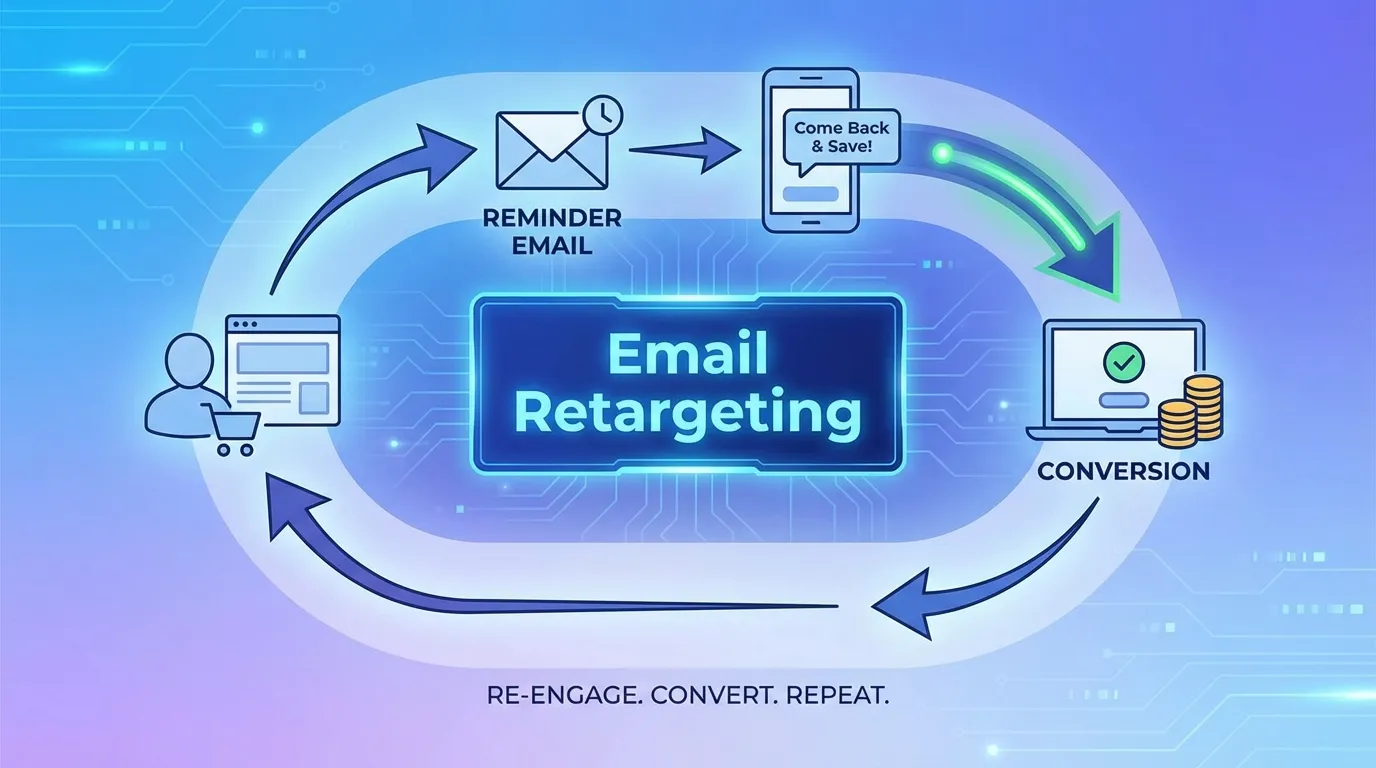
In the hyper-saturated digital economy of 2026, a single interaction is rarely enough to secure a sale. Consumers are constantly distracted, switching between apps and devices at a breakneck pace. This has made the Email Retargeting Strategy Explained the most critical bridge in the entire customer journey. It is the technical art of using email as a "Precision Recall" system—not just to send messages, but to dynamically re-engage users based on their specific, real-time actions across your entire digital ecosystem.
The evolution of retargeting has moved beyond simple "Tracking Pixels" into the realm of "Identity Resolution." In 2026, an effective retargeting strategy doesn't just treat everyone who visited your pricing page the same; it understands the difference between a returning customer looking for an upgrade and a new lead who is comparing you to a competitor for the first time. By syncing your email database with your paid ad platforms and your website's behavioral data layer, you create a "Surround Sound" effect that keeps your brand top-of-mind exactly when the user is most likely to convert.
In this exhaustive 2,500+ word master guide, we will aggressively deconstruct the framework of a superior Email Retargeting Strategy Explained. We will explore the mechanics of "Site-to-Email" triggers, the power of "Social-to-Email" syncing, the implementation of "In-Inbox Retargeting," and the critical "Privacy-First" infrastructure required to operate in 2026. By the end of this read, you will possess a repeatable blueprint for building a high-velocity retargeting engine that drastically lowers your CAC and maximizes your conversion ROI.
Why You Must Master Email Retargeting Strategy Explained Right Now
In 2026, "Cold" traffic is the most expensive it has ever been. Real Profit resides in "Recapturing" the attention you have already paid for.
By implementing a rigorous Email Retargeting Strategy Explained, you are:
- Dramatically Lowering CPA (Cost Per Acquisition): Retargeted leads are up to 70% more likely to convert than first-time visitors because the "Initial Friction" of brand discovery has already been overcome.
- Eliminating "Funnel Leaks": Every time a user leaves your site without converting, they are a "Leaked Lead." Retargeting is the "Seal" that pulls them back into the conversion flow.
- Maximizing Customer Lifetime Value (CLV): Retargeting isn't just for new sales; it is a primary tool for "Expansion Revenue," reminding existing customers about products and services that complement their previous purchases.
Phase 1: Site-to-Email Retargeting (The Behavioral Loop)
The most powerful retargeting happens when your website and your email tool are in "Perfect Sync."
1. The "Browse Abandonment" Trigger
If a known user (someone on your email list) views a specific product or service category but doesn't add to cart, they should receive a "Category Deep-Dive" email within 2 to 4 hours.
- The Strategy: Do not offer a discount yet. Provide "Social Proof" or a "Buyer’s Guide" for that specific category. Show them you are an expert, not just a seller.
2. High-Intent Page Triggers
Certain pages on your site signal "Immediate Purchase Readiness."
- Pricing Page: If they view the pricing page twice in 48 hours but don't book a demo or buy, trigger an email from a "Success Representative" offering a 1-on-1 walkthrough.
- Comparison Page: If they view your "Us vs. Competitor" page, send them a technical whitepaper detailing your unique ROI advantage.
Phase 2: Email-to-Social Retargeting (Cross-Channel Syncing)
Your email segments should act as the "Source of Truth" for your paid social ads (Facebook, LinkedIn, Google).
1. The "Custom Audience" Push
In 2026, your email list should be automatically "Pushed" to Meta and Google Ads hourly.
- The Workflow: If a user clicks a "Case Study" link in your email, they should be automatically added to a "High Interest" audience on LinkedIn, where they start seeing video ads featuring that exact case study.
- The Benefit: This creates a consistent narrative across every screen the user touches.
2. "Exclusion" Retargeting (Protecting the Budget)
Equally important is what you don't show. As soon as a user clicks "Buy" from an email, they must be immediately excluded from all "Sales-Focused" retargeting ads to save your ad budget and avoid annoying the customer.
Phase 3: Abandoned Everything Recovery (The 2026 Protocol)
Abandoned Cart emails are the "Table Stakes." In 2026, you must retarget every lost opportunity.
1. The Multi-Step Cart Recovery
Don't send one email; send a 3-part "Rescue Mission."
- Email 1 (60 Minutes): "Did life get in the way?" (Helpful approach).
- Email 2 (24 Hours): "Your items are still here + Social Proof." (Trust approach).
- Email 3 (48 Hours): "A one-time gift to help you decide." (Direct offer approach).
2. Search Intent Retargeting
If your site has a search bar, and a user searches for "Enterprise Integration" but leaves, send them a personalized email focusing on your integration capabilities. This is "Hyper-Contextual" retargeting.
Phase 4: In-Inbox Retargeting and Personalized Dynamic Blocks
Modern Email Retargeting Strategy Explained involves changing the content of an email after it has already been sent, or utilizing dynamic blocks to reflect the user's latest site visit.
1. Real-Time Dynamic Content
Use "Open-Time" personalization. This means that if you send a weekly newsletter on Tuesday, but the user views a blue jacket on your site on Wednesday morning, when they open the email on Wednesday afternoon, the product block dynamically updates to show the blue jacket.
2. Countdown and Urgency Blocks
If a user is in a retargeting flow for a limited-time offer, use a real-time countdown timer that reflects the actual remaining time on their personalized coupon, creating genuine "Social Scarcity."
Phase 5: Privacy-First Identity Resolution and Consent
In 2026, with the death of third-party cookies, retargeting must be built on "First-Party Identity."
1. Hashed ID Matching
Instead of tracking pixels, use "Server-Side Tagging." When a user interacts with your email, your server sends a unique, encrypted "Hashed ID" to the ad platform. This allows for precise retargeting without violating modern privacy directives (GDPR/CCPA).
2. The "Consent Wall"
Always ensure your retargeting is "Transparent." In your footer or signup form, explicitly state: "We use your browsing activity to provide personalized offers." This builds long-term trust and legal compliance.
Phase 6: Measuring Incremental ROI and Lift
If you don't measure the "Lift," you might be paying for sales that would have happened anyway.
1. Hold-Out Tests (Control Groups)
For every retargeting flow, keep a 10% "Hold-Out Group" that receives the generic, non-retargeted experience.
- The Calculation: The difference in conversion rate between the "Retargeted" group and the "Control" group is your Incremental Lift. This provides the only true proof of the strategy's value.
2. Time-to-Conversion Analysis
Effective retargeting should "Compress" the sales cycle. Track whether users in your retargeting loops convert in 5 days vs. the standard 15-day average.