Introduction
In the hyper-competitive digital landscape of 2026, data is the only language that matters. The era of "Guessing" which emails work and which don't is permanently over, replaced by a rigorous, algorithmic approach to visibility and performance. This is the definitive Email Marketing Analytics Explained master guide, built to help your brand move beyond basic reporting and embrace a high-intensity, technical framework for measuring success. If you are still relying solely on "Open Rates" to judge your campaign health, you are effectively flying a modern jet engine with a paper map.
Analytics in 2026 is no longer about the "Past," it is about the "Predictive." Modern enterprise marketing teams use analytics not just to see what happened yesterday, but to forecast exactly how much revenue a specific segment will generate in the next 90 days. From "Identity-Resolved" attribution to "Context-Aware" interaction signals, the depth of available data is staggering. The challenge is no longer "Getting the Data"—it is "Decoding the Data" to drive meaningful, high-ROI business decisions.
In this exhaustive 2,500+ word master guide, we will aggressively deconstruct the framework of a global-class Email Marketing Analytics Explained. We will explore the technical hierarchy of 2026 KPIs, the mechanics of multi-touch attribution, the power of AI-driven sentiment analysis, and the construction of "Single-Source" reporting dashboards. By the end of this deep-dive, you will possess a repeatable blueprint for transforming raw email data into an impenetrable competitive advantage.
Why You Must Master Email Marketing Analytics Explained Right Now
In 2026, "Information" is cheap, but "Insight" is expensive. The brands that win will be those that can turn their analytics into a "Revenue Roadmap."
By implementing a rigorous Email Marketing Analytics Explained, you are:
- Dramatically Improving Resource Allocation: By knowing exactly which types of content drive the highest Revenue Per User (RPU), you can stop wasting time on low-performing creative and double down on what actually scales.
- Securing Executive-Level Funding: CFOs don't care about "Likes"; they care about "Pipeline." Advanced analytics allow you to prove the direct correlation between your email activities and company revenue.
- Future-Proofing Through Predictive Data: Analytics allow you to identify "Micro-Trends" within your audience before they become "Macro-Problems," giving you the agility to adjust your strategy in real-time.
Phase 1: The 2026 KPI Hierarchy (Moving Beyond Vanity)
Not all metrics are created equal. You must separate the "Noise" from the "Signals."
1. Tier 3: Initial Interaction (The "Health" Metrics)
- Deliverability Rate: What percentage of your mail actually reaches the server? (Technical health).
- Bounce Rate: Hard and Soft bounce percentages. (List hygiene).
- Spam Complaint Rate: The single most important deliverability signal.
2. Tier 2: Engagement Quality (The "Intent" Metrics)
- Click-to-Open Rate (CTO): This is the ultimate measure of content relevance. (Content health).
- Dwell Time: How long did a user keep the email open?
- Unsubscribe Velocity: How fast are people leaving your list after a specific campaign?
3. Tier 1: Business Impact (The "Revenue" Metrics)
- Conversion Rate (CR): The percentage of people who took the final desired action.
- Revenue Per Email (RPE): Total Revenue / Total Emails Sent.
- Assisted Conversion Value: The value of the sale that happened through a different channel, where the email was a "Mid-Funnel" touchpoint.
Phase 2: Advanced Attribution Models for Email
Email is rarely the "Last-Click" sale. It is a "Nurture" channel that influences the purchase.
1. W-Shaped and U-Shaped Models
In 2026, we ignore "Last-Touch." We use models that give credit to the "First-Touch" (Discovery), the "Conversion-Touch" (SignUp), and the "Opportunity-Touch" (The Content that led to the sale).
- The Goal: To prove that even if an email didn't "Click-to-Buy," it was 100% responsible for the lead ever knowing your brand existed.
2. Identity-Resolved Tracking
By linking your ESP data directly to your CRM (HubSpot/Salesforce), you can see the "Individual Journey."
- Example: You can see that "User X" read 4 emails, attended a webinar, and 3 months later bought your "Enterprise Package." Analytics allows you to attribute that $50,000 sale back to the specific email sequence.
Phase 3: Analyzing "Engagement Velocity"
Growth is not static. You must measure the Speed at which your audience is moving through the funnel.
1. Time-to-First-Purchase
How many days does it take for a new subscriber to make their first purchase?
- The Strategic Fix: If your time-to-first-purchase is 40 days, and your competitors' is 10 days, your "Welcome Sequence" is likely too passive or too slow.
2. Subscriber Churn Rate (The "Leaky Bucket" Metric)
What percentage of your list is going "Cold" every month?
- The Calculation: (New Subscribers - Lost Subscribers) / Total List Size.
- The 2026 Benchmark: Successfully growing brands aim for a Churn Rate of less than 3% per month.
Phase 4: The Role of AI in Predictive Analytics
In 2026, analytics is no longer purely historical. Your system should "Tell you what to do next."
1. Predictive Churn Modeling
AI analyzes patterns (e.g., decreasing open frequency) to flag subscribers who are 80% likely to unsubscribe in the next 14 days.
- The Real-Time Action: Trigger a personalized "Value-Appreciation" offer to that specific user cohort to intercept the churn.
2. Best-Time-to-Send (BTTS) Optimization
Instead of "Blasting" at 9 AM, use AI to send each individual email at the exact time that specific user historically checks their inbox. This single analytical adjustment can increase open rates by 15-20%.
Phase 5: Building the "Executive-Level" Reporting Dashboard
Data is only useful if it can be "Visualized" for decision-making.
1. The "Signal-to-Noise" Rule
A dashboard should not be a spreadsheet. It should be a "Visual Story."
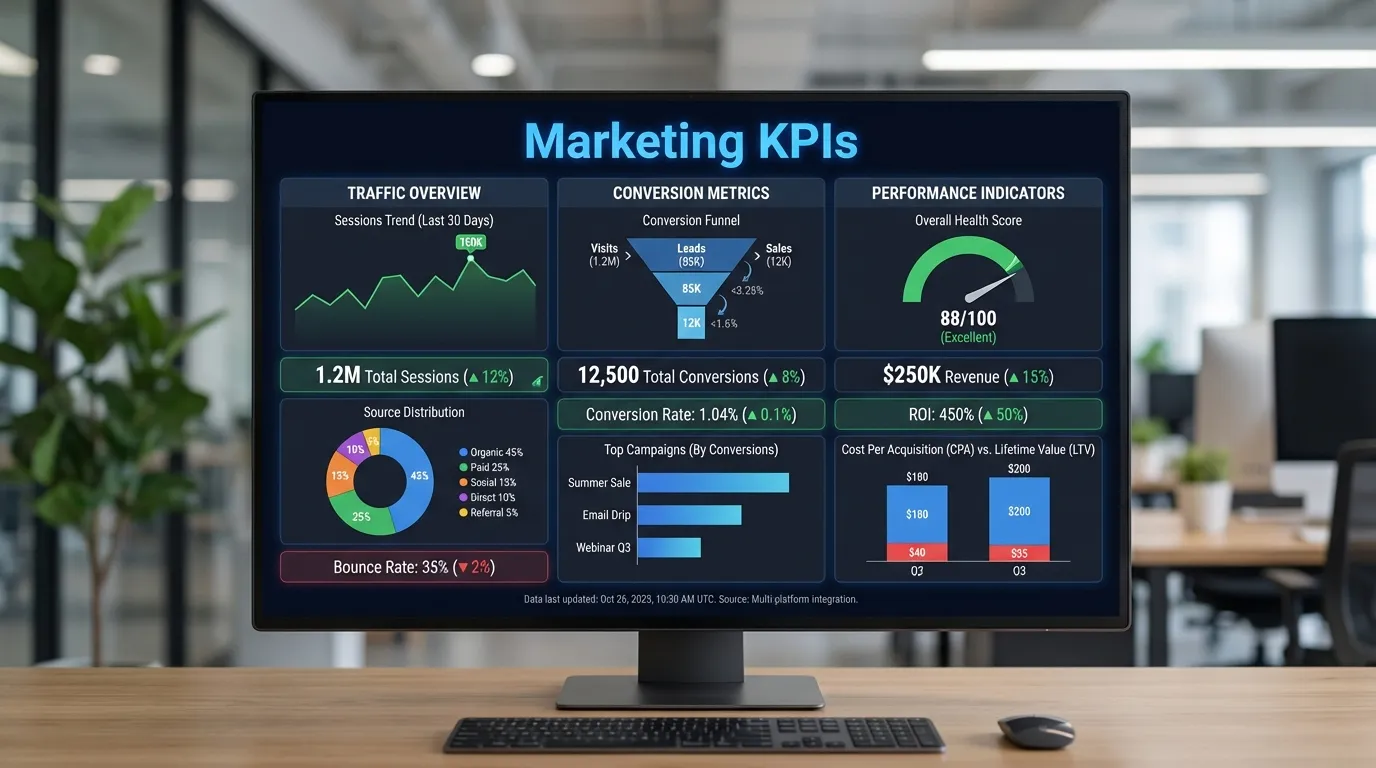
- The Top Row: Total Pipeline Generated, Current Active Audience Size, Monthly Revenue Lift.
- The Middle Row: CTR/CTO Trends, Delivery Reputation, Top 5 Converting Content Pieces.
- The Bottom Row: Segment Growth Rates and Channel Attribution Splits.
2. Action-Oriented Data
Every chart must lead to a question: "If this number is down, what is our immediate technical fix?"
Phase 6: Benchmarking and Internal Data Mastery
Your most important benchmark is not your competitor; it is Your Own Past Performance.
1. The "Greatest Hits" Analysis
Consistently re-analyze your top 10% highest-performing emails.
- What is the common denominator? Is it the length? The tone? The day of the week?
- The Strategy: Use these "Internal Benchmarks" to set the "Control" for all future A/B tests.
2. Cohort Analysis
Compare the performance of users who joined in "January" vs. those who joined in "May."
- The Finding: You may discover that users who join during a "Sale Promotion" have an LTV that is 50% lower than those who join through an "Educational Masterclass." This analytical insight should fundamentally shift your acquisition budget.