
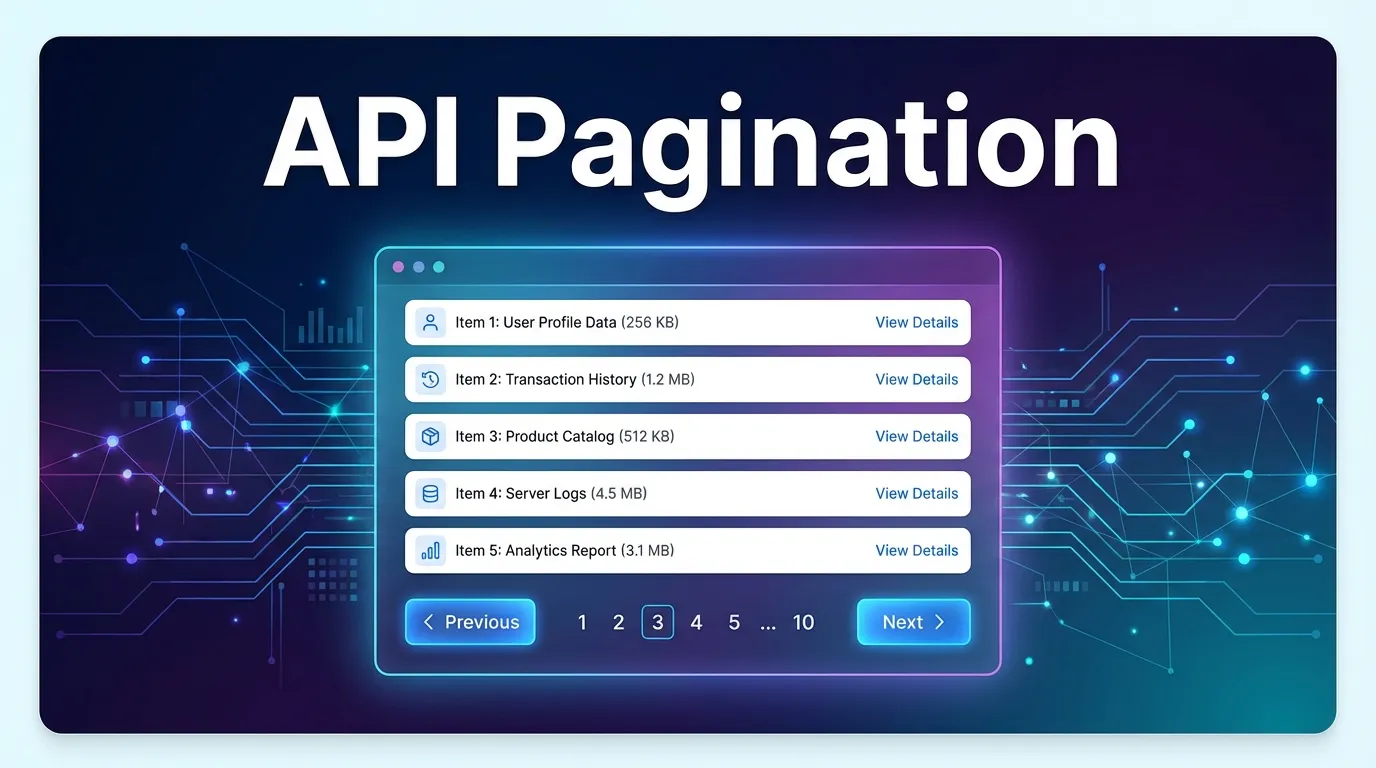
Pagination in APIs: Best Practices
Introduction
Imagine opening an ecommerce app that tries to load every product ever created at once.
The page freezes. The API slows down. The server struggles. Users leave instantly.
This problem is exactly why API pagination exists.
Modern applications process enormous amounts of data users, orders, analytics events, posts, logs, and messages. Without proper pagination, APIs become slow, expensive, and impossible to scale.
Pagination allows APIs to return small, manageable chunks of data, improving performance, usability, and infrastructure efficiency.
In this complete guide on api pagination, you will learn:
- What API pagination really is
- Why pagination is critical for scalable systems
- Different pagination strategies explained clearly
- Offset vs Cursor vs Keyset pagination comparison
- Backend implementation examples
- Performance optimization techniques
- Real-world best practices used by production APIs
By the end of this article, you will understand how professional engineers design APIs capable of handling millions of records smoothly.
What Is API Pagination
API pagination is a technique used to split large datasets into smaller pages returned across multiple API requests.
Instead of returning thousands of records in a single response, an API returns limited data per request.
Basic Concept
Without pagination
GET api users
Returns entire dataset.
With pagination
GET api users page 1 limit 10
Returns only ten records.
Pagination improves performance while keeping responses predictable.
Why API Pagination Is Important
Large responses cause multiple issues.
Problems Without Pagination
- Slow response time
- Increased memory usage
- High bandwidth consumption
- Poor mobile performance
- Server overload risks
Pagination ensures data delivery remains efficient regardless of dataset size.
How Pagination Works
Step by Step API Pagination Flow
1 Client sends request with pagination parameters 2 Server queries limited dataset 3 Database returns subset of records 4 API responds with structured metadata 5 Client requests next page when needed
This controlled data flow keeps applications fast and scalable.
Key Pagination Terminology
Understanding common terms helps developers design better APIs.
- Page
- Limit
- Offset
- Cursor
- Metadata
Standard terminology improves API usability.
Types of API Pagination
Different systems require different pagination strategies.
Offset Based Pagination
Offset pagination uses numerical position within a dataset.
Example
GET api products limit 10 offset 20
The server skips the first 20 records and returns the next 10.
Advantages
- Easy to implement
- Simple SQL queries
- Ideal for small datasets
Disadvantages
- Slower with large databases
- Requires scanning skipped records
- Can produce inconsistent results during updates
Offset pagination is beginner friendly but limited at scale.
Page Based Pagination
Page based pagination builds on offset logic but is more readable.
Example
GET api users page 3 limit 10
Backend converts page number into offset automatically.
Best Use Cases
- Admin dashboards
- Data tables
- Reporting interfaces
This approach is widely used in traditional web apps.
Cursor Based Pagination
Cursor pagination uses a unique reference value instead of record position.
Example
GET api posts cursor abc123
The server returns records after the provided cursor.
Benefits
- High performance
- Stable results during data updates
- Ideal for real time feeds
Challenges
- Slightly more complex implementation
- Harder manual navigation
Major platforms use cursor pagination extensively.
Keyset Pagination Explained
Keyset pagination retrieves data based on indexed columns.
Example
GET api orders after id 100
Database retrieves rows greater than a specified key.
Advantages
- Extremely fast queries
- Scales efficiently
- Avoids deep offset scanning
Keyset pagination is preferred for large enterprise systems.
Offset vs Cursor vs Keyset Comparison
| Method | Performance | Complexity | Ideal Use |
|---|---|---|---|
| Offset | Medium | Easy | Small apps |
| Page | Medium | Easy | Dashboards |
| Cursor | High | Medium | Social feeds |
| Keyset | Very High | Advanced | Large datasets |
Choosing the correct strategy directly affects API scalability.
Designing a Proper Pagination Response
Good API design includes metadata.
Example Response
{ "data": [], "page": 1, "limit": 10, "total": 200, "hasNext": true, "hasPrevious": false }
Metadata allows frontends to navigate easily.
API Pagination Best Practices
Always Limit Results
Never allow unlimited queries.
Provide Navigation Information
Include next page, previous page, and total results.
Use Consistent Parameter Naming
Standard parameters include limit, page, and cursor.
Sort Results Deterministically
Always apply default sorting to prevent duplicate results.
Implementing Pagination in Node.js
Example Express API
app.get("api users", async (req, res) => { const page = Number(req.query.page) || 1; const limit = 10; const skip = (page - 1) * limit;
const users = await User.find() .skip(skip) .limit(limit);
res.json(users); });
Backend controls data delivery efficiently.
SQL Pagination Example
SELECT * FROM users LIMIT 10 OFFSET 20;
Indexes significantly improve query speed.
Pagination in GraphQL APIs
GraphQL commonly uses cursor pagination.
Typical structure includes edges, nodes, and pageInfo.
GraphQL connections enable efficient incremental fetching.
Performance Optimization Techniques
Add Database Indexes
Indexed fields accelerate pagination queries.
Avoid Deep Offsets
Large offsets increase query time dramatically.
Cache Frequently Requested Pages
Use Redis or CDN caching.
Implement Lazy Loading
Load data progressively as users scroll.
Infinite Scroll vs Traditional Pagination
Both rely on API pagination.
Pagination buttons provide clear navigation and accessibility.
Infinite scroll provides smooth interaction and higher engagement.
Choose based on product goals.
Security Considerations for Pagination
Pagination must be secure.
Best practices include limiting maximum page size, validating parameters, preventing data scraping, and applying rate limiting.
Handling Massive Datasets
Enterprise APIs handle millions of rows using cursor pagination, database partitioning, read replicas, and background processing.
Scaling begins with smart pagination design.
Common Pagination Mistakes
Returning too much data destroys performance.
Missing metadata breaks frontend navigation.
No default sorting creates duplicate or missing records.
Exposing internal database IDs should always be avoided.
Real World API Pagination Examples
Pagination powers social media timelines, ecommerce catalogs, analytics dashboards, search results pages, and messaging applications.
Efficient pagination enables modern web experiences.
Choosing the Right Pagination Strategy
Ask these questions
Does dataset grow rapidly Is data frequently updated Is SEO required Is navigation important
Your answers determine the correct pagination approach.
Future Trends in API Pagination
Modern API development is evolving toward streaming APIs, edge caching, real time pagination, and AI assisted data delivery.
Pagination will remain essential for scalable systems.
Short Summary
This api pagination guide explained how APIs divide large datasets into manageable pages, explored offset, page, cursor, and keyset pagination strategies, and demonstrated best practices for building scalable, secure, and high performance APIs.
Conclusion
Pagination is not just a feature it is a core principle of modern API architecture.
Well designed pagination improves speed, reduces server load, enhances user experience, and enables massive scalability.
Whether you build dashboards, SaaS platforms, ecommerce systems, or mobile applications, mastering API pagination ensures your backend remains efficient as your data grows.
Developers who understand pagination build systems that scale effortlessly.
Frequently Asked Questions
API pagination splits large datasets into smaller pages returned through multiple requests.