
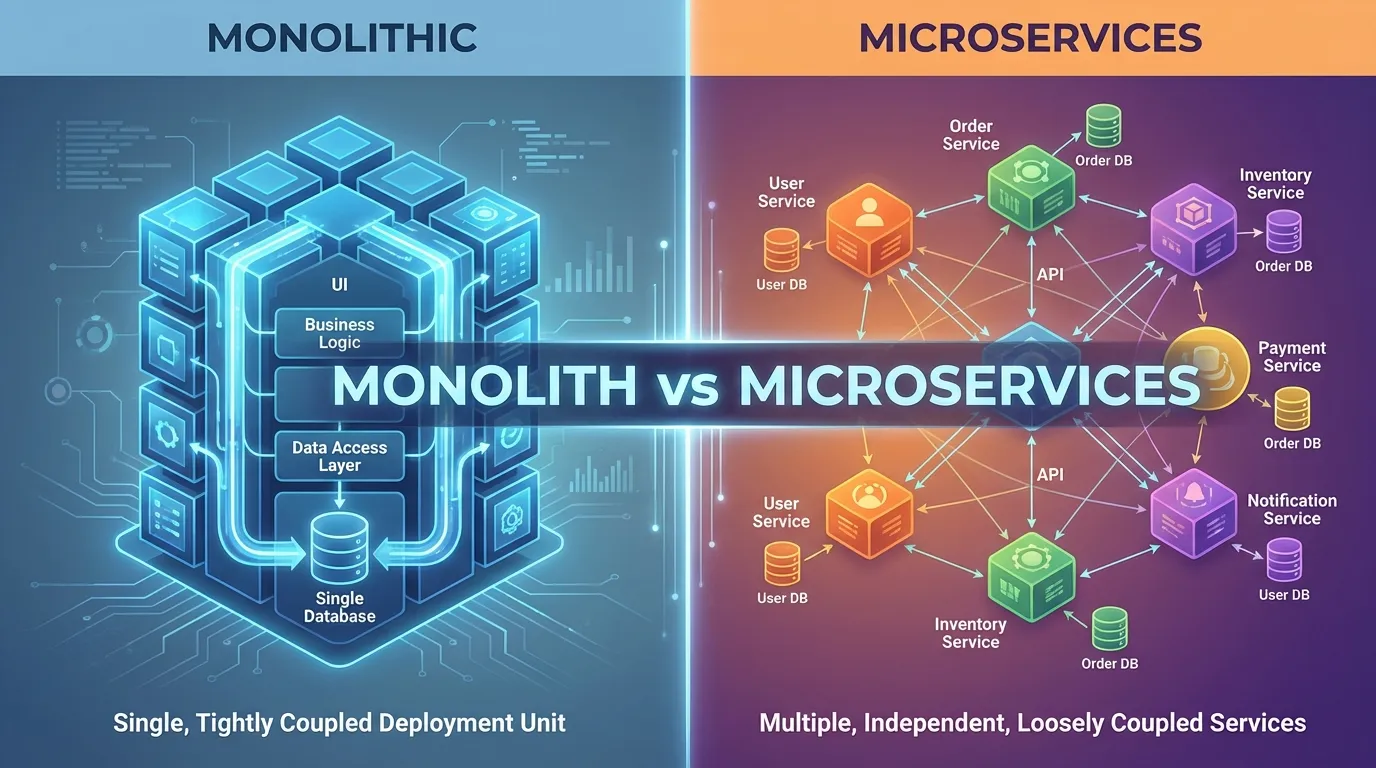
Monolithic vs Microservices Architecture
Introduction
Imagine building an application that starts small but suddenly grows to serve thousands or even millions of users.
At the beginning, everything works perfectly.
One codebase.
One deployment.
One database.
But as features increase, development slows down. Deployments become risky. Scaling becomes expensive.
This is where the architectural debate begins: monolithic vs microservices.
Modern companies like Netflix, Amazon, and Uber shifted from traditional monolithic systems to microservices to handle massive growth and continuous innovation.
But here’s the truth many beginners don’t realize:
Microservices are not always better.
Choosing the right architecture depends on project size, team maturity, scalability needs, and long-term vision.
In this complete guide, you will learn:
- What monolithic architecture is
- What microservices architecture means
- Key differences between both approaches
- Real-world use cases
- Advantages and disadvantages
- Migration strategies
- Best practices for modern systems
By the end, you’ll know exactly when to choose monoliths and when microservices make sense.
What Is Monolithic Architecture
Monolithic architecture is a traditional software design approach where the entire application exists as a single unified codebase.
All components are tightly integrated.
Core Characteristics of Monolithic Systems
- Single application deployment
- Shared database
- Unified backend logic
- Centralized codebase
- One runtime environment
Example structure:
- User authentication
- Product management
- Payment processing
- Admin dashboard
All modules live inside one application.
How Monolithic Applications Work
Single Deployment Unit
The entire system deploys together.
If you update one feature, the whole application redeploys.
Shared Resources
All services share:
- database
- memory
- runtime dependencies
This simplicity makes early development faster.
Advantages of Monolithic Architecture
Simple Development Setup
Beginners can start quickly without infrastructure complexity.
Easier Testing
Testing occurs within one system environment.
Faster Initial Development
No need for inter-service communication.
Simplified Deployment
Only one application needs deployment.
Disadvantages of Monolithic Architecture
Scaling Limitations
You must scale the entire application even if only one feature needs more resources.
Slower Development Over Time
Large codebases become difficult to maintain.
Technology Lock-In
Changing frameworks becomes risky.
Deployment Risk
One bug can crash the entire system.
What Are Microservices
Microservices architecture divides an application into independent services, each responsible for a specific business function.
Every service runs independently.
Example Microservices System
- Authentication Service
- Order Service
- Payment Service
- Notification Service
- Analytics Service
Each service communicates through APIs.
How Microservices Architecture Works
Independent Services
Each service:
- has its own codebase
- runs independently
- deploys separately
API Communication
Services interact using:
- REST APIs
- message queues
- event streams
Advantages of Microservices Architecture
Independent Scaling
Scale only the services needing resources.
Faster Development Teams
Different teams work on separate services simultaneously.
Technology Flexibility
Each service can use different technologies.
Example:
- Node.js for API
- Python for AI service
- Go for performance systems
Fault Isolation
Failure in one service does not crash the entire system.
Disadvantages of Microservices Architecture
Increased Complexity
Requires advanced infrastructure management.
DevOps Dependency
Needs CI/CD, monitoring, containerization, orchestration.
Network Overhead
Service communication introduces latency.
Data Management Challenges
Distributed databases increase complexity.
Monolithic vs Microservices Architecture Comparison
| Feature | Monolithic | Microservices |
|---|---|---|
| Deployment | Single | Multiple |
| Scaling | Entire app | Individual services |
| Complexity | Low | High |
| Development Speed | Fast initially | Faster at scale |
| Infrastructure | Simple | Advanced |
| Maintenance | Hard at scale | Easier modular updates |
When to Choose Monolithic Architecture
Ideal Scenarios
- Startup MVP projects
- Small teams
- Limited infrastructure budget
- Early product validation
Many successful startups begin as monoliths.
When to Choose Microservices Architecture
Best Use Cases
- Large enterprise systems
- High traffic applications
- Multiple development teams
- Continuous deployment environments
Microservices shine at scale.
Real World Examples
Monolithic Example
Early Facebook operated as a monolithic PHP application.
Microservices Example
Netflix migrated to microservices to handle global streaming traffic.
Hybrid Systems
Many companies use modular monoliths before transitioning.
Monolith First Strategy
Modern architecture advice:
Start with a monolith.
Why?
- faster development
- fewer operational challenges
- easier debugging
Transition later when scaling requires it.
Migrating from Monolith to Microservices
Step 1 Identify Boundaries
Separate business domains.
Example:
- authentication
- payments
- reporting
Step 2 Extract Services Gradually
Move one module at a time.
Step 3 Introduce API Gateway
Central routing system manages communication.
Step 4 Implement CI/CD Pipelines
Automation becomes essential.
Communication Patterns in Microservices
Synchronous Communication
REST API requests between services.
Asynchronous Communication
Event driven systems using queues.
Examples:
- Kafka
- RabbitMQ
Data Management Differences
Monolithic Database
Single centralized database.
Microservices Database
Each service owns its data.
Benefits:
- independence
- scalability
Challenges:
- data consistency
- transactions
Deployment Strategies
Monolithic Deployment
One build and deploy cycle.
Microservices Deployment
Multiple independent deployments.
Requires automation tools.
DevOps Role in Microservices
Microservices depend heavily on DevOps practices.
Key tools include:
- Docker containers
- Kubernetes orchestration
- CI/CD pipelines
- Monitoring systems
DevOps becomes mandatory.
Performance Considerations
Monolith advantages:
- faster internal communication
- reduced network latency
Microservices advantages:
- distributed processing
- horizontal scalability
Performance depends on use case.
Security Considerations
Monolithic Security
Single security layer.
Microservices Security
Requires:
- API authentication
- service authorization
- zero trust networking
Security complexity increases.
Cost Comparison
Monolith
Lower infrastructure cost initially.
Microservices
Higher operational cost but scalable long term.
Common Architecture Mistakes
- adopting microservices too early
- ignoring domain boundaries
- lack of monitoring
- poor service communication design
Architecture should evolve naturally.
Future of Software Architecture
Modern trends include:
- serverless microservices
- event driven architecture
- cloud native systems
- modular monolith design
Architecture decisions now focus on adaptability.
Short Summary
This monolithic vs microservices guide explained architectural differences, advantages, disadvantages, scalability considerations, migration strategies, deployment models, and real world applications to help developers choose the right system design.
Conclusion
There is no universal winner between monolithic and microservices architecture.
Monoliths provide simplicity and speed during early development.
Microservices provide flexibility and scalability for large evolving systems.
The smartest engineering teams understand one key principle:
Architecture should grow with your product.
Start simple. Scale intelligently. Evolve when necessary.
Frequently Asked Questions
A monolithic application is a single unified codebase deployed as one system.