
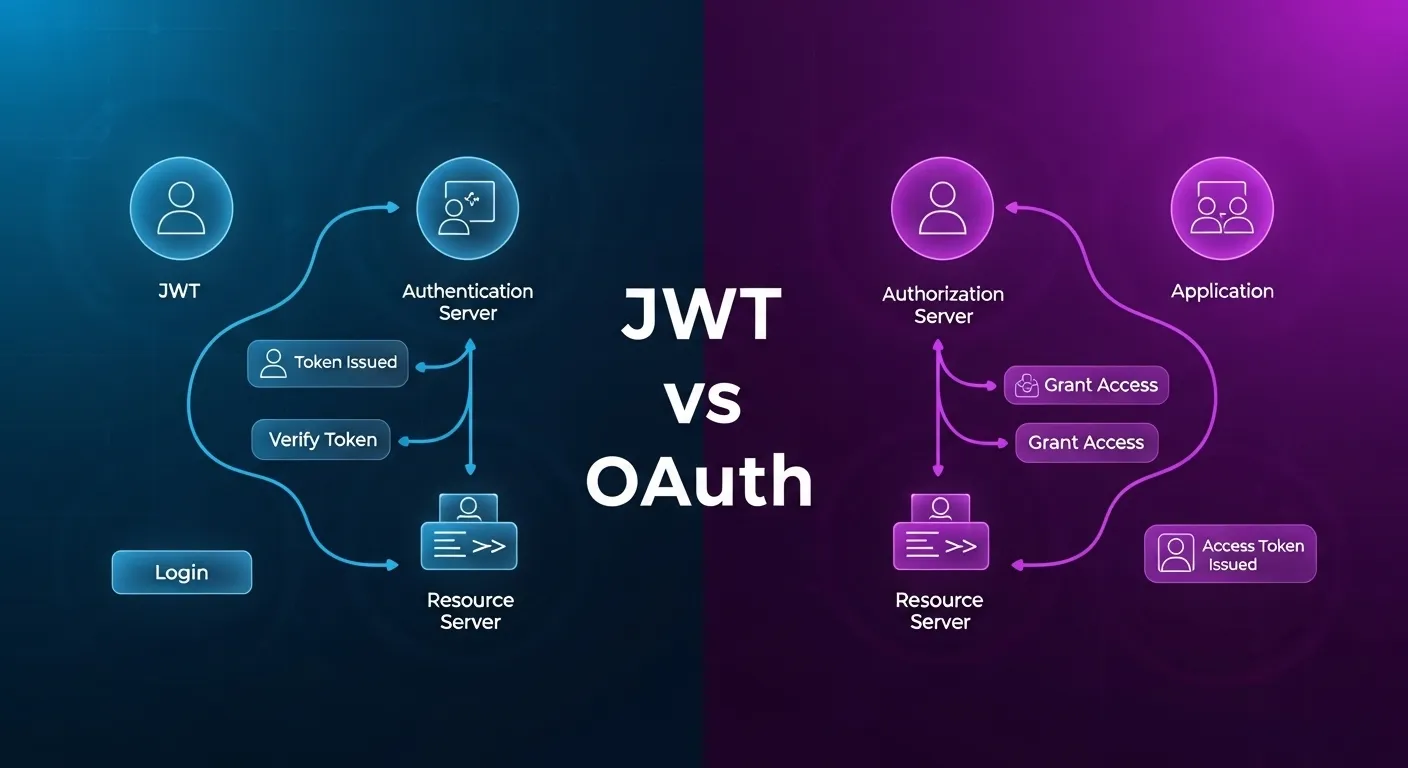
JWT vs OAuth: What’s the Difference?
Introduction
If you’ve ever logged into an application using Google, GitHub, or Facebook, you’ve already experienced modern authentication systems in action. Behind these seamless login experiences are powerful security technologies — primarily JWT and OAuth.
Many developers, especially beginners, confuse these two concepts. Some believe JWT replaces OAuth. Others assume OAuth is simply a token format. The reality is more nuanced.
Understanding jwt vs oauth is essential for building secure APIs, modern web applications, and scalable authentication systems.
In this complete guide, you will learn:
- What JWT is and how it works
- What OAuth is and why it exists
- The key differences between JWT and OAuth
- When to use JWT, OAuth, or both together
- Real-world authentication architecture
- Security best practices used by professionals
What Is Authentication and Authorization?
Authentication
Authentication answers the question:
Who are you?
Examples:
- Logging in with email and password
- Signing in using Google account
- Verifying identity using tokens
Authorization
Authorization answers:
What are you allowed to access?
Examples:
- Admin dashboard access
- Viewing private resources
- API permissions
JWT and OAuth solve different parts of this problem.
What Is JWT?
JWT stands for JSON Web Token.
It is a token format used to securely transmit information between client and server.
Structure of a JWT
A JWT consists of three parts:
- Header
- Payload
- Signature
Format:
Header.Payload.Signature
How JWT Authentication Works
1 User logs in 2 Server validates credentials 3 Server generates JWT 4 Token sent to client 5 Client stores token 6 Token sent with future requests
Advantages of JWT
- Stateless authentication
- Faster performance
- Scalable systems
- Reduced database queries
- Works well with APIs
Limitations of JWT
- Hard to revoke tokens
- Token size can grow large
- Requires secure storage
- Sensitive payload risks if misused
What Is OAuth?
OAuth stands for Open Authorization.
It is an authorization framework, not a token format.
OAuth allows applications to access user resources without sharing passwords.
How OAuth Works Step by Step
1 User clicks login with provider 2 Redirect to authorization server 3 User grants permission 4 Access token issued 5 Application accesses resources
OAuth Grant Types Explained
- Authorization Code Flow
- Implicit Flow
- Client Credentials Flow
- Password Grant
JWT vs OAuth: Core Difference
JWT is a token format. OAuth is an authorization framework.
JWT vs OAuth Comparison Table
Feature comparison between token format and authorization framework.
When Should You Use JWT?
- Building REST APIs
- Creating SPA applications
- Stateless authentication
- Internal authentication systems
When Should You Use OAuth?
- Social login systems
- Third-party integrations
- Delegated authorization
- External identity providers
Using JWT and OAuth Together
1 OAuth authenticates user 2 Provider returns authorization token 3 Backend generates JWT 4 JWT used for API access
Security Best Practices
JWT Security:
- Use HTTPS
- Set expiration
- Secure storage
- Avoid sensitive payload
OAuth Security:
- Use Authorization Code Flow
- Validate redirects
- Protect client secrets
- Use scopes correctly
Common Developer Misconceptions
- JWT replaces OAuth
- OAuth only for social login
- JWT always secure
- OAuth equals authentication
JWT vs OAuth Performance Considerations
JWT advantages include fast verification. OAuth advantages include centralized identity management.
JWT vs OAuth in Microservices Architecture
OAuth manages identity. JWT used between services.
Future of Authentication Technologies
Includes OpenID Connect, Zero Trust Security, Passwordless authentication, and biometric verification.
Short Summary
The jwt vs oauth comparison shows JWT handles authentication tokens while OAuth manages authorization delegation.
Conclusion
JWT provides stateless authentication while OAuth enables secure authorization across platforms. Modern applications often use both together.
Frequently Asked Questions
No they serve different purposes.