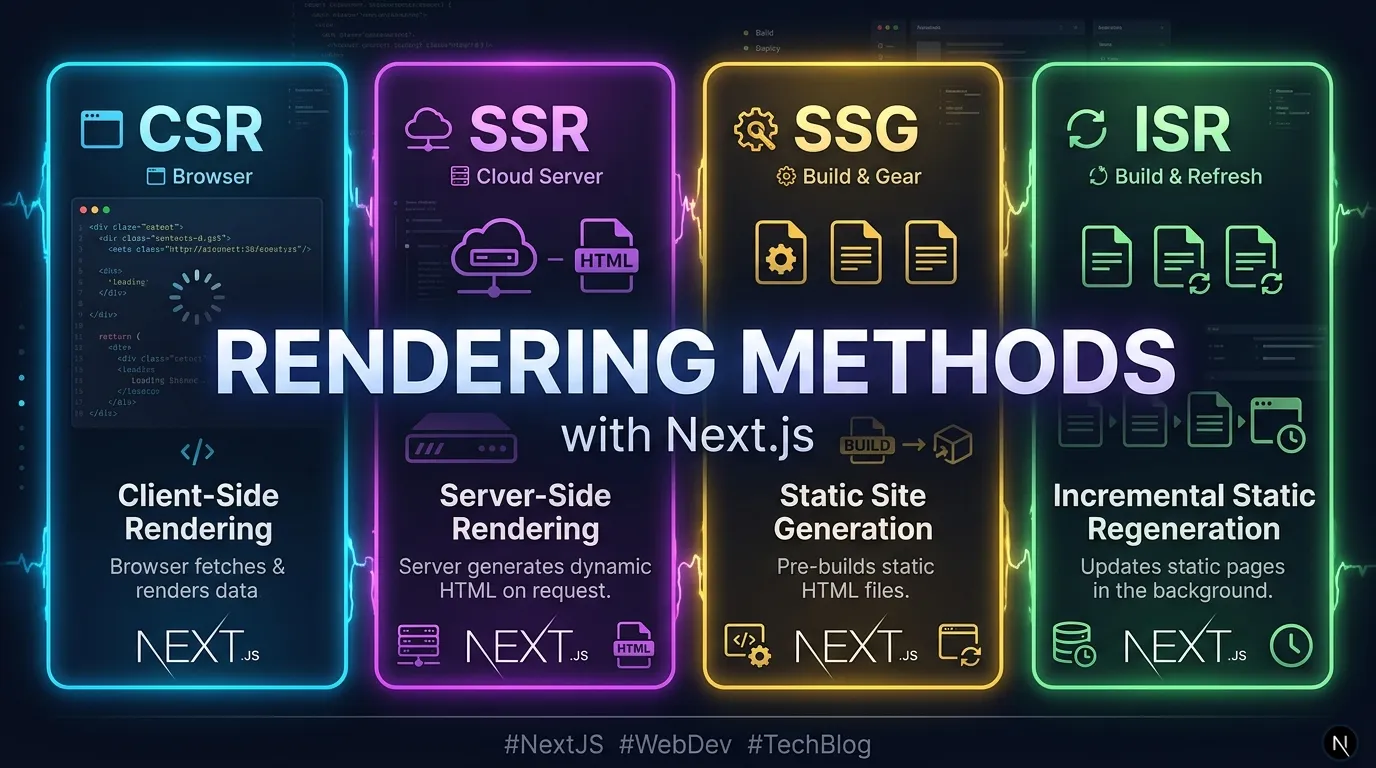
CSR vs SSR vs SSG vs ISR in Next.js
Introduction
Modern web development has evolved far beyond simple static pages. Today, developers must balance performance, SEO, scalability, and user experience all at the same time.
If you have worked with Next.js, you have probably encountered four important rendering strategies:
- CSR
- SSR
- SSG
- ISR
At first, these terms feel confusing. Many developers struggle to answer a simple but critical question:
Which rendering method should I use
Choosing the wrong strategy can lead to:
- Slow page loads
- Poor SEO rankings
- High server costs
- Bad user experience
This complete csr ssr ssg isr guide explains everything clearly.
In this article, you will learn:
- What CSR, SSR, SSG, and ISR mean
- How Next.js rendering works internally
- Performance differences between rendering methods
- Real world use cases
- SEO implications
- Practical decision making framework
By the end, you will know exactly when and why to use each rendering strategy in Next.js applications.
Understanding Rendering in Modern Web Applications
Rendering refers to how HTML content is generated and delivered to the browser.
Next.js supports multiple rendering strategies because modern applications have different needs:
- Dynamic dashboards
- SEO focused websites
- Ecommerce platforms
- Blogs and documentation
There is no single perfect solution only the right choice for the situation.
What Is Client Side Rendering CSR
Client Side Rendering means the browser builds the page using JavaScript.
How CSR Works
1 Browser loads minimal HTML 2 JavaScript bundle downloads 3 React renders UI in browser 4 Data fetched via API 5 Page becomes interactive
Example in React:
useEffect(() => { fetch("api data").then(setData); }, []);
Advantages of CSR
- Highly interactive applications
- Reduced server workload
- Smooth client navigation
- Ideal for dashboards
Disadvantages of CSR
- Slow initial load
- Poor SEO performance
- Blank screen before rendering
CSR powers traditional Single Page Applications.
What Is Server Side Rendering SSR
Server Side Rendering generates HTML on the server for every request.
How SSR Works
1 User requests page 2 Server fetches data 3 HTML generated dynamically 4 Browser receives ready content
Next.js SSR example:
export async function getServerSideProps() { return { props: {} }; }
Benefits of SSR
- Excellent SEO
- Faster first paint
- Dynamic real time content
Drawbacks of SSR
- Increased server cost
- Slower response under heavy load
SSR is perfect for frequently updated pages.
What Is Static Site Generation SSG
Static Site Generation builds pages during build time.
How SSG Works
1 Application builds project 2 Pages generated as static HTML 3 CDN serves pages instantly
Next.js example:
export async function getStaticProps() { return { props: {} }; }
Benefits of SSG
- Extremely fast performance
- Low hosting cost
- Highly scalable
- Great SEO
Limitations of SSG
- Content updates require rebuild
- Not suitable for real time data
SSG works best for blogs and marketing pages.
What Is Incremental Static Regeneration ISR
ISR combines the power of SSR and SSG.
Pages are generated statically but updated automatically in the background.
How ISR Works
1 Page built statically 2 User visits page 3 After defined time page regenerates
Next.js ISR example:
export async function getStaticProps() { return { props: {}, revalidate: 60 }; }
Page updates every 60 seconds.
Advantages of ISR
- Static performance
- Dynamic freshness
- Reduced rebuild times
ISR solves scalability problems for large websites.
CSR vs SSR vs SSG vs ISR Comparison
| Feature | CSR | SSR | SSG | ISR |
|---|---|---|---|---|
| Render Location | Browser | Server | Build Time | Hybrid |
| SEO | Weak | Strong | Strong | Strong |
| Performance | Medium | Fast | Very Fast | Very Fast |
| Server Load | Low | High | Very Low | Low |
| Real Time Data | Yes | Yes | No | Partial |
Each method solves different problems.
Choosing the Right Rendering Strategy
Use CSR When
- Building admin dashboards
- Authentication based apps
- Internal tools
- Highly interactive interfaces
Use SSR When
- SEO matters
- Content updates frequently
- Personalized pages required
Examples:
- Ecommerce product pages
- News websites
Use SSG When
- Content rarely changes
- Maximum performance needed
- Marketing sites or blogs
Use ISR When
- Large content websites
- Thousands of pages
- Frequent updates without full rebuild
ISR is often the best balance.
Real World Next.js Architecture
Professional applications rarely use one strategy.
Typical setup:
- Landing pages → SSG
- Product pages → ISR
- Dashboard → CSR
- Search pages → SSR
Hybrid rendering is the real power of Next.js.
SEO Impact of Rendering Strategies
Search engines prefer pre rendered HTML.
Ranking order for SEO:
1 SSG 2 ISR 3 SSR 4 CSR
CSR may delay content visibility for crawlers.
Performance Comparison
Initial Load Speed
SSG and ISR are fastest because CDN serves static HTML.
SSR adds server processing time.
CSR delays rendering until JavaScript loads.
User Experience
SSR improves first impression. CSR improves navigation experience. ISR balances both.
Developer Experience in Next.js
Next.js simplifies rendering using built in functions:
- getServerSideProps
- getStaticProps
- revalidate option
Developers can switch strategies easily.
Cost Considerations
Rendering strategy directly affects hosting cost.
CSR
Low server cost.
SSR
Higher server compute usage.
SSG
Lowest cost due to static hosting.
ISR
Optimized cost performance balance.
Common Mistakes Developers Make
Using SSR Everywhere
Creates unnecessary server load.
Using CSR for SEO Pages
Hurts search rankings.
Rebuilding Large Sites Constantly
ISR prevents long deployment times.
Advanced Next.js Rendering Trends
Modern innovations include:
- React Server Components
- Edge Rendering
- Streaming SSR
- Partial Hydration
Rendering strategies continue evolving rapidly.
Practical Decision Framework
Ask these questions:
Is SEO important Does data change frequently Is personalization required How large is the website
Your answers determine the correct rendering approach.
Future of Rendering in Next.js
The future combines:
- Server intelligence
- Edge computing
- Hybrid rendering
- Performance optimization
Next.js continues leading modern rendering architecture.
Short Summary
This csr ssr ssg isr guide explained how Next.js provides multiple rendering strategies how each works internally and when developers should use CSR SSR SSG or ISR for optimal performance and SEO.
Conclusion
Modern web development is no longer about choosing one rendering method.
It is about choosing the right rendering strategy for the right page.
CSR delivers interactivity. SSR ensures dynamic freshness. SSG provides unmatched speed. ISR combines scalability with performance.
Mastering these concepts allows developers to build high performance applications that scale efficiently while delivering excellent user experience and search visibility.
Understanding CSR vs SSR vs SSG vs ISR is a defining skill for modern Next.js developers.
Frequently Asked Questions
Client Side Rendering renders content inside the browser using JavaScript.