CRUD Operations in MERN Stack
Introduction
Every modern web application — whether it’s a social media platform, ecommerce store, learning management system, or admin dashboard — revolves around one fundamental concept:
CRUD operations.
Create.
Read.
Update.
Delete.
These four operations power almost every database-driven application on the internet.
If you are learning full-stack development, mastering a mern crud tutorial is one of the most important milestones in your journey.
The MERN Stack combines:
- MongoDB for database management
- Express.js for backend APIs
- React for frontend interfaces
- Node.js for server runtime
Together, they allow developers to build powerful, scalable JavaScript applications using a single language across the entire stack.
In this complete guide, you will learn:
- What CRUD operations mean in MERN
- How MERN architecture works
- Step-by-step CRUD implementation
- Backend API creation
- React frontend integration
- Best practices used in production apps
By the end, you will understand how real-world applications manage data efficiently using the MERN ecosystem.
What Is the MERN Stack
The MERN stack is a popular JavaScript-based full-stack development framework.
MERN Stack Components
MongoDB
A NoSQL database storing data as JSON-like documents.
Express.js
Backend framework used to create APIs and middleware.
React
Frontend library for building dynamic user interfaces.
Node.js
JavaScript runtime used to execute backend code.
Using one language across the stack improves developer productivity.
Understanding CRUD Operations
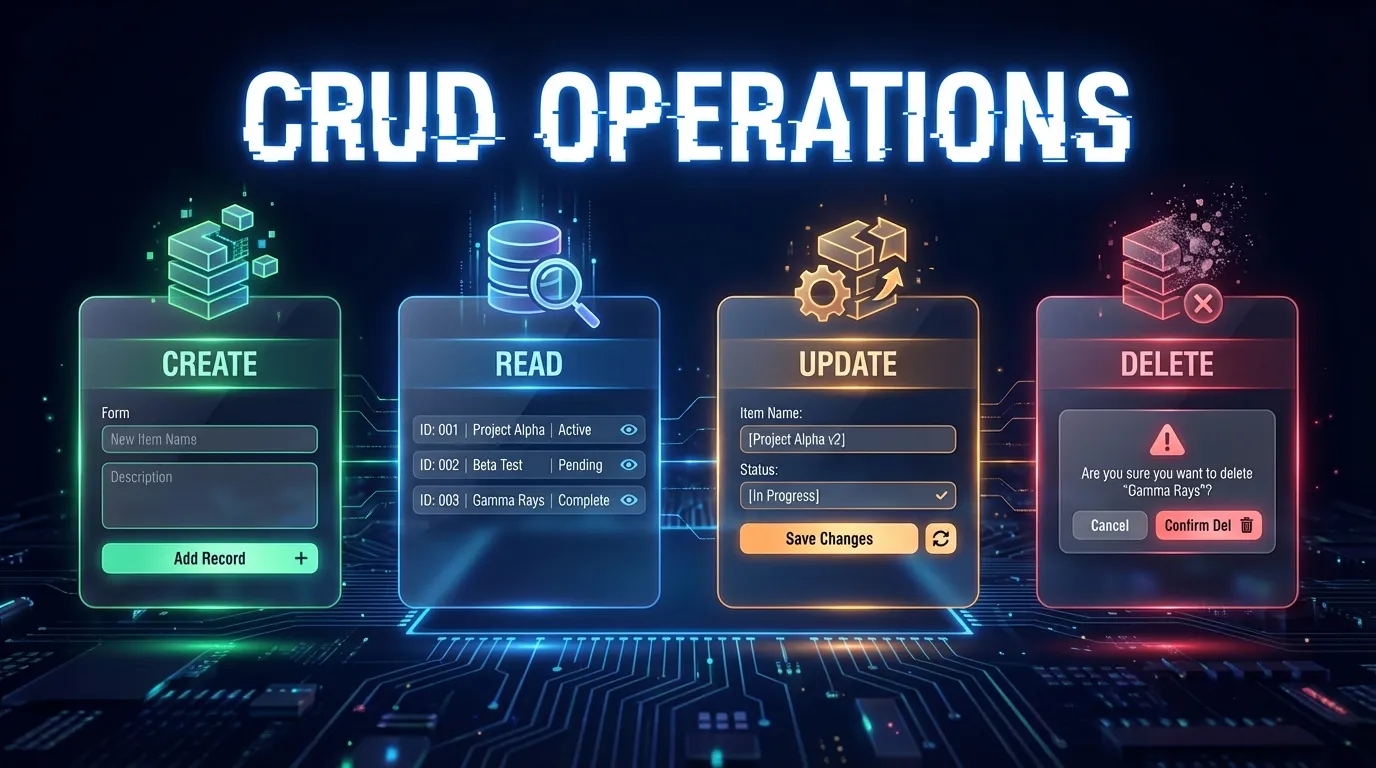
CRUD represents the four basic database actions.
| Operation | Meaning | Example |
|---|---|---|
| Create | Add data | New user registration |
| Read | Fetch data | Display products |
| Update | Modify data | Edit profile |
| Delete | Remove data | Delete post |
Every MERN application depends on these operations.
MERN Stack Application Architecture
A typical MERN CRUD application contains three layers.
Frontend Layer
React handles:
- Forms
- UI rendering
- API requests
Backend Layer
Node and Express manage:
- Business logic
- Routing
- Validation
Database Layer
MongoDB stores application data.
Clear separation improves scalability and maintenance.
Setting Up MERN Project
Step 1 Initialize Backend
npm init -y
npm install express mongoose cors dotenv
Step 2 Setup Express Server
const express = require("express");
const app = express();
app.use(express.json());
Step 3 Connect MongoDB Database
mongoose.connect(process.env.DB_URL);
Database connection enables data persistence.
Create Operation in MERN Stack
Create operation inserts new data into database.
Backend Create API
app.post("api users", async (req,res)=>{
const user = new User(req.body);
await user.save();
res.json(user);
});
Create operation powers registration and data entry features.
Read Operation in MERN Stack
Read operation retrieves stored data.
Fetch All Records
app.get("api users", async(req,res)=>{
const users = await User.find();
res.json(users);
});
Read operations enable dashboards and listings.
Update Operation in MERN Stack
Update modifies existing records.
Update API
app.put("api users id", async(req,res)=>{
const updated = await User.findByIdAndUpdate(
req.params.id,
req.body,
{new:true}
);
res.json(updated);
});
Update functionality allows profile editing.
Delete Operation in MERN Stack
Delete removes data permanently.
Delete API
app.delete("api users id", async(req,res)=>{
await User.findByIdAndDelete(req.params.id);
res.json({message:"Deleted"});
});
Delete operations maintain clean datasets.
React Frontend Integration
React communicates with backend APIs.
Typical flow:
1 User performs action
2 React sends API request
3 Express processes request
4 MongoDB updates data
5 React updates UI
This creates a seamless user experience.
Managing State in MERN CRUD Apps
State management controls application behavior.
Popular options:
- React useState
- Context API
- Redux Toolkit
- Zustand
Proper state handling improves performance.
Form Handling in MERN Applications
Forms collect user data.
Best practices:
- Controlled inputs
- Validation before submission
- Error handling
User-friendly forms increase engagement.
REST API Design Best Practices
Good APIs follow consistent patterns.
Use:
- GET for reading
- POST for creating
- PUT or PATCH for updating
- DELETE for removing
RESTful structure improves scalability.
Data Validation and Security
Never trust user input.
Use validation libraries:
- Joi
- Express Validator
- Mongoose schema validation
Validation prevents database corruption.
Error Handling in MERN CRUD Applications
Handle errors properly.
Examples:
- Invalid data
- Database failures
- Network errors
Return meaningful responses instead of crashing.
Authentication in MERN CRUD Systems
Most applications require secure access.
Common methods:
- JWT authentication
- Session authentication
- OAuth login
Authentication protects CRUD endpoints.
Performance Optimization Techniques
Backend Optimization
- Use indexes in MongoDB
- Optimize queries
- Implement pagination
Frontend Optimization
- Lazy loading
- Memoization
- Efficient rendering
Performance improves user satisfaction.
Folder Structure Best Practices
Recommended structure:
Backend:
- models
- routes
- controllers
- middleware
Frontend:
- components
- pages
- services
Clean architecture simplifies scaling.
Testing MERN CRUD Applications
Testing ensures stability.
Types of testing:
- API testing
- Unit testing
- Integration testing
- UI testing
Automated tests reduce production bugs.
Deploying MERN CRUD Applications
Typical deployment stack:
Frontend → Vercel
Backend → Render
Database → MongoDB Atlas
CI CD pipelines automate deployment.
Common MERN CRUD Mistakes
Mixing Business Logic
Separate controllers from routes.
Ignoring Validation
Leads to security issues.
Poor API Design
Creates maintenance problems.
Real World MERN CRUD Examples
- Blog management systems
- Ecommerce product dashboards
- Student management systems
- Inventory tracking apps
CRUD operations power almost every web platform.
Future of MERN Stack Development
Emerging trends:
- Server components
- Edge computing
- AI integrated dashboards
- Real time applications
MERN remains one of the most demanded stacks.
Short Summary
This mern crud tutorial explained how CRUD operations work in the MERN stack, covering backend APIs, React integration, database management, validation, security, optimization, and deployment workflows.
Conclusion
CRUD operations form the backbone of full-stack development.
By mastering CRUD in MERN, developers gain the ability to build real-world applications that store, manage, and manipulate data efficiently.
The MERN stack simplifies development by allowing JavaScript across frontend and backend while providing flexibility, scalability, and modern performance standards.
Learning CRUD is not just a tutorial milestone — it is the foundation of professional full-stack engineering.
Frequently Asked Questions
MERN CRUD refers to Create Read Update Delete operations implemented using MongoDB, Express, React, and Node.js.