
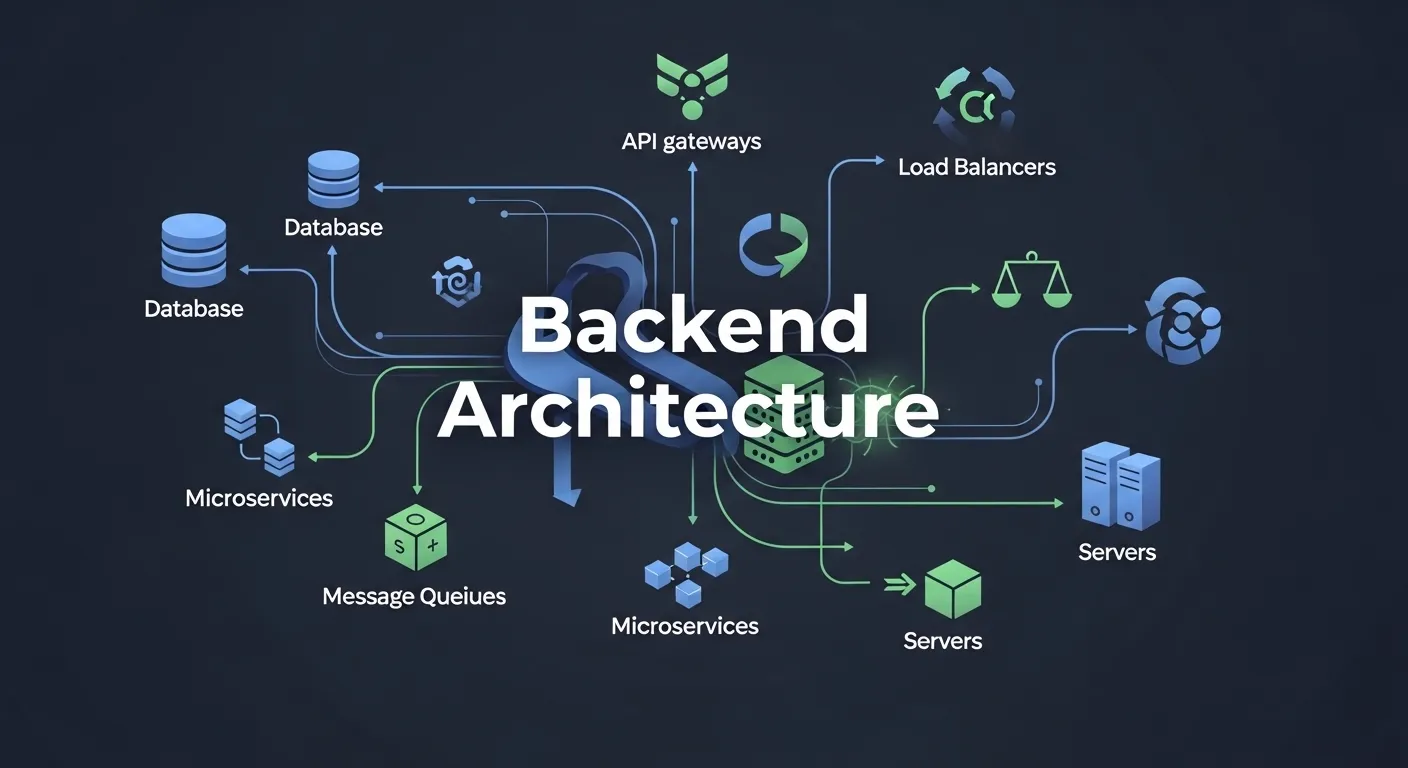
Backend Architecture Guide
Introduction
Every successful application you use daily — social media platforms, banking apps, streaming services, or e-commerce websites — relies on something users never see:
The backend architecture.
While frontend design attracts users, backend architecture powers performance, scalability, security, and reliability. A poorly designed backend leads to slow applications, downtime, security risks, and frustrated users.
Modern developers must understand backend systems beyond writing APIs. They need to design structured, scalable, and maintainable backend environments capable of supporting thousands or even millions of users.
In this complete backend architecture guide, you will learn:
- What backend architecture means
- Core components of backend systems
- Different architectural patterns
- Database and API design strategies
- Scalability and performance techniques
- Real-world backend examples
- Best practices used by professional engineers
Whether you are a student learning backend development or an experienced developer building production systems, this guide will help you understand backend architecture from foundation to advanced concepts.
What is Backend Architecture?
Backend architecture refers to the structural design of server-side systems responsible for handling application logic, data processing, authentication, and communication between services.
Simply put:
Backend architecture is how the server works behind the scenes.
Core Responsibilities of Backend Systems
- Processing user requests
- Managing databases
- Handling authentication
- Running business logic
- Communicating with external services
- Ensuring security and scalability
A well-designed backend architecture ensures applications remain stable under heavy usage.
Key Components of Backend Architecture
Application Server
The application server handles client requests and executes business logic.
Common responsibilities include:
- API processing
- Data validation
- Authentication checks
- Response generation
Popular backend technologies:
- Node.js
- Django
- Spring Boot
- ASP.NET
Database Layer
Databases store application data.
Types include:
- Relational databases
- NoSQL databases
- Distributed databases
Backend architecture depends heavily on database design efficiency.
API Layer
APIs act as communication bridges between frontend and backend systems.
APIs:
- Receive requests
- Process logic
- Return structured responses
REST and GraphQL APIs dominate modern backend development.
Caching System
Caching improves performance by storing frequently accessed data.
Benefits:
- Faster response time
- Reduced database load
- Improved scalability
Load Balancer
Load balancers distribute traffic across servers to prevent overload.
Essential for high-traffic applications.
Backend Architecture Patterns
Choosing the right architecture is critical.
Monolithic Architecture
All components exist inside one application.
Advantages
- Easy initial setup
- Simple deployment
- Good for small projects
Disadvantages
- Hard to scale
- Difficult maintenance as application grows
Best for startups and MVPs.
Microservices Architecture
Application divided into independent services.
Each service handles a specific function.
Advantages
- Independent scaling
- Technology flexibility
- Better fault isolation
Disadvantages
- Complex deployment
- Requires advanced DevOps practices
Used by large-scale applications.
Serverless Architecture
Developers deploy functions instead of servers.
Advantages:
- Automatic scaling
- Lower operational cost
- Faster development
Ideal for event-driven applications.
Comparison of Architectures
| Architecture | Best For |
|---|---|
| Monolithic | Small apps |
| Microservices | Enterprise systems |
| Serverless | Scalable cloud apps |
Designing Scalable Backend Architecture
Scalability ensures systems handle increasing users smoothly.
Horizontal Scaling
Add more servers instead of upgrading one machine.
Benefits:
- Improved reliability
- Load distribution
- High availability
Vertical Scaling
Increase server resources such as CPU or RAM.
Simpler but limited long-term.
Stateless Services
Stateless systems store session data externally.
Advantages:
- Easy scaling
- Faster deployment
- Better fault tolerance
Modern backend systems favor stateless architecture.
Database Architecture Design
SQL vs NoSQL Databases
| Feature | SQL | NoSQL |
|---|---|---|
| Structure | Structured | Flexible |
| Scaling | Vertical | Horizontal |
| Best Use | Transactions | Large data systems |
Choose database type based on application needs.
Database Optimization Techniques
- Index frequently queried fields
- Avoid unnecessary joins
- Use caching layers
- Optimize query performance
Database performance directly impacts backend architecture success.
API Design Best Practices
RESTful API Design
Key principles:
- Resource-based URLs
- Standard HTTP methods
- Clear status codes
REST APIs remain widely used.
GraphQL API Design
Allows clients to request only required data.
Benefits:
- Reduced over-fetching
- Faster performance
- Flexible data queries
API Versioning
Version APIs to prevent breaking existing clients.
Example:
api version one
api version two
Authentication and Security in Backend Architecture
Security must be integrated from the beginning.
Authentication Systems
Common methods:
- Token authentication
- Session authentication
- OAuth login
Data Encryption
Encrypt:
- User credentials
- Sensitive transactions
- API communication
Always use HTTPS.
Access Control
Implement role-based permissions.
Users should access only allowed resources.
Security Monitoring
Track suspicious activity using logs and monitoring tools.
Backend Performance Optimization
Use Caching Layers
Store frequently accessed data in memory systems.
Asynchronous Processing
Handle heavy tasks asynchronously.
Examples:
- Email sending
- Image processing
- Background jobs
Content Delivery Networks
Deliver static content from global servers.
Improves performance worldwide.
Optimize API Responses
Send only required data.
Smaller responses equal faster performance.
Backend Architecture for Cloud Applications
Cloud platforms changed backend design completely.
Cloud-Native Architecture
Characteristics:
- Containerized services
- Auto scaling
- Distributed systems
Containerization
Containers package application and dependencies together.
Benefits:
- Consistent environments
- Faster deployments
Infrastructure Automation
Automated infrastructure reduces manual configuration errors.
Logging and Monitoring Systems
Monitoring ensures backend health.
Logging
Logs record:
- Errors
- Requests
- System behavior
Monitoring Tools
Track:
- CPU usage
- Response times
- Error rates
Proactive monitoring prevents outages.
Real-World Backend Architecture Example
Consider an online shopping platform.
Architecture includes:
- Frontend client
- API gateway
- Authentication service
- Product service
- Payment service
- Database cluster
- Cache layer
- Load balancer
Each component works together to deliver seamless user experience.
Common Backend Architecture Mistakes
Overengineering Early
Avoid complex architecture for small projects.
Ignoring Scalability
Applications grow faster than expected.
Poor Database Design
Bad schemas cause long-term performance issues.
Lack of Monitoring
Problems remain undetected without monitoring tools.
Backend Architecture Best Practices
- Design for scalability early
- Separate concerns clearly
- Implement caching strategies
- Secure APIs properly
- Monitor performance continuously
- Automate deployments
Professional backend engineers follow structured architecture principles.
Future Trends in Backend Architecture
Backend development continues evolving with:
- Microservices adoption
- Event-driven systems
- Edge computing
- AI-powered infrastructure
- Distributed databases
Developers who understand backend architecture will remain highly valuable in the software industry.
Actionable Tips for Developers
- Learn networking fundamentals
- Understand database indexing
- Practice API design
- Study system design concepts
- Build scalable side projects
- Analyze architectures of large platforms
Hands-on learning builds real expertise.
Short Summary
Backend architecture defines how server-side systems process data, manage requests, and scale applications. Understanding architectural patterns, database design, API structure, security practices, and performance optimization enables developers to build reliable and scalable software systems.
Conclusion
Backend architecture is the foundation of modern applications.
Great applications are not only well designed visually — they are engineered to scale, remain secure, and perform efficiently under heavy load.
By mastering backend architecture concepts discussed in this guide, developers can design systems that support real-world growth, handle millions of users, and maintain long-term stability.
Invest time in learning backend architecture today, and you will transition from writing backend code to designing powerful software systems.
Frequently Asked Questions
Backend architecture is the structure of server-side systems responsible for handling data processing, APIs, databases, and business logic.