Authentication vs Authorization
Introduction
Every secure application asks two important questions:
Who are you
What are you allowed to do
These questions form the foundation of modern cybersecurity and backend development. Yet many beginners and even experienced developers confuse authentication and authorization.
Understanding auth vs authz is essential when building secure applications, APIs, SaaS platforms, ecommerce systems, and enterprise software.
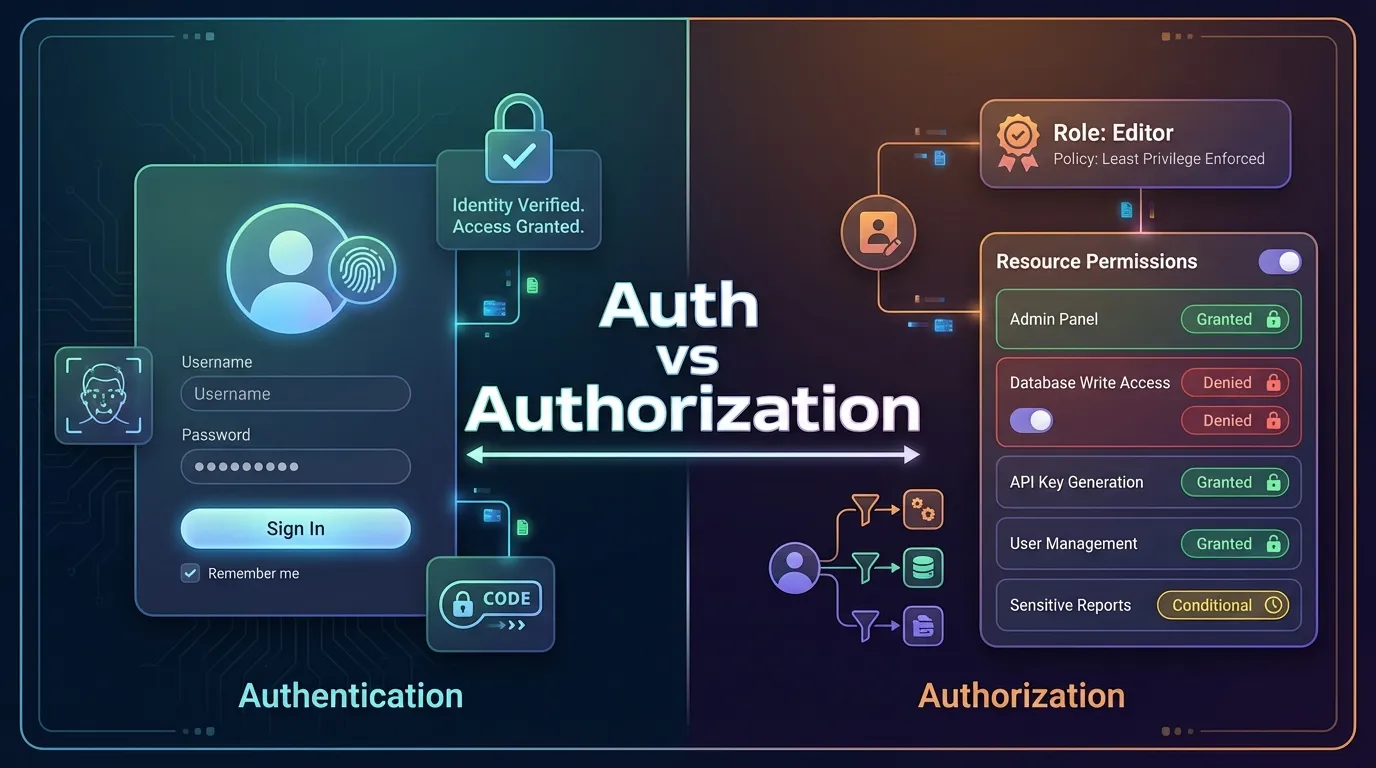
Authentication verifies identity.
Authorization controls permissions.
In this complete guide, you will learn:
- What authentication and authorization really mean
- Core differences between auth and authz
- Real world implementation examples
- Security workflows used by modern applications
- Best practices for protecting web apps and APIs
- Common developer mistakes to avoid
By the end, you will clearly understand how professional systems protect user data while maintaining seamless user experience.
What Is Authentication
Authentication is the process of verifying a user's identity.
It answers the question Who are you.
Common Authentication Methods
- Username and password
- Email and OTP login
- Social login
- Biometric authentication
- Multi factor authentication
Authentication happens before any access is granted.
Real World Authentication Example
1 User enters username
2 User enters password
3 Server verifies credentials
4 Identity confirmed
What Is Authorization
Authorization determines what an authenticated user is allowed to access.
It answers the question What can you do.
Authorization Examples
- Admin can delete users
- Editor can publish content
- Viewer can only read data
Authorization always happens after authentication.
Authentication vs Authorization Explained
| Feature | Authentication | Authorization |
|---|---|---|
| Purpose | Verify identity | Grant permissions |
| Question | Who are you | What can you access |
| Happens First | Yes | After authentication |
| Example | Login | Role access |
| Data Used | Credentials | Roles policies |
Why Developers Must Understand Auth vs Authz
Poor security implementation causes vulnerabilities including:
- Unauthorized data access
- Privilege escalation attacks
- Data leaks
- Broken access control
Separating authentication from authorization ensures layered security.
Authentication Workflow Step by Step
1 User login request
2 Credential verification
3 Token generation
4 User authenticated
Authorization Workflow Step by Step
1 Request protected resource
2 Verify identity
3 Check permissions
4 Grant or deny access
Authentication Methods in Modern Applications
Password Based Authentication
Traditional login using stored credentials.
Multi Factor Authentication
Adds additional verification layer like OTP or authenticator apps.
OAuth Authentication
Allows login using third party providers such as Google or GitHub.
Passwordless Authentication
Uses magic links or OTP instead of passwords.
Authorization Models Explained
Role Based Access Control
Permissions assigned based on roles such as Admin Manager or User.
Attribute Based Access Control
Permissions depend on attributes like location device or time.
Policy Based Authorization
Access controlled through defined policies.
Authentication Technologies Developers Use
- JSON Web Tokens
- Session Authentication
- OAuth 2.0
- OpenID Connect
Authorization Techniques in APIs
Common approaches:
- Token scopes
- API keys
- Permission middleware
- Access control lists
JWT Authentication and Authorization Flow
1 User logs in
2 Server generates token
3 Token contains user role
4 Client sends token
5 Server verifies permissions
Authentication vs Authorization in REST APIs
Authentication validates identity.
Authorization verifies permissions.
Security Best Practices for Authentication
- Hash passwords
- Use HTTPS
- Implement MFA
- Rate limit login attempts
- Store tokens securely
Security Best Practices for Authorization
- Follow least privilege principle
- Validate permissions on backend
- Avoid frontend only checks
- Separate admin endpoints
Common Developer Mistakes
Mixing Authentication and Authorization
Authentication alone does not grant permission.
Trusting Frontend Permissions
Backend must enforce access control.
Hardcoding Roles
Use database driven roles.
Missing Token Validation
Creates vulnerabilities.
Authentication vs Authorization in Microservices
Modern architectures use:
- Central identity providers
- API gateways
- Token based authentication
Real World Use Cases
Ecommerce Platforms
Authentication user login
Authorization admin inventory access
SaaS Applications
Authentication user sign in
Authorization subscription feature access
Enterprise Systems
Authentication employee identity
Authorization department access
Future of Authentication and Authorization
Emerging trends include:
- Passwordless login
- Biometric authentication
- Zero Trust security
- AI driven identity systems
Short Summary
This auth vs authz guide explained the difference between authentication and authorization including workflows models and security best practices.
Conclusion
Authentication confirms identity while authorization controls permissions. Together they create secure scalable applications.
Understanding this difference is essential for every modern developer.
Frequently Asked Questions
Authentication verifies user identity.