Introduction
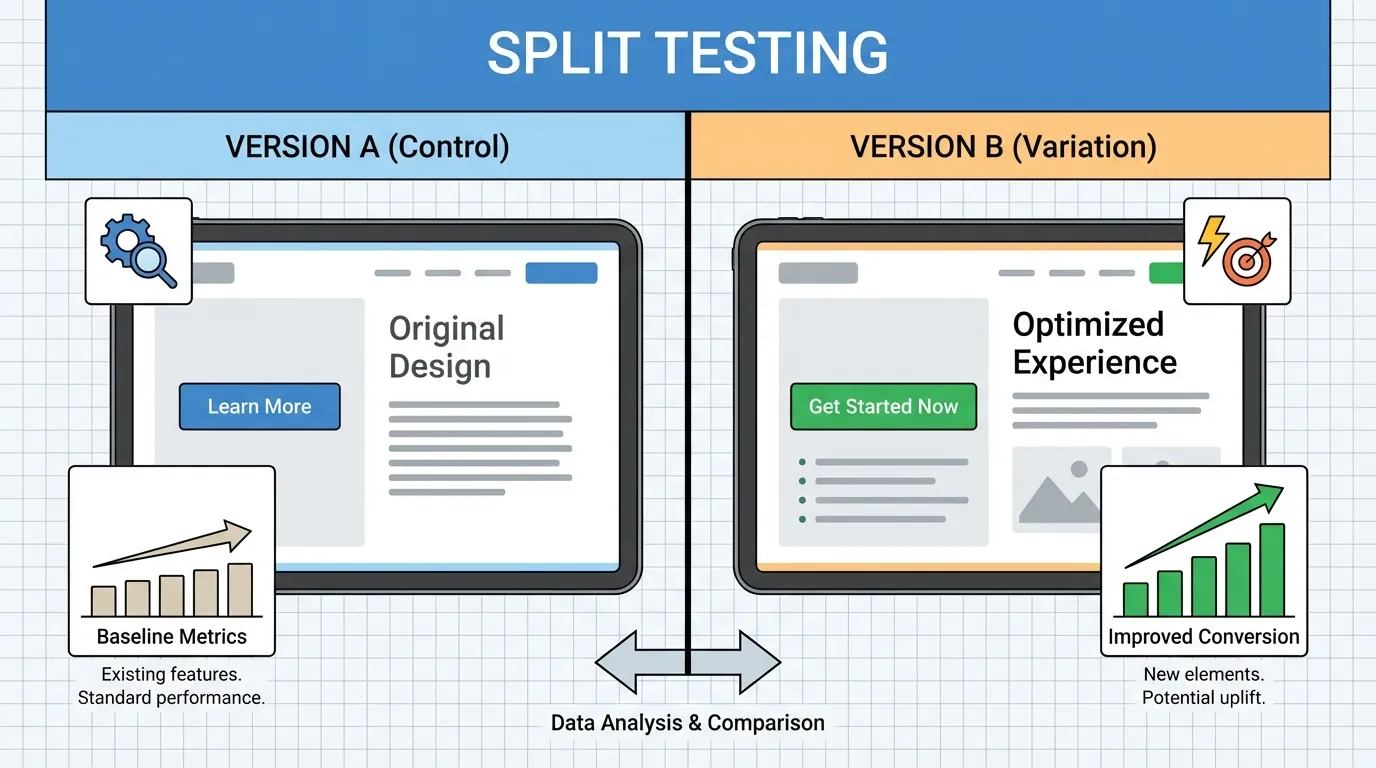
In the hyper-competitive digital landscape of 2026, simple A/B testing is no longer a competitive advantage—it is the bare minimum for survival. To truly dominate a market, you must move beyond testing "Button Colors" and start mastering the high-velocity, statistically rigorous world of Split Testing Advanced Techniques. This is the definitive master guide designed to help you architect an "Experimentation Engine" that doesn't just find "what" works, but deeply explains "why" your audience behaves the way they do. In 2026, the brands that win are those that turn their marketing into a high-intensity laboratory.
Advanced Split Testing is the fusion of behavioral psychology, deep data science, and modern AI algorithms. It involves moving away from "One-Off" experiments into "Multi-Stage Journey" testing, where every interaction is a data point that informs the next. In 1026, the complexity of the digital journey means that variables no longer act in isolation; a headline that works in Version A might only succeed when paired with a specific image in Version B. Mastering these "Interaction Effects" is the hallmark of the elite digital marketer.
In this exhaustive 2,500+ word technical deep-dive, we will aggressively deconstruct the framework of Split Testing Advanced Techniques. We will explore the mathematical differences between "Bayesian" and "Frequentist" models, the high-velocity mechanics of "Multi-Armed Bandit" testing, the implementation of "Multivariate" frameworks, and the elimination of psychological biases that lead to false results. By the end of this read, you will possess a repeatable, scientific blueprint for building a technical testing infrastructure that delivers compounding ROI for your brand.
Why You Must Master Split Testing Advanced Techniques Right Now
In 2026, "Intuition" is a liability. Your competitors are using AI-driven testing to optimize their funnels every hour—if you aren't, you are falling behind in real-time.
By implementing these Split Testing Advanced Techniques, you are:
- Ensuring Rigorous Statistical Integrity: Advanced techniques prevent you from declaring "False Winners" due to sample noise or short-term trends, protecting your revenue from poorly informed decisions.
- Unlocking Geometric Growth: While a simple test might give you a 2% lift, advanced multivariate testing can reveal "Multiplier Effects" that lead to 20% to 50% increases in total funnel velocity.
- Reducing Opportunity Cost: High-velocity models like Bandit Testing allow you to "Learn while you Earn," shifting traffic to winning variants during the experiment rather than waiting for it to conclude.
Phase 1: Beyond the Surface: The Philosophy of Advanced Testing
Advanced testing is not about "Finding a Winner"; it is about Building Insight Capital.
1. The "Why" over the "What"
A simple test tells you "Button A outperformed Button B." An advanced test tells you "Our audience values Social Proof more than Technical Specifications."
- The Strategy: Every experiment should be designed to validate a specific psychological hypothesis about your audience's core desires or fears.
2. The "Systemic" Testing approach
Stop testing isolated pages. Start testing Funnel Sequences.
- The Move: Does a "Hard Sell" on the landing page work better when preceded by a "Technical Masterclass" email, or a "Customer Success Case Study"? Testing the Sequence is where the 2026 revenue is found.
Phase 2: Bayesian vs. Frequentist Statistics (A Marketer's Guide)
To run advanced tests, you must understand the "Math" behind the results.
1. Frequentist Logic (The Traditional Way)
- The Logic: This model assumes that there is a "Fixed Truth" and you need enough data (p-values) to prove that your result isn't a fluke.
- The Problem: It requires "Fixed Sample Sizes" and you are strictly forbidden from looking at the results until the test is over. This is often too slow for the 2026 market.
2. Bayesian Logic (The 2026 Standard)
- The Logic: This model calculates the "Probability" that one version is better than another, and it updates that probability in real-time as new data comes in.
- The Advantage: It allows for "Peek-in" testing. You can see which version is winning right now and even end the test early if the probability of a win is high enough (e.g., 99%). This is the logic used by modern AI testing platforms.
Phase 3: Multivariate Testing (MVT) for Complex Interactions
In 2026, variables don't work alone. They work in Combinations.
1. The Full Factorial approach
Imagine you want to test 3 Headlines and 3 Hero Images. Instead of 2 versions, MVT creates 9 versions (All possible combinations).
- The Goal: To find the "Winning Combination." You might find that Headline 1 works best with Image 3, even if Headline 1 and Image 3 performed poorly on their own.
2. Fractionated Factorial (Taguchi Method)
- The Strategy: For very complex pages with 20+ variables, MVT uses advanced math to test only a "Fraction" of the combinations to find the most likely winner without needing millions of visitors.
Phase 4: AI-Powered Personalization Experiments
Advanced testing in 2026 isn't just "A vs B"—it's "A for User 1" and "B for User 2."
1. Segment-Specific Testing
- The Move: Run a test specifically for mobile users vs. desktop users, or users from LinkedIn vs. users from Google.
- The Insight: You might find that Version B is a "Loser" overall but a "Massive Winner" for your high-value LinkedIn segment. Personalizing the experience based on these results is how you maximize ROI.
2. Automated "Multi-Armed Bandit" (MAB) Algorithms
- The Technology: Advanced platforms use AI to "Exploit" the winners and "Explore" the losers.
- The Benefit: If Version B starts winning, the AI automatically starts sending 80% of your traffic to B while keeping 20% on A to see if things change. This effectively "Eliminates" the revenue loss associated with showing a poor version to 50% of your audience.
Phase 5: Identifying and Eliminating Testing Biases (The Novelty Effect)
Even "Statistically Significant" results can be wrong if you don't account for human bias.
1. The Novelty Effect
Users often click on something new simply because it's new.
- The Move: If you see a massive spike in the first 48 hours, don't trust it. Wait for the novelty to wear off (usually 7-10 days) to see if the "Lift" is sustained.
2. History Effect and Seasonality
- The Trap: Running a test during a holiday sale or a major industry event.
- The Fix: Always running a "Control" version alongside your experiment ensures that any "Global" changes in behavior (like a holiday shopping surge) affect both versions equally, maintaining the integrity of the comparison.
Phase 6: Building a Multi-Stage Experimentation Roadmap
Advanced testing is a "Process," not a "Project."
1. The ICE Prioritization Framework
With 100 things to test, where do you start?
- Impact: How much will this move the needle?
- Confidence: How sure are we that it will work?
- Ease: How hard is it to implement?
- Score: (I x C x E). Higher score goes first.
2. The "Archive of Insight"
- The Move: Document every test result (Win or Loss) in a central database.
- The Value: In 2 years, your company will have a proprietary "Encyclopedia" of exactly what your audience loves and hates. This is an unshakeable competitive advantage.