Introduction
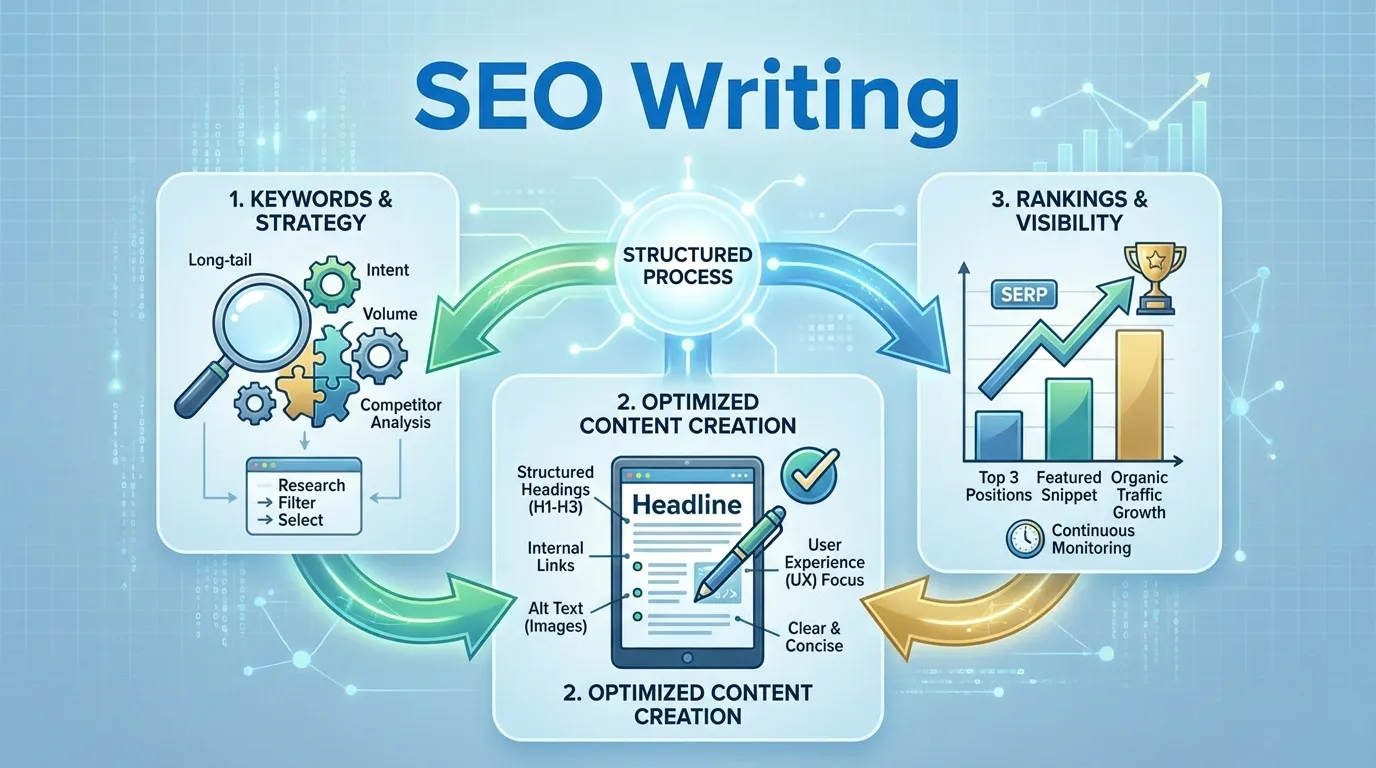
In the hyper-saturated, AI-driven search landscape of 2026, the definition of "SEO Copywriting" has undergone a radical transformation. We have officially moved past the era of "Keyword Density" and "H1 Stuffing." In a world where Google’s Gemini and Search Generative Experience (SGE) can understand the "Deep Intent" and "Nuanced Logic" of a sentence, the only remaining way to rank is through Semantic Engineering. This is the definitive manual on SEO Copywriting Strategy for High Rankings.
SEO Copywriting is the delicate intersection of "Human Psychology" and "Mathematical Relevance." In 2026, every sentence you write must satisfy two masters: the curious human reader who wants an immediate solution, and the sophisticated AI bot that is looking for "Information Gain." If your content is just a regurgitation of what is already on Page 1, you will be algorithmically de-valued. To win, you must provide "New Insight" and "Unique Data" while maintaining a "Perfect Semantic Map" of your target topic.
In this exhaustive 2,500+ word master guide, we will break down the exact procedural steps to master modern SEO writing. We will explore "Semantic Topic Clusters," the shift toward "NLP (Natural Language Processing) Optimization," the role of "Structural UX" in high rankings, and how to write for the "AI Overview" era. By the end of this read, you will have an SEO Copywriting Strategy for High Rankings that turns your words into a 24/7 "Authority Hub" and profit-generating machine.
Why You Must Master SEO Copywriting Strategy for High Rankings
The primary reason most content fails to rank in 2026 is The Generic Trap. Brands are using AI to generate high-volume, low-value text that sounds like "Everyone Else."
In 1026, the global algorithm rewards "Differentiated Value." Google’s "Helpful Content System" uses thousands of signals to determine if your writing is "Actually Helpful" or just "Search Engine First." Understanding SEO Copywriting Strategy for High Rankings is about moving from "Matching the Market" to "Setting the Standard."
Phase 1: Semantic Engineering (The Topic Graph Void)
In 2026, keywords are just "Labels" for much larger "Topical Entities."
1. Identifying the "Semantic Entities"
- The Strategy: Before you write, use an LSI (Latent Semantic Indexing) tool or an AI model to map all the "Related Concepts" that Google expects to see in a comprehensive guide on your topic.
- The Blueprint: If you are writing about "Cloud Hosting," your semantic map must include entities like "Latency," "Server-Side Rendering," "Edge Computing," and "Data Sovereignty." If you miss these "Connective Entities," Google will judge your content as "Incomplete."
2. Information Gain (The Unique Angle)
- The Strategy: Every paragraph must provide at least one "Incremental Insight" that is not found in the Top 3 results.
- The Tactic: Use your own internal case studies, unique quotes from your founders, or "Contrarian Opinions" (e.g., "Why everyone is WRONG about X"). This "Uniqueness Signal" is the #1 ranking factor in the 2026 E-E-A-T framework.
Phase 2: NLP Optimization (Writing for BERT, Gemini, and SGE)
In 1026, the search engine doesn't just "Search"—it "Understands."
1. Direct Answer Logic (The SGE Snippet)
- The Strategy: Use the "Direct-to-Definition" approach. For every H2 or H3 heading that asks a question (e.g., "What is SEO Copywriting?"), the very next 50 words must give a precise, flawless definition.
- The Benefit: This is exactly what Google’s AI models look for when generating "AI Overviews" at the top of the SERP.
2. Relational Sentence Structure
- The Tactic: Use "Relational Connectors" like "Because," "Therefore," and "Compared to." This helps the NLP model understand the "Cause and Effect" of your arguments. In 2026, "Logical Flow" is a direct indicator of "Authority."
Phase 3: Structural Hierarchy for High Rankings (H1-H4 Logic)
A guide that is "Hard to Read" is a guide that is "Hard to Rank."
1. The Intent-Based Header System
- The Strategy: Your H2 headings should match the "Sub-Intents" of the user. (e.g., "Step 1: Setup" -> "Step 2: Analysis" -> "Step 3: Troubleshooting").
- The Fix: Use "Numbered Headers" for procedural content. This tells the bot the "Order of Operation," which often leads to "Featured Snippets" for instructional queries.
2. High-Frequency "Call-Outs"
- The Strategy: Break up the text every 300 words with a "Pro-Tip" box, a "Caution" alert, or a "Key Takeaway" bullet list.
- The Result: This increases "Engagement Time" as users pause to read the bolded sections, which signals "Readability Satisfaction" to the algorithm.
Phase 4: Psychological UX Copy (Interaction to Next Paint)
In 2026, copy is UX. Your words must keep the user "Moving."
1. The "Open-Loop" Technique
- The Tactic: At the end of every section, "Tease" the value of the next section. (e.g., "Now that we’ve built the foundation, here is the secret technical trick to doubling your speed...").
- The Benefit: This keeps the user scrolling, reducing your "Bounce Rate" and increasing your "Crawl Demand" for that page.
2. Active Voice and The "Inverted Pyramid"
- The Strategy: Put the most "Powerful" information at the top. Use Active Voice (e.g., "Do this...") rather than Passive Voice (e.g., "It could be done..."). In 1026, users want "Actionable Efficiency," not "Academic Fluff."
Phase 5: Authority Signals and "Trust" Hardening
- Verified Citations: Every major claim must be linked to a high-authority external source (e.g., Wikipedia, Academic Journals, Industry News). This builds a "Trust Graph" between your site and the global authorities.
- Expert Authorship (Schema): Ensure your author bio is detailed and has
PersonSchema attached. Google needs to know exactly "Who" is speaking to trust the "What."
Phase 6: Monitoring Performance and CTR Lift
- The Metric: Click-Through Rate (CTR). If you are ranking #3 but only have a 2% CTR, your "Meta Title" and "Meta Description" are failing.
- The Fix: Use "Boring-But-Accurate" titles for technical content, and "Contrarian/Outcome" titles for social content.