Introduction
Have you ever searched for a recipe and noticed that some results show a bright star rating, a mouth-watering thumbnail photo, the calorie count, and the exact cooking time right in the search results? Or perhaps you've looked for a local music event and seen the tour dates, exact venue locations, and ticket prices listed directly below the website title?
Those eye-catching, highly clickable search enhancements aren't there by accident. They are entirely by design. They are the direct result of a sophisticated, well-executed Schema Markup Strategy for Rich Results. While your lazy competitors are stuck attempting to rank with plain, boring blue links that blend into the background, you have the profound opportunity to occupy significantly more "real estate" on the search engine results page (SERP) and command dramatically higher click-through rates (CTR).
In the modern era of semantic search, search engines like Google, Bing, and even emerging AI-driven answer engines are no longer just looking for generic keywords matching text strings; they are actively looking to identify entities, concepts, and relationships. They desperately want to understand the exact context of what your content is about, not just what individual vocabulary words it happens to contain.
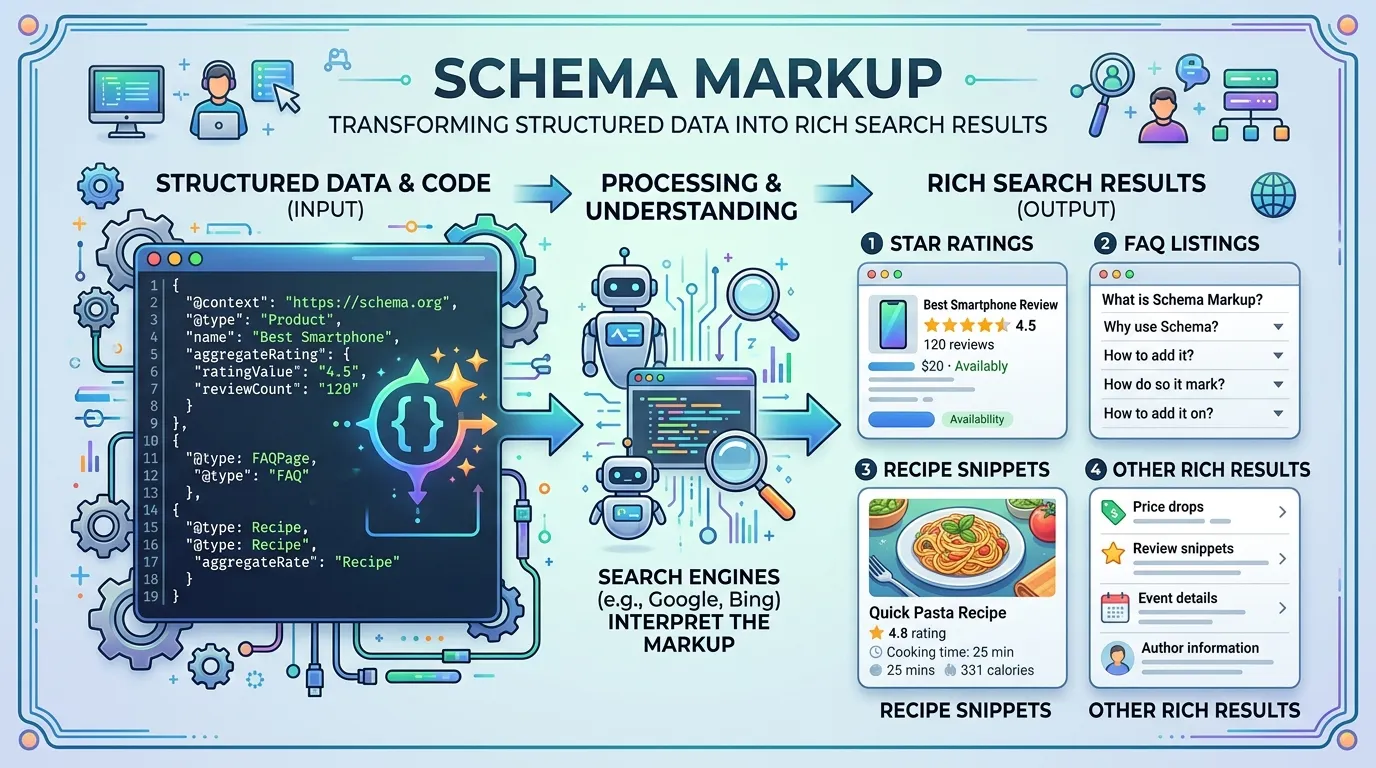
Implementing a robust Schema Markup Strategy for Rich Results is the equivalent of providing Google's crawling bots with a high-definition, perfectly labeled map of your most critical data. It effortlessly transforms your raw, unstructured HTML into universally standardized information that machines, algorithms, and AI models can process with 100% clarity and zero ambiguity.
Whether you are an ambitious e-commerce giant looking to dynamically showcase product prices and immediate availability, a local service provider wanting to highlight glowing customer reviews to build local trust, or a sprawling content publisher aiming for the highly coveted FAQ dropdowns to steal space from competitors, this master guide is explicitly engineered for you. We will break down the daunting technical barriers, explore the most commercially impactful schema models, and logically build a repeatable, step-by-step Schema Markup Strategy for Rich Results that will definitively make your un-enhanced listings a thing of the past.
Why a Schema Markup Strategy for Rich Results is Absolutely Non-Negotiable
The digital landscape in 2026 is more visually crowded, noisy, and fiercely competitive than ever. Users are aggressively scanning search results much faster than they ever have before—often making a split-second, subconscious decision on where to click based almost entirely on visual cues. In this unforgiving environment, visual prominence is undoubtedly your greatest organizational asset.
Rich results (traditionally known as rich snippets) are the heavily enhanced search listings that magically appear when search engines can successfully parse, validate, and trust the structured data embedded on your specific page.
But why does investing time and development resources into a Schema Markup Strategy for Rich Results fundamentally matter for your bottom-line revenue?
- Dramatically Higher Click-Through Rates (CTR): Large-scale industry studies consistently demonstrate that securing rich results can wildly increase CTR by anywhere from 10% to an astonishing 35%. When your result looks inherently more authoritative, visually appealing, and provides immediate logistical value (like price or rating), users are significantly more likely to click your link over the one sitting slightly above you.
- Improved Search Engine Understanding and Indexing: By fluently using the standardized Schema.org vocabulary, you are metaphorically speaking Google's exact native language. This explicitly helps the core algorithm categorize your content drastically more accurately, which directly leads to improved visibility for highly targeted, long-tail, and semantically related queries.
- Voice Search and AI Assistant Readiness: As increasingly more users ditch the keyboard and strictly rely on voice assistants like Siri, Alexa, Google Assistant, or AI-chat integrations, perfectly structured data becomes hyper-critical. These assistants do not traditionally "read" paragraphs well; they rely directly on schema markup variables to provide concise, accurate, single-breath answers to user questions. If you lack schema, you simply do not exist in voice search.
- Defending Against Zero-Click Searches: Search engines are answering more questions directly on the SERP, leading to a rise in "zero-click searches." By using schema to feed that data (like FAQs or How-Tos), you ensure your brand is the one providing the answer, retaining authority and mindshare even if the click never happens.
The Core Foundation: Understanding JSON-LD and Schema.org
Before we can confidently build your active Schema Markup Strategy for Rich Results, we need to intimately understand the underlying tools of the trade.
Schema.org is a unique, collaborative, open-community project originally founded by the major search giants: Google, Microsoft, Yahoo, and Yandex. Its sole purpose is to provide a unified, shared collection of distinct schemas (vocabularies) that webmasters globally can use to cleanly markup their respective pages in a way all engines understand.
While there historically have been several complex ways to implement this code (such as Microformats, Microdata, or RDFa), the undisputed industry gold standard today—and Google's explicitly, repeatedly preferred method—is JSON-LD (JavaScript Object Notation for Linked Data).
Why JSON-LD is the Undisputed Winner
Unlike older methods like Microdata, which painfully required you to wrap intricate schema tags directly around individual HTML elements scattered within the visual body of your complex page layout, JSON-LD is a wonderfully clean, highly compartmentalized block of lightweight script. It typically lives safely tucked away in the <head> of your HTML document, completely invisible to the human reader.
- Infinitely Easier Maintenance: Because JSON-LD is entirely decoupled from your user-facing visual layout, changing your site's CSS design, swapping themes, or moving a button won't inadvertently break your fragile schema validation.
- Highly Developer Friendly: It is significantly easier and cleaner for developers to programmatically and dynamically generate JSON-LD script from a backend database (like pushing product inventory) than it is to aggressively inject fragmented Microdata into messy front-end templates.
- Superior Site Speed Performance: Since the JSON-LD script block is incredibly lightweight and can be loaded entirely asynchronously, it has a practically non-existent, minimal impact on your critical page load speed and Core Web Vitals.
High-Impact Schema Types to Prioritize in Your Strategy
With hundreds of available schema types, knowing where to start can be paralyzing. However, not all schema is created equal. To rapidly maximize your commercial ROI, your aggressive Schema Markup Strategy for Rich Results should strictly focus on the specific data types that offer the most profound visual impact for your exact business model.
1. Product & Offer Schema (Essential for E-commerce)
If you operate an online store and sell physical or digital products, this is your absolute bread and butter. Robust Product schema empowers you to prominently display:
- Price, Currency, and Sales: Show users exactly what it costs. If it's on a major sale, Schema can display the price drop.
- Live Availability: Dynamically mark vital items as "In Stock," "Out of Stock," or "Pre-Order" to drive immediate purchasing intent or prevent frustrating bounces.
- Review Ratings (Aggregate Rating): Those shiny gold stars are subconscious psychological triggers for massive trust and authority.
2. Review and Aggregate Rating Schema (For Services & Software)
Trust is unequivocally the currency of the modern digital internet. Whether you are a local plumber, an enterprise SaaS platform, or an online consultancy, showing your aggregate average rating (e.g., prominently displaying a 4.8/5 based on 2,500 verified reviews) directly in the SERP establishes instant, unbeatable authority and heavy social proof.
3. FAQ (Frequently Asked Questions) Schema
Currently, this is one of the single most powerful tactical tools for legally "stealing" pixel real estate on the SERP. By accurately marking up a list of relevant questions and answers, you can forcibly trigger a massive, expandable dropdown menu directly below your primary search listing. This not only ruthlessly pushes your competitors further down the page—often below the fold—but it also preemptively answers user queries, proving your unmatched expertise before they even load your site.
4. Article and NewsPosting Schema
For publishers, heavy content marketers, and news outlets, strict Article schema aggressively helps Google immediately understand the exact headline, the verified author, the precise date published or modified, and highlights the featured thumbnail image. This is totally essential to become eligible for appearing in the highly trafficked "Top Stories" news carousel and for dramatically improving your viral presence in the personalized Google Discover feed.
5. Local Business Schema
If you have a physical brick-and-mortar location or serve a specific geographic radius, Local Business schema is absolutely hyper-critical for localized SEO success. It rigidly provides Google with your exact street address, precise geolocation coordinates, official phone number, accurate opening/closing hours, and general price range. This cleanly ensures you show up prominently, accurately, and authoritatively in the lucrative Google Maps interface and local "Snack Pack" search results.
6. Video Object Schema
If you host native video content on your site or embed Youtube videos on your landing pages, Video Object schema is mandatory. It allows you to define the video's title, description, thumbnail URL, and exact duration. crucially, it allows you to define "Clips" or "Key Moments"—allowing Google to link users directly to the 2-minute mark of a 30-minute tutorial directly from the search page.
7. Event Schema
Hosting a webinar, conference, or local concert? Event schema prominently displays the date, time, exact venue location (or virtual link), and ticketing information (like price and availability) in a dedicated snippet module above standard results. This massively drives ticket conversions directly from organic search.
Step-by-Step Execution: Building and Deploying Your Schema Strategy
Intelligently implementing a Schema Markup Strategy for Rich Results absolutely doesn't have to be a terrifying coding nightmare. Simply follow this logical, battle-tested workflow to consistently ensure technical success without completely breaking your site.
Step 1: Audit Your Content and Identify Key Entities
Don't blindly guess. Look deeply at your analytics to find your most important, traffic-driving, and revenue-generating pages. Are they flagship products? Are they cornerstone articles? Do they contain step-by-step recipes? Diligently map each high-value page to the absolute most relevant Schema.org data type. Don't recklessly try to markup thousands of pages manually at once; strategically start with your top 20 highest-traffic, highest-conversion pages for maximum immediate impact.
Step 2: Generate the JSON-LD Script Code
Unless you are a senior software engineer, you absolutely do not need to meticulously write JSON syntax from scratch. Leverage powerful, free tools like the official Google Structured Data Markup Helper, Merkle’s Technical SEO Schema Generator, or sophisticated AI systems.
- Simply input your live URL or neatly paste your raw text content.
- Carefully select the specific data type (Event, Product, FAQ, etc.).
- Accurately highlight and assign the strictly required fields (Name, Featured Image, Valid URL, Author, Price).
- Download the cleanly generated block of JSON-LD script.
Step 3: Implement Safely on Your Website Environment
Once you have the perfected script, it needs to be securely injected into your site's architecture.
- For Custom Hand-Coded Sites: Ask a developer to place the script securely within the
<head>of the specific, relevant HTML page. - For WordPress Environments: Strongly lean on premium plugins like "Rank Math Pro" or "Yoast SEO Premium" which elegantly handle schema dynamically. Alternatively, use a lightweight "Header and Footer Scripts" plugin to manually inject custom one-off JSON-LD snippets on specific posts.
- For Shopify / Magento E-commerce: Most highly-rated modern themes have very basic Product schema built-in natively. However, to achieve advanced, highly sought-after multi-variant product schema (handling different sizes and colors under one URL), you will almost certainly require a dedicated, advanced Schema App or a capable backend developer.
- For Webflow / Ghost: Both modern platforms allow you to inject custom code into the header of individual pages natively, making manual JSON-LD drops incredibly seamless.
Step 4: Rigorously Validate and Test Output (Crucial)
This is universally the most critical step where most amateurs fail. Google is notoriously and aggressively strict about exact schema syntax. If your generated code possesses a single missing comma, an unclosed quotation mark, or a mismatched trailing bracket, it will silently fail entirely.
- Google Rich Results Test Tool: This is the absolute definitive, officially supported testing environment. Paste your raw code snippet or your live URL to immediately see a visual preview of exactly which rich results your page is currently eligible to generate. Fix errors immediately.
- Schema.org Canonical Validator: Exceptionally useful for checking for more advanced, generalized syntax errors, missing recommended fields, and ensuring strict compliance with the broader, constantly evolving Schema.org global standard.
Step 5: Monitor Relentlessly in Google Search Console
After a successful deployment, your job is not finished. Head over directly to your dedicated Google Search Console dashboard. Under the distinct "Enhancements" tab, you will eventually see populated, specific reports specifically for your active FAQs, Products, Reviews, and Video schemas. This rich data will definitively show you exactly how many impressions and clicks your new rich results are genuinely generating. More importantly, it will proactively alert you via email to any sudden parsing errors, warnings, or broken syntax that may inevitably crop up as your website evolves over time.
Avoiding Devastating Common Pitfalls in Your Schema Strategy
Even the absolute most comprehensive, well-intentioned Schema Markup Strategy for Rich Results can catastrophically backfire if you don't rigidly follow the search engine's strict guidelines. Google's severe manual algorithmic actions for actively utilizing "Spammy Structured Data" are incredibly real, highly punitive, and can tragically result in your entire domain losing its rich result eligibility permanently.
- Markup Must 100% Reflect Visible Human Content: You must never markup hidden data that isn't instantly and clearly visible to a normal human user reading the page. For example, do not ever include fake 5-star review schemas hidden in the code if those exact reviews cannot be read by a user on the actual visual frontend.
- Never Misrepresent the Core Entity: Do not aggressively try to exploit the system by categorizing a page inaccurately just to get a rich snippet. Adding highly visual "Recipe" schema to a blog post discussing "How to Repair a Car Transmission" will actively confuse the search algorithms, look ridiculous to users, and is completely guaranteed to lead to a severe algorithmic penalty.
- Data Must Remain Current and Fresh: If your flagship product price fundamentally changes from $50 to $75 in your shopping cart, your underlying Product schema must instantly be updated to reflect that exact new price. Outdated, mismatched structured data leads to a violently poor user experience (a user expecting a $50 price tag only to be charged $75), immense loss of brand trust, and warnings inside Google Search Console.
- Nesting Schema Incorrectly: When you have multiple schema types on a page (e.g., an Article that is written by an Author, who works for an Organization), the schema must be properly "nested" or linked using
@idtags. Dumping three separate, totally unrelated schema blocks on a page dilutes the context; linking them properly tells Google a cohesive story about the page entities.
The Ultimate Future of Schema: Moving far Beyond Basic Results
The incredibly vast world of structured linked data is expanding at lightning speeds. As search moves from simple indexing to complex AI computation, we are already seeing aggressive support for targeted "Speakable" schema (specifically designed for smart speakers and news organizations), robust "Course" schema for online educational platforms, and even highly technical "Dataset" schema for scientific researchers to share massive analytical data dumps.
A hyper-forward-thinking Schema Markup Strategy for Rich Results should persistently monitor the absolute edge of the next frontier. As Google and competitors rapidly transition closer to becoming literal, AI-assisted "answer engines" rather than just traditional "search engines," your direct technical ability to actively provide deeply structured, perfectly machine-readable answers will definitively become your ultimate, untouchable competitive advantage in the decade to come.
Comprehensive Short Summary Checklist
- Schema markup is fundamentally a universally standardized, structured data vocabulary that explicitly helps complex search algorithms perfectly understand the hidden intent and core entities of your content with absolutely 100% clarity.
- A highly methodical, well-executed strategy directly leads to coveted Rich Results, which visually dominate your SERP presence and can significantly, measurably boost click-through rates (CTR) by massive margins.
- Clean JSON-LD is unequivocally the preferred implementation method by search engineers due to its profound ease of use, superior rendering performance benefits, and essential separation from the messy visual HTML layer.
- Key high-revenue, high-impact types include Product, Review, FAQ, Article, local Business, and Video schema—the priority strictly relies upon your unique business model.
- Aggressive validation utilizing Google's official Rich Results Test, combined with relentless error monitoring inside Google Search Console, are absolutely mandatory steps to avoid devastating technical errors and permanent "Spammy Structured Data" manual penalties.
Final Conclusion
In a hyper-competitive landscape where every single visual pixel of search engine real estate is a violently contested battleground, an aggressive, technically sound Schema Markup Strategy for Rich Results is undoubtedly your most powerful, underutilized secret weapon. It profoundly acts as the unbreakable bridge between legacy, traditional SEO practices and the looming, chaotic future of robust, AI-driven semantic search.
By strategically dedicating the time and development resources required to properly map and perfectly structure your organization's data, you are actively making it extraordinarily easier for Google to promote your content, overwhelmingly easier for potential users to explicitly trust your brand authority, and wildly easier for your business to massively scale its organic revenue. Do not ever settle for being just another boring, easily ignorable blue link. Radically give your hard-earned content the dominant visual edge it rightly deserves and immediately start fluently speaking the core language of the modern, algorithmic web today.
Frequently Asked Questions (FAQs)
1. Does successfully implementing schema markup directly, inherently improve my SERP rankings? While Google's core engineers have stated repeatedly on the record that structured data code itself is absolutely not a direct indexing ranking signal, it acts as a massive indirect factor. By heavily improving your user click-through rate (CTR) and making it vastly easier for Google to perfectly understand your content's contextual relevance, it consistently leads to substantially improved long-term rankings.
2. What is the actual technical difference between Rich Snippets, Rich Results, and Featured Snippets? "Rich Snippets" was merely the older, legacy term used by developers to describe enhanced listings. Google now officially uses "Rich Results" as the blanket name for all enhanced search experiences specifically triggered by structured data. Conversely, "Featured Snippets" (those large answer boxes at the very top of Google) are generally pulled directly from normal paragraph text by the AI, and usually do not require schema to trigger, although having schema highly helps establish the page authority needed to win that spot.
3. Is it genuinely possible to get a localized or site-wide penalty strictly from abusing schema? Yes, absolutely. If you knowingly or accidentally implement what Google identifies as "Spammy Structured Data"—such as marking up hidden content that isn't visually accessible to users, intentionally misrepresenting your page entity, or artificially injecting completely fake local reviews—Google's web spam team can and will issue a devastating "manual action." This definitively removes your eligibility for any rich results across your entire site until fixed and reviewed.
4. Realistically, how long does it take for my new rich results to finally show up in live search? It varies wildly based on your site's inherent crawl budget. Once you've flawlessly implemented the JSON-LD code and forcefully requested Google to re-crawl your URL via Search Console (which can happen in mere hours or painstakingly take several days), rich results can suddenly appear. However, Google emphatically does not guarantee that it will consistently show rich results for every correctly marked-up page; it aggressively calculates complex user intent before displaying them.
5. Can I strategically use multiple different types of complex schema stacked on a single landing page? Absolutely. In fact, it's often highly recommended for comprehensive pages. For a highly optimized e-commerce scenario, a cornerstone product landing page might simultaneously utilize deep Product schema, Aggregate Rating schema for reviews, Video Object schema for a demonstration clip, and FAQ schema all seamlessly "nested" together to effortlessly create an overwhelmingly dominant, highly informative search listing that takes up half a mobile screen.
6. Do I need to be a senior backend developer to actively manage my site's schema strategy? Not necessarily. While highly custom, dynamic multi-variant e-commerce store architectures often require a developer's touch to automate schema generation, standard content publishers or local service businesses can easily rely heavily on premium WordPress plugins or incredibly simple, free online Schema Generator form tools to easily generate and paste the required header code themselves with minimal risk.
7. Is structured data purely a Google-centric strategy, or do other major engines utilize it? While Google is undeniably the primary driver of the initiative, Schema.org is a massive, unified collaborative effort actively supported and heavily utilized by Microsoft Bing, Yahoo, and the Russian giant Yandex. Furthermore, next-generation AI platforms and social media scraping bots increasingly rely on JSON-LD data to swiftly understand your page context, making it a universally critical, platform-agnostic web standard.
8. How do I effectively measure and prove the raw ROI of my extensive schema implementation efforts? Do not ever rely purely on blind guesswork. The most definitive way is to rigorously monitor your exact Click-Through Rates (CTR) inside Google Search Console. Annotate the exact date your verified schema went live. Specifically monitor your targeted URL's CTR performance 30 days before the implementation versus 30 days after. Usually, you will witness a highly dramatic CTR spike for the identical keyword position once the visually enhanced schema elements go live, directly proving the monetary value of your time investment.
Dedicated Meta Title
Schema Markup Strategy for Rich Results: The Ultimate 2026 SERP Domination Guide
Dedicated Meta Description
Master the ultimate Schema Markup Strategy for Rich Results. Thoroughly learn how to deploy complex JSON-LD, heavily boost CTR with aggregate review stars, and effectively use FAQ schema to dominate the entire search engine results page.
Verified References & Further Academic Reading
- https://en.wikipedia.org/wiki/Schema.org
- https://en.wikipedia.org/wiki/Structured_data
- https://en.wikipedia.org/wiki/JSON-LD
- https://en.wikipedia.org/wiki/Semantic_Web
- https://en.wikipedia.org/wiki/Search_engine_results_page
- https://en.wikipedia.org/wiki/Knowledge_Graph
- https://en.wikipedia.org/wiki/Click-through_rate