Introduction
You have finally achieved the digital marketing dream: you found a highly profitable "Winner" ad. After grueling weeks of testing dozens of different creatives, varied interests, and punchy ad copy, you have a specific ad set that is consistently delivering an incredible 4x Return on Ad Spend (ROAS). Your heart races as you look at the dashboard and think about the sheer mathematical possibilities. Logic dictates that if you are currently spending $100 a day to make $400, then aggressively spending $10,000 a day should effortlessly generate $40,000 in revenue, right? You excitedly log into your Ads Manager and immediately double or triple your daily budget, only to wake up the very next morning and discover your ROAS has catastrophically plummeted to an unprofitable 0.8x.
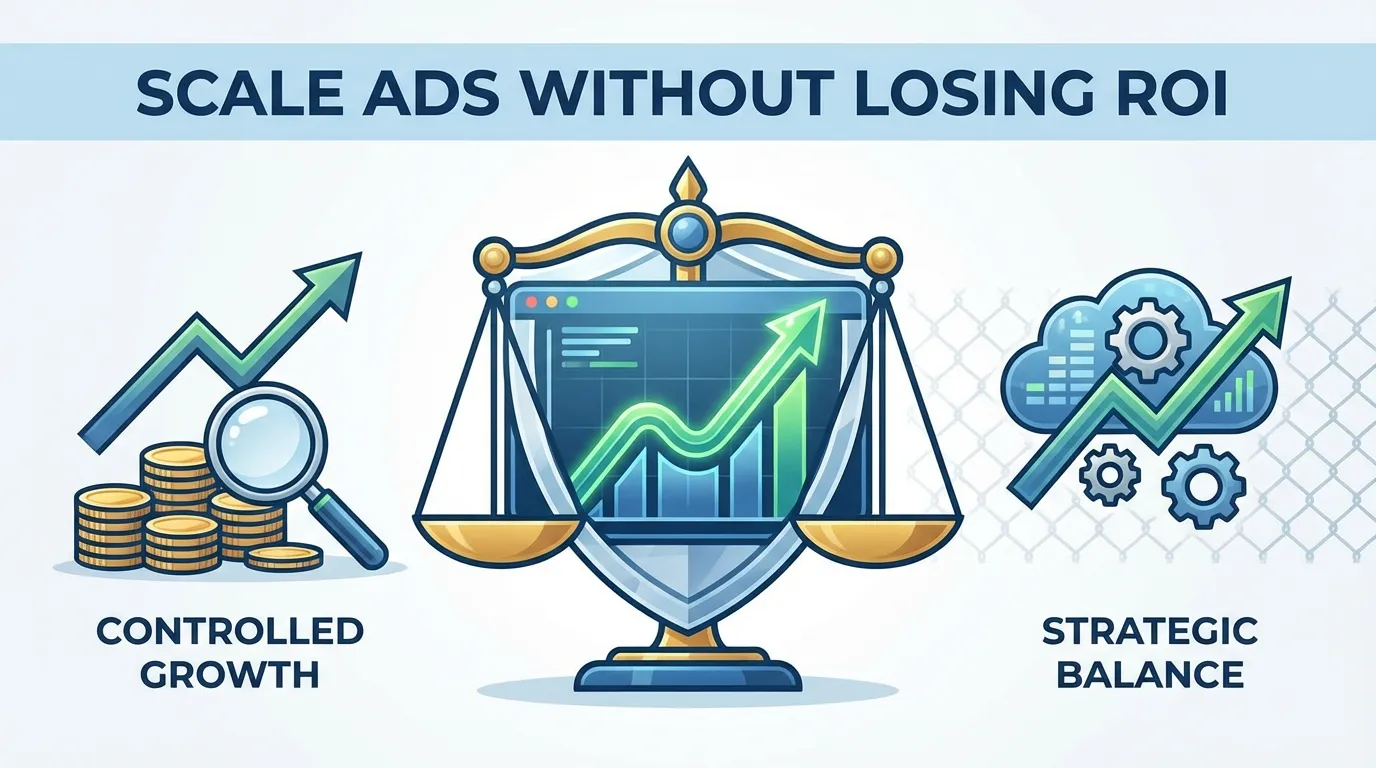
You are no longer just losing daily profit margins; you are actively burning your cash reserves. This frustrating phenomenon is known as the "Scaling Wall," and hitting it is the absolute #1 reason why ambitious businesses fail to grow on the Meta ad platform. This precarious moment is exactly where you require a definitive, battle-tested plan on how to scale Facebook ads without losing ROI.
Predictable ad scaling is not a linear mathematical equation; it is a biological and behavioral process. When you attempt to scale a campaign, you aren't just handing Meta more money to show the exact same ad to the same people; you force the machine learning algorithm to hunt for "New People" who have never interacted with your brand. As your budget grows, the algorithm must reach beyond your "Warm" retargeting pool or "Perfect" core lookalike audience, venturing into the massive, untested "Broad" demographic. If your creative is weak, your conversion tracking (CAPI) is broken, or your core offer isn't irresistible, the entire system breaks down under the weight of the spend.
In this exhaustive 2,500+ word master guide, we will break down the precise mechanics of elite media buying and campaign scaling. We will explore the differences between "Vertical" and "Horizontal" scaling, the defensive utility of manual "Cost Caps," and how to leverage Meta’s advanced "Advantage+" AI logic to do the heavy lifting for you. By the end of this read, you will have a reproducible, scientific framework for how to scale Facebook ads without losing ROI, turning your successful "experiment" into a predictable "revenue engine."
The Strategic Reality: Why ROI Craters Under Scale
Before we dive into the technical "how-to," we must understand the algorithmic "why." There are three primary reasons why ROAS reliably crashes during an aggressive budget scale:
- Creative Fatigue at Scale: At $10/day, your ad might see 500 people. At $1,000/day, it hits 50,000 new people daily. Once everyone in your niche has seen your ad three times without buying, your "Frequency" spikes and your "Click-Through Rate" (CTR) drops. This is "Banner Blindness."
- Learning Phase Resets: If you increase a budget by more than 20% in a single day, the algorithm formally triggers a "Reset." It throws out previous data and starts "Testing" again, leading to volatile performance.
- The Marginal Return Problem: The first $100 targets the "Easiest" customers. The next $900 has to work harder to convince skeptical prospects who require more "Touchpoints" before buying.
Phase 1: Controlled Vertical Scaling (The 20% Rule)
Vertical scaling is the process of increasing daily budget on existing winning ad sets.
- The Increment Strategy: Never increase your budget by more than 20% every 48 to 72 hours. This allows the Meta AI to slowly expand its target reach without shocking the stable "Learning Phase."
- The Patience Window: Do not touch the budget again until you have at least 2 full days of data at the new spending level.
Phase 2: Horizontal Scaling (Audience Diversification)
Horizontal scaling involves taking your "Winning" creative and launching it into completely new audience segments.
- Duplicating Success: If your ad is winning in a "Broad" audience, duplicate it into several 1% and 3-5% "Lookalike Audiences" (LAL) based on your "Purchasers" and "Cart Adders."
- The "Broad" Revolution: In 1026, most elite media buyers rely on "Broad" targeting (No interests, just Age/Gender/Location). This gives the AI the largest possible "Sandbox" to find your customers as you scale the spend.
Phase 3: Defensive Scaling with Manual "Cost Caps"
As you scale towards $1,000+ per day, "Cost Caps" become your financial insurance policy.
- What is a Cost Cap? A limit that tells Meta: "Do not spend my money unless you can acquire a customer for $X."
- The Safety Valve: If the auction environment gets too expensive (e.g., Black Friday), the algorithm will stop spending rather than burning your budget on unprofitable clicks. This prevents "Overnight ROI Death."
Phase 4: Creative Production (The "Creative Lab")
At scale, your "Interest" targeting matters less than your "Ad Creative." Creative is the targeting.
- The 3-2-2 Testing Method: Test 3 Creatives, 2 Headlines, and 2 Primary Text variations in a separate testing campaign before moving the "Winner" into your scaling campaign.
- Content Variation: You must diversify between UGC (User Generated Content), high-production brand videos, and simple static "Benefit" graphics to avoid whole-account fatigue.
Phase 5: Predictive Audience Modeling and First-Party Data
In 2026, third-party cookies are dead. You must scale using First-Party Data.
- CAPI Integration: Ensure your Server-Side Conversions API (CAPI) is sending 100% of event data back to Meta. Without this, the algorithm "flies blind," making scaling impossible.
- Predictive LTV: Upload your list of "Highest Spenders" to create a Lookalike audience of your most valuable customers, not just "any" customers.