Introduction
In the hyper-analytical marketing landscape of 2026, the success of an email is no longer measured by how many people open it, but by how many people take action inside it. As consumer attention becomes the world's most finite resource, the ability to convert that attention into a click, a lead, or a sale is the ultimate differentiator. This is the era of Email Conversion Optimization Techniques, where behavioral psychology meets rigorous data science to guide a user through a seamless, high-velocity journey from the inbox to the checkout.
Conversion optimization in 2026 is no longer about "Gimmicks" or "Trickery." It is about "Clarity" and "Relevance." Modern users can sense a generic sales pitch from a mile away and will instantly delete anything that feels high-pressure or misaligned with their needs. To win, you must master the delicate balance of persuasive copywriting, technical design hierarchy, and the subtle use of social proof. If your email click-through rates (CTR) are stagnant, it isn't because email is "Dead"—it is because your conversion architecture is leaking revenue through friction and "Choice Paralysis."
In this exhaustive 2,500+ word master guide, we will aggressively deconstruct the absolute frontier of Email Conversion Optimization Techniques. We will explore the "Psychology of the Open," the "Z-Pattern" of visual design, the "Anatomy of the High-Performance CTA," and the implementation of "Hyper-Personalized" dynamic blocks. By the end of this deep-dive, you will possess a repeatable, scientific framework for building emails that dont just get "read"—they get "results."
Why You Must Master Email Conversion Optimization Techniques Right Now
In 2026, your email list is a "High-Intensity Funnel." Every click you don't get is a missed opportunity for revenue and a waste of your acquisition budget.
By implementing these Email Conversion Optimization Techniques, you are achieving:
- Drastic Increases in Campaign ROI: Even a 1% increase in conversion rate can lead to a 20% to 50% increase in total revenue for high-volume senders.
- Superior Customer Experience: Optimization is fundamentally about making the user's life easier. By removing friction and providing clear next steps, you build brand trust and loyalty.
- Algorithmic Domain Authority: High click-to-open (CTO) rates signal to inbox providers that your content is high-quality, ensuring you stay in the "Primary" inbox for future campaigns.
Phase 1: The Psychology of the "Open" (Beyond the Subject Line)
You cannot convert a user who hasn't opened your email. The "Open" is the first micro-conversion.
1. The Subject Line "Hook"
In 2026, curiosity beats "Shouting."
- Variable-Length Logic: Test ultra-short (2 words) vs. descriptive (10 words) subject lines. For technical audiences, "Specific Facts" (e.g., "The [Product] 22% ROI Report") always outperform vague promises.
- The "Missing Element": Use a subject line that starts a sentence but doesn't finish it, forcing the user to open the email to "Close the Loop" in their brain.
2. The Power of the Pre-header (The "Secondary Hook")
The pre-header is the 40-70 characters of text that appears after the subject line in most inboxes.
- The Rule: Never let your pre-header say "View this email in a browser." Use it to provide a "Secondary Benefit" or "Additional Urgency" that supports (but doesn't repeat) the subject line.
Phase 2: Advanced Copywriting for Maximum Persuasion
Once the email is open, your copy must act as a "Slippery Slope," leading the reader effortlessly toward the button.
1. The "AIDA" vs. "PAS" Framework
- AIDA: Attention, Interest, Desire, Action. (Classic sales approach).
- PAS: Problem, Agitation, Solution. (High-velocity conversion approach).
- Step 1: State the user's specific pain point.
- Step 2: Deepen the pain by explaining the cost of inaction.
- Step 3: Introduce your product as the bridge to the solution.
2. The "Me-to-You" Ratio
Count the number of times you use "We/Our" vs. "You/Your."
- The 3:1 Rule: For every time you mention your company, you should mention the customer's benefit three times. Your email should be a mirror reflecting the customer’s desires, not a brochure for your brand.
Phase 3: Visual Design and "Eye-Tracking" Hierarchy
The human eye scans an email in a very specific pattern (usually an "F" or "Z" pattern). Your design must work with this biology, not against it.
1. The Single-Column Layout
In 2026, 80%+ of emails are opened on mobile.
- The Strategy: Use a single-column layout exclusively. This ensures a consistent, high-readability experience on every device and eliminates the "Crowded Footer" issue that kills mobile conversions.
2. The "Inverted Pyramid" of Design
Place your most important visual "Anchor" (Headline + Image) at the top. Use the underlying visual elements (lines, colors, or image gazes) to "Point" the user's eyes directly toward the CTA button.
Phase 4: The Anatomy of a High-Performance CTA (Call to Action)
The CTA is the moment of truth. Every detail of the button determines the conversion probability.
1. The "Benefit-Oriented" Button Text
Stop using "Submit," "Learn More," or "Click Here."
- The Better Way: "Claim My 20% Discount," "Get the ROI Blueprint," or "Start My Free Audit." The button text should describe the Outcome the user receives, not the Action they take.
2. The "First-Click" Placement
Place your primary CTA "Above the Fold." The user should not have to scroll to understand what you want them to do.
- Pro Tip: For longer vertical emails, repeat the CTA button at the very bottom after the final "Social Proof" section to capture those who read the whole post.
Phase 5: Social Proof and "Trust Injection"
In 2026, what you say about yourself is irrelevant; what others say is everything.
1. Micro-Testimonials
Don't use massive, 3-paragraph reviews. Use 1-sentence "Punchy" quotes that address the specific objection a user might have at that point in the funnel.
2. Real-Time "Live" Proof
Use dynamic blocks that show recent activity: "15 other people in [User_City] just bought this!" or "Only 4 spots left in the [Service] webinar." This "Group Validation" is a massive driver of conversion velocity.
Phase 6: The "Testing and Iteration" Framework
Conversion optimization is never "Done." It is a continuous loop of testing and learning.
1. The "Champion-Challenger" A/B Test
Run every campaign with a "Control" (The Champion) and a "New Variation" (The Challenger).
- What to Test:
- Subject Line (The Open).
- CTA Color/Text (The Click).
- Hero Image (The Vibe).
- "Long vs. Short" Copy length.
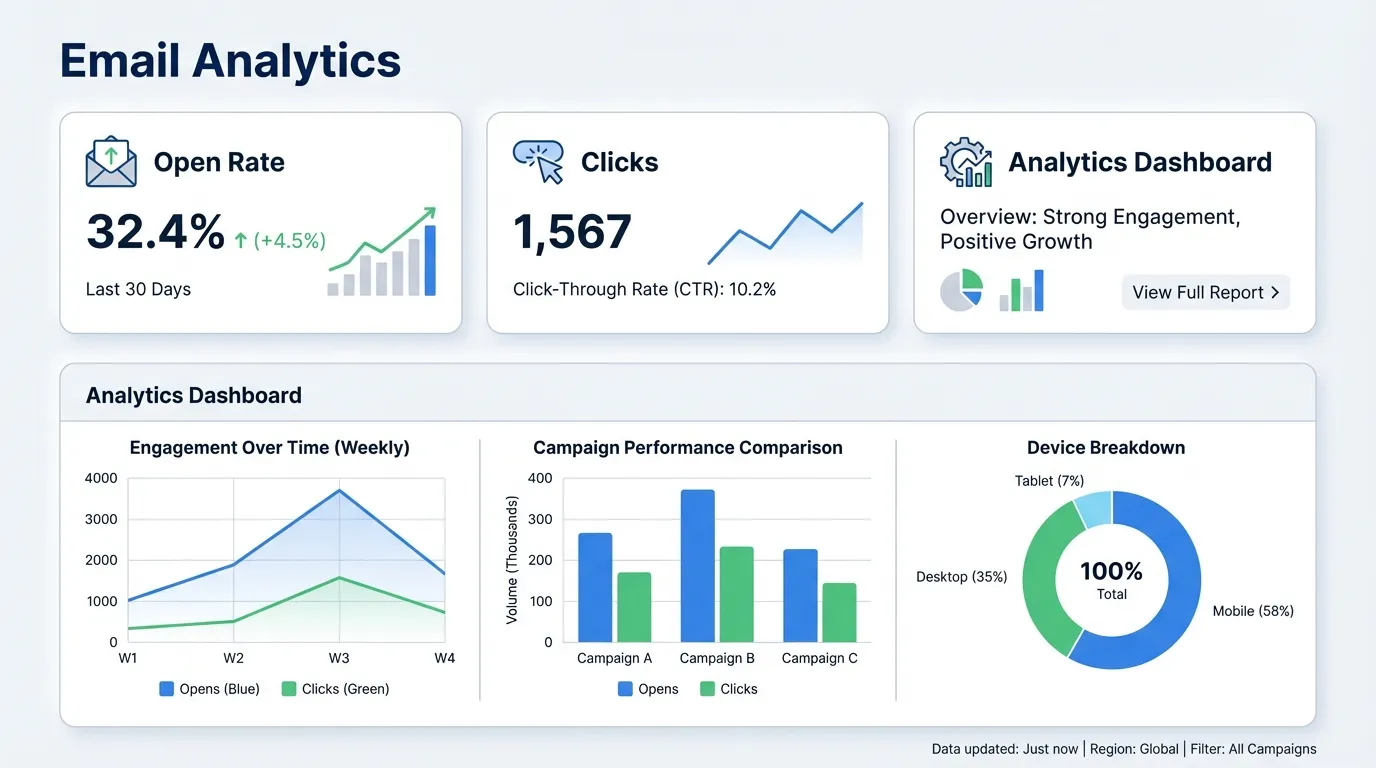
2. Analyzing the "Click-to-Open" (CTO) Rate
The CTO is the most important conversion metric. It measures what percentage of the people who opened the email actually clicked. A low CTO means your subject line made a promise that your content didn't keep.