Introduction
In the data-driven world of 2026, "Expert Opinions" are a dangerous liability. The marketers who dominate their industries are not those who claim to have the best intuition, but those who have built the best "Experimentation Engines." This is the definitive A/B Testing Best Practices for Marketers master guide, built to help you move beyond guess-work and embrace a rigorous, scientific framework for optimizing every touchpoint of your customer journey. In 2026, if you aren't testing, you aren't marketing—you are gambling with your company's revenue.
A/B testing, or split testing, is the process of comparing two versions of a marketing asset to see which one performs better. While the concept is simple, the execution in 2026 requires a deeper understanding of statistical logic, behavioral psychology, and the impact of AI on traffic distribution. True success in testing isn't about finding a "winner"; it's about gaining a reproducible insight into why your audience chooses one option over another. This "Insight Capital" is what allows you to scale your business with unshakeable confidence.
In this exhaustive 2,500+ word technical deep-dive, we will aggressively deconstruct the framework of global-class A/B Testing Best Practices for Marketers. We will explore the mechanics of "Statistical Significance," the shift toward "Multi-Armed Bandit" algorithms, the hierarchy of "High-Impact Variables," and the construction of an "Always-On" testing culture. By the end of this master guide, you will possess a repeatable, scientific blueprint for transforming your marketing from a series of "One-Off" efforts into a continuous, compounding revenue machine.
Why You Must Master A/B Testing Best Practices for Marketers Right Now
In 2026, the cost of traffic is too high to waste on underperforming pages. Testing is the only way to ensure you are squeezing every possible dollar out of your marketing spend.
By implementing these A/B Testing Best Practices for Marketers, you are:
- Dramatically Improving Asset Performance: Even a 5% improvement in conversion rate from every test can lead to a massive compounding increase in total annual revenue.
- Mitigating Brand Risk: Testing allow you to validate new ideas on a small percentage of your traffic before rolling them out to your entire audience, protecting you from potentially disastrous "Gut-Feeling" mistakes.
- Unlocking Deep Market Insights: Every test tells you something specific about your customer's psychology. Over time, these insights form a proprietary "Playbook" that your competitors cannot replicate.
Phase 1: The Scientific Method in Marketing (The 2026 Standard)
A/B testing is not about "Trying things." It is about Validating Hypotheses.
1. The Hypothesis Framework
Every test must start with a written hypothesis.
- The Format: "If we [Change X], then we will see [Outcome Y], because of [Psychological Reason Z]."
- The Key: If you can't explain the "Z" (The Reason), you aren't learning. You are just stumbling onto lucky results that you won't be able to repeat.
2. The "One-Variable" Integrity Rule
To get a clean result, you must only test one thing at a time.
- The Problem: If you change the headline AND the button color AND the image in Version B, and Version B wins, you have no idea which change caused the lift. You’ve successfully increased revenue, but you haven't gained any "Insight Capital."
Phase 2: Identifying High-Impact Variables (What to Test)
Don't waste 14 days testing something that doesn't move the needle. Focus on the "Conversion Catalysts."
1. The "Big Three" Testing Targets
- The Headline: This is the #1 driver of "Attention." Test emotional vs. logical, or "Pain-focused" vs. "Goal-focused" headlines.
- The Primary Offer: Test "Free Trial" vs. "Money-Back Guarantee" or different price points/bonuses. The "Offer" is often the strongest lever in the whole funnel.
- The Call to Action (CTA): Test the button text, size, and placement. Focus on "Action-Oriented" vs. "Result-Oriented" labels.
2. Testing the "Value Hierarchy"
Does your audience care more about "Saving Time" or "Making Money"?
- The Move: Run a version where the headline focuses purely on speed, and a version where it focuses purely on ROI. The winner tells you the "Primary Desire" of your market, which should then inform your entire 2026 content strategy.
Phase 3: Statistical Significance and Sample Size Logic
The most common mistake in A/B testing is calling a winner too early. In 2026, we follow the "Math," not our emotions.
1. The "95% Confidence" Rule
You should never declare an A/B test finished until you reach at least 95% statistical significance.
- The Logic: This means there is only a 5% chance that the result was due to random chance. If you call a winner at 70%, you are essentially flipping a coin with your company's money.
2. Minimum Sample Size Requirements
Testing doesn't work on low traffic.
- The Benchmark: You generally need at least 100-200 conversions (not just visitors) per variant to have a reliable result. If your page only gets 10 conversions a month, you shouldn't be A/B testing—you should be focusing on "Acquisition Strategy" first.
Phase 4: Beyond the Button Color (Testing Emotional Resonance)
In 2026, technical optimization is the baseline. The real advantage comes from Psychological Optimization.
1. Testing "Social Validation" Formulas
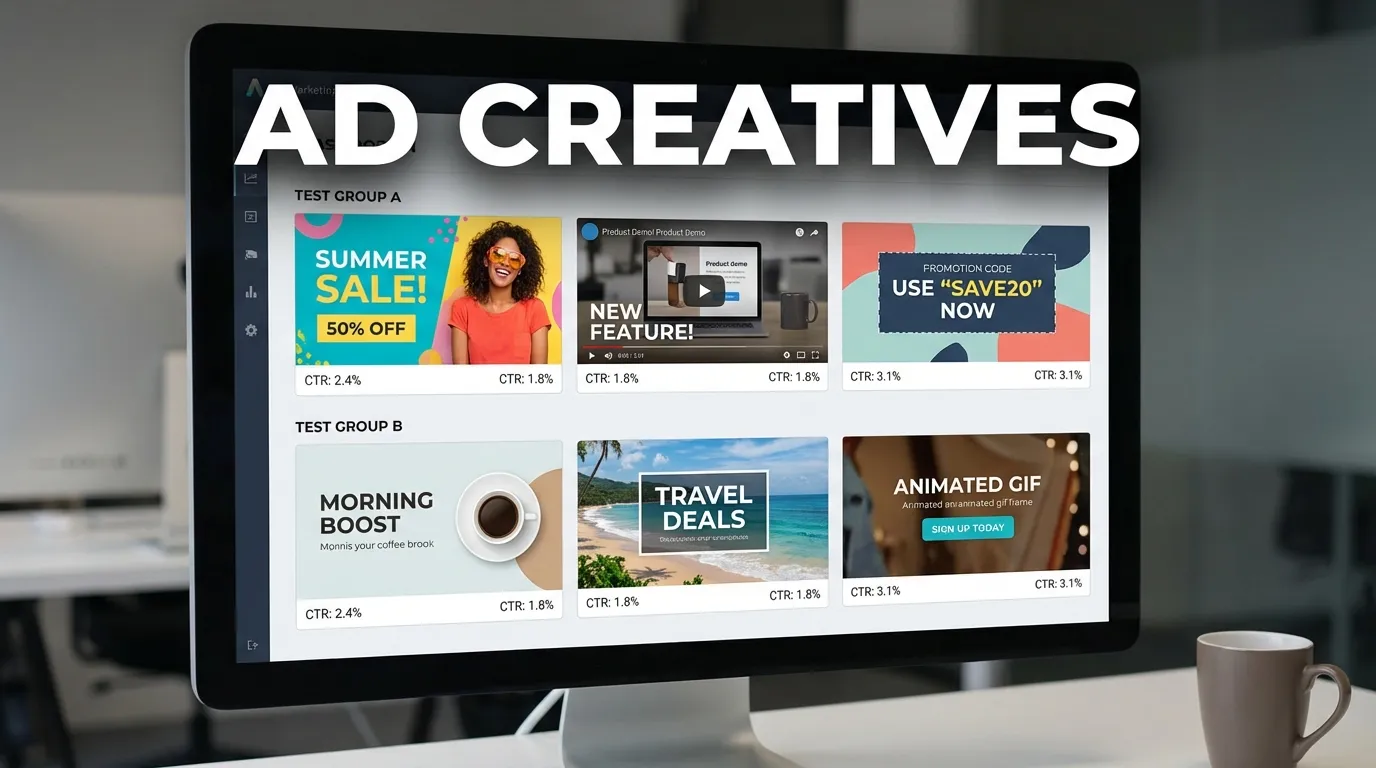
- Version A: Expert endorsement (e.g., "Used by top 5% of CEOs").
- Version B: Social volume (e.g., "Join 50,000 others").
- The Insight: This tells you if your audience is driven more by "Authority" or by "Belonging."
2. High-Intensity vs. Low-Intensity Imagery
- The Move: Test real-world "Lifestyle" photos vs. clean, abstract "Studio" photos.
- The Benefit: Understanding the "Visual Language" that resonates with your brand can lower your ad costs across every social platform.
Phase 5: Multivariate and Bandit Testing (The AI Shift)
Static A/B testing is being replaced by high-velocity algorithmic experimentation.
1. Multivariate Testing (MVT)
This allows you to test multiple variables simultaneously (e.g., Headline A/B x Image A/B).
- The Strategic Value: MVT identifies "Interaction Effects"—how different elements on the page work together. (e.g., Maybe Headline B only works when paired with Image A).
2. Multi-Armed Bandit (MAB) Testing
In 2026, advanced platforms use MAB to optimize while the test is running.
- The Logic: Instead of splitting traffic 50/50 until the end, the system starts shifting more traffic to the "Winning" version as soon as it sees a trend. This minimizes the "Opportunity Cost" of showing the losing version to half your audience for weeks.
Phase 6: Building a Culture of Continuous Experimentation
A/B testing is not a "Project"; it is a Process.
1. The Testing Roadmap (Internal Knowledge Base)
Every test, whether it wins or loses, must be documented in a central "Testing Library."
- Win: Document the lift and the new "Control."
- Loss: Document what you learned about the audience's lack of interest in that specific variable. A loss is just as valuable as a win if it prevents you from making a similar mistake elsewhere.
2. The "Velocity" Metric
Measure how many experiments your team runs per month.
- The Standard: In 2026, a high-growth marketing team should be running at least 1 to 2 significant experiments per week on their core funnels.