
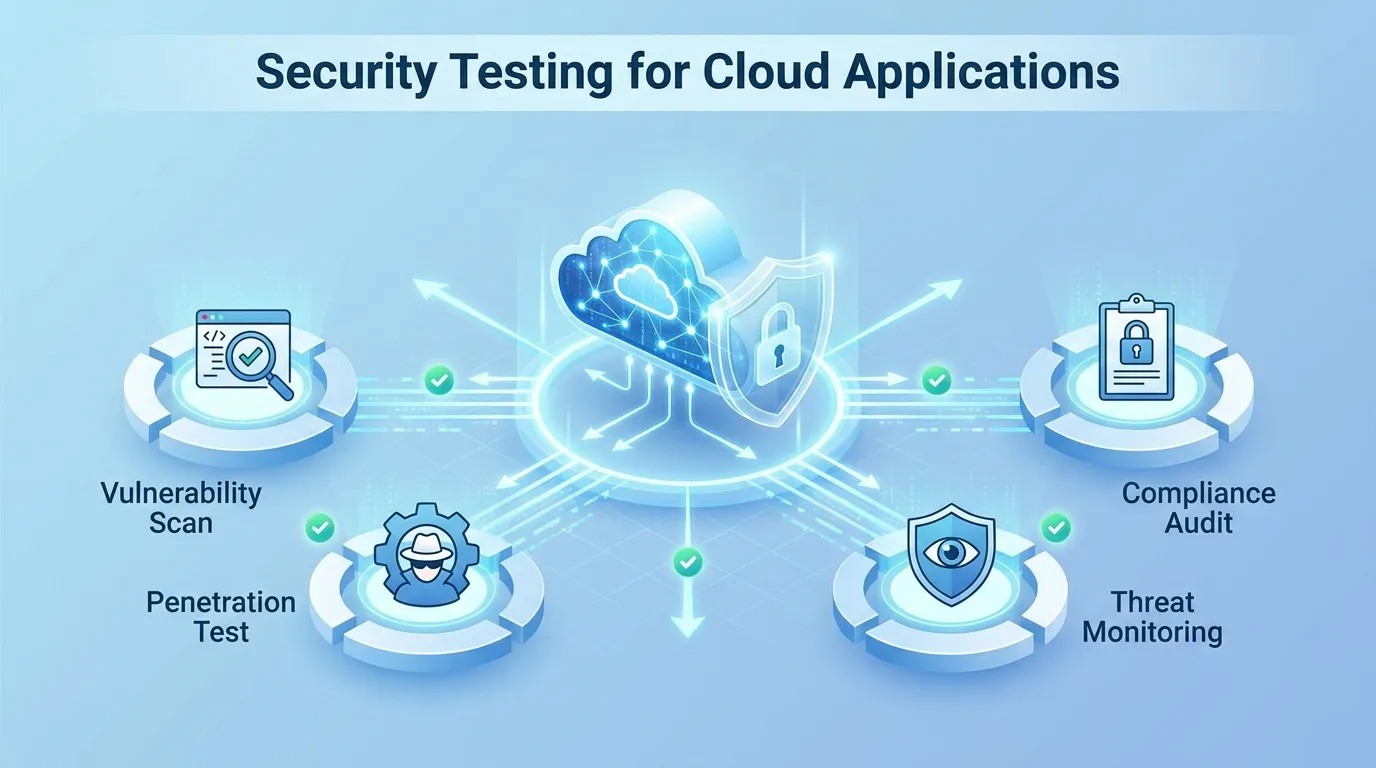
Security Testing for Cloud Applications
A decade ago, application security testing was predominantly an exercise in boundary defense. An organization housed its servers in a physical data center, surrounded them with an expensive hardware firewall, and ran vulnerability scanners against the perimeter. If the outer wall held, the soft, vulnerable applications inside were considered safe. Today, in the era of Kubernetes, serverless functions, and multi-cloud environments, that perimeter has completely vaporized.
The modern cloud application is no longer a single monolithic asset; it is a sprawling, ephemeral web of microservices, third-party APIs, managed databases, and infrastructure configured entirely by code. An attacker rarely needs to break through a firewall anymore; they simply scan GitHub for accidentally committed AWS keys or exploit an overly permissive IAM (Identity and Access Management) role attached to a lambda function. As a result, cloud security testing has evolved into a highly specialized discipline requiring continuous, automated validation across the entire stack. In this 2026 masterguide, we will deconstruct the modern attack surface, explore the convergence of CNAPP tooling, and outline the strategies necessary to test applications natively residing in the cloud.
The Evolution of Cloud Security Boundaries
Why does testing a cloud application differ so radically from testing a legacy on-premise application? The answer lies in the Shared Responsibility Model and the infrastructure layer.
The Shared Responsibility Model
When you deploy an application to AWS, Azure, or GCP, the cloud provider guarantees the security of the cloud (the physical locked doors of the data center, the hypervisor patching). However, you are entirely responsible for security in the cloud. If you misconfigure an S3 bucket to allow public read access, that is not a failure of AWS; it is a failure of your internal security testing.
The Infrastructure is the Application
In a cloud-native world, the line between "code" and "infrastructure" is gone. A developer doesn't submit a ticket to IT to provision a server; they write a Terraform script that spins up a virtual network, configures the routing tables, and provisions the database automatically. Therefore, testing the application logic via SAST (Static Application Security Testing) is useless if the underlying Terraform script deploys a database port that is left wide open to the public internet.
Understanding CNAPP (Cloud-Native Application Protection Platform)
To address this sprawling complexity, the security industry has consolidated around a unified framework known as CNAPP. By 2026, enterprise cloud security testing is heavily centered around this integrated approach, which combines several previously siloed testing methodologies into a single pane of glass.
The Core Components of CNAPP
A true CNAPP solution does not just test one layer; it provides end-to-end visibility. It combines Cloud Security Posture Management (CSPM) for infrastructure validation, Cloud Workload Protection Platforms (CWPP) for runtime execution, and Cloud Infrastructure Entitlement Management (CIEM) for identity and permissions testing.
By unifying these tools, testers gain "Context." If a vulnerability scanner detects a critical flaw in a Docker image, that is bad. But if the CNAPP correlates that image vulnerability with CSPM data revealing that the specific Docker container is exposed to the public internet via a misconfigured load balancer, the alert is instantly escalated from "Medium" to "Critical, Fix Immediately."
CSPM: Validating the Cloud Posture
Cloud Security Posture Management (CSPM) is the bedrock of modern cloud testing. It continuously queries the cloud provider's APIs to test whether the deployed environment matches the organization's strict security baselines (such as CIS benchmarks).
What CSPM Tests
- Storage Configurations: Are databases and object storage buckets (like Azure Blob Storage) strictly private and encrypted at rest?
- Network Boundaries: Do the Virtual Private Cloud (VPC) security groups limit inbound traffic strictly to expected ports (e.g., 443 for HTTPS)?
- Logging and Auditing: Are CloudTrail or Azure Monitor logs enabled, properly retention-policy locked, and immune to tampering by a compromised admin account?
CSPM tools test the environment continuously. If an engineer manually logs into the AWS console at 2:00 AM and temporarily opens a firewall port to troubleshoot a bug, the CSPM tool detects the deviation in seconds, generates an alert, and—if configured correctly—automatically reverts the firewall rule to its safe state.
CWPP: Validating the Runtime Workload
While CSPM tests the "shelves" holding the applications, Cloud Workload Protection Platforms (CWPP) test the applications themselves during runtime execution.
A massive paradigm shift in cloud architecture is the use of containers (Docker) and orchestration (Kubernetes). CWPP tools integrate deeply into these runtimes. When a container spins up, the CWPP actively scrutinizes its memory and process interactions.
- Immutable Testing: Containers should ideally be immutable; once they start, their core code should never change. A critical CWPP test is detecting "File Integrity Alarms." If a malicious actor successfully exploits an application vulnerability and attempts to write a new malicious script to the container's disk, the CWPP instantly terminates the container.
- Network Drift: CWPP tests internal (East-West) network traffic. If
Frontend-Apptraditionally only talks toBackend-API, but suddenly begins attempting to port-scanDatabase-Server, the CWPP flags this as an anomaly indicating a compromised workload.
CIEM: Testing Identity Boundaries
In the cloud, Identity is the new perimeter. The most devastating cloud breaches are rarely caused by SQL injection; they are caused by stolen API keys and overly permissive IAM roles.
Cloud Infrastructure Entitlement Management (CIEM) is a methodology exclusively focused on testing permissions. It analyzes millions of active permissions across a multi-cloud environment to enforce "Least Privilege."
- The "Over-Privileged" Test: A CIEM tool analyzes a Lambda function that was granted full
s3:*access (giving it the right to read, write, and delete any bucket). By monitoring execution logs over 30 days, the CIEM proves the Lambda function only ever reads from one specific bucket. The test fails the security policy, and the CIEM automatically suggests a drastically reduced, highly tailored IAM policy restricting the Lambda strictly tos3:GetObjecton that single bucket.
Infrastructure as Code (IaC) Validation
Finding a misconfigured bucket in production via CSPM is great, but finding it before it is deployed is vastly superior.
Modern cloud security testing pushes validation directly into the Developer's IDE. Engineers write their infrastructure using Terraform, Pulumi, or AWS CloudFormation. Security tools (like Checkov or Terrascan) automatically scan these text files the moment the developer hits "Save." If the .tf file attempts to create an unencrypted database, the test fails locally on the developer's laptop, completely blocking the deployment. This "Shift-Left" approach ensures that bad infrastructure is caught at the code level, drastically reducing the burden on live-production CSPM monitoring.
Top Cloud Security Testing Tools in 2026
The market for cloud security is dominated by massive, consolidated CNAPP platforms capable of digesting multi-cloud complexity.
1. Wiz
Wiz is arguably the dominant force in modern cloud security. Rather than installing heavy, performance-draining agents on every single server, Wiz utilizes an entirely agentless, API-driven approach. It takes instantaneous snapshots of cloud environments, creating a massive visual "Security Graph." This graph allows security teams to query their infrastructure like a database, easily executing complex penetration-testing queries (e.g., "Show me any virtual machine that is connected to the internet, contains a critical vulnerability, AND has read access to an S3 bucket with PII data").
2. Palo Alto Prisma Cloud
Prisma Cloud is one of the most comprehensive enterprise CNAPP solutions, handling everything from early-stage IaC scanning in GitHub to deep runtime execution monitoring within Kubernetes nodes. It excels in highly complex hybrid environments, allowing organizations to apply unified security testing policies equally across AWS, GCP, Azure, and legacy on-premise hardware simultaneously.
3. Aqua Security
For organizations deeply invested in Docker and Kubernetes, Aqua provides intense, specialized workload protection. It focuses heavily on software supply chain security, actively scanning base images for hidden malware or exposed secrets before they are allowed into the container registry, and employing strict runtime enforcement policies to prevent container breakouts.
Step-by-Step: Securing a Multi-Cloud Deployment
To effectively test a modern cloud deployment, organizations should follow a unified CNAPP testing lifecycle.
Step 1: Pre-Commit (IaC Scanning)
The developer writes a Terraform script to deploy a new AWS RDS database. Before the code can be merged into the main Git branch, an automated Checkov test runs. It verifies that storage_encrypted = true and publicly_accessible = false. If either is incorrect, the commit is blocked.
Step 2: Build (Container Scanning)
The application code is compiled into a Docker container. Before that container is pushed to Amazon ECR (Elastic Container Registry), a tool like Trivy scans the container's base operating system. It ensures that the current version of the OpenSSL library does not contain any known, unpatched vulnerabilities (CVEs).
Step 3: Deployment (CSPM Baseline)
The container is deployed to production. Instantly, the CSPM platform queries the AWS API to verify the deployment. It tests the attached Security Group to ensure no unexpected ports were opened during the deployment process.
Step 4: Runtime (CWPP and CIEM)
The application goes live. The CWPP agent monitors the Kubernetes pod, ensuring the application doesn't execute unexpected shell commands. Simultaneously, the CIEM monitors the application's IAM role, ensuring it doesn't attempt to assume unauthorized privileges to read sensitive adjacent AWS accounts.
Summary
In summary, protecting a cloud environment requires abandoning the concept of a single perimeter firewall and embracing continuous, multi-layered validation:
- Acknowledge the Shared Model: Understand that your cloud provider secures the hardware, but testing the configuration is explicitly your responsibility.
- Unify with CNAPP: Consolidate disparate tools into a single platform that correlates infrastructure risks (CSPM) with workload risks (CWPP).
- Test Identity Fiercely: Use CIEM to aggressively test and trim down IAM roles, enforcing strict Least Privilege.
- Shift Left with IaC: Do not wait for production to find a misconfigured bucket. Test the Terraform scripts directly in the developer's IDE.
- Monitor Runtime Context: Use tools like Wiz to understand the true "Blast Radius" of a vulnerability by mapping its proximity to public internet exposure and sensitive data.
Conclusion
The flexibility and speed that make the cloud so powerful are the exact same traits that make it so dangerous. You can deploy a global infrastructure in three seconds; you can also deploy a catastrophic security flaw in three seconds. Traditional point-in-time penetration testing is insufficient for environments that mutate hourly. By abandoning siloed testing tools and embracing the consolidated, continuous, and context-aware capabilities of modern cloud security testing platforms, organizations can confidently harness the speed of the cloud without exposing their most critical assets to the open internet.
FAQs
1. Is cloud security testing just running traditional SAST/DAST tools in AWS? No. SAST/DAST test the application logic (e.g., finding a SQL injection in your Python code). Cloud security testing primarily tests the infrastructure (e.g., ensuring the Python code isn't running on an unpatched Docker image residing on a publicly accessible Kubernetes node).
2. What is a "Zero-Day" vulnerability, and can CNAPP stop it? A Zero-Day is a vulnerability unknown to the software vendor. While a CNAPP cannot usually detect the vulnerability itself (since it has no CVE signature yet), a strong CWPP layer can stop it by detecting the anomalous runtime behavior (like the application suddenly trying to download unknown code) when the attacker tries to exploit the Zero-Day.
3. Why is agentless testing becoming so popular? Traditional testing requires installing a software "agent" on every single virtual machine. This takes massive amounts of IT effort and degrades server performance. Agentless testing (used by platforms like Wiz) queries the cloud provider's API directly and takes external snapshots of the server's hard drive, allowing 100% visibility without installing any software on the server itself.
4. How does "Shift-Left" affect cloud security? It moves the testing from the "Security Operations" team directly to the "Developers." Instead of the security team finding a misconfigured AWS bucket in production, the developer gets an error message in their IDE telling them their Terraform script is insecure before they even submit the code.
5. What is the difference between CSPM and CIEM? CSPM tests the physical/logical configurations (e.g., "Is this server's hard drive encrypted?"). CIEM tests the identities and permissions (e.g., "Does the service account running on this server have the right to delete the database?").
6. Can we use the cloud provider's native security tools instead of buying a CNAPP? AWS (Security Hub), Azure (Defender for Cloud), and GCP (Security Command Center) offer excellent native tools. However, they only secure their specific cloud. If your company uses AWS for databases and Azure for active directory, you need a third-party CNAPP to provide a unified testing pane across the multi-cloud environment.
7. How frequent should cloud security testing be? Continuous. Because infrastructure is code, the environment can change massively with a single Git commit. CSPM tools generally scan the environment API every few minutes to detect configuration drift instantly.