
Introduction
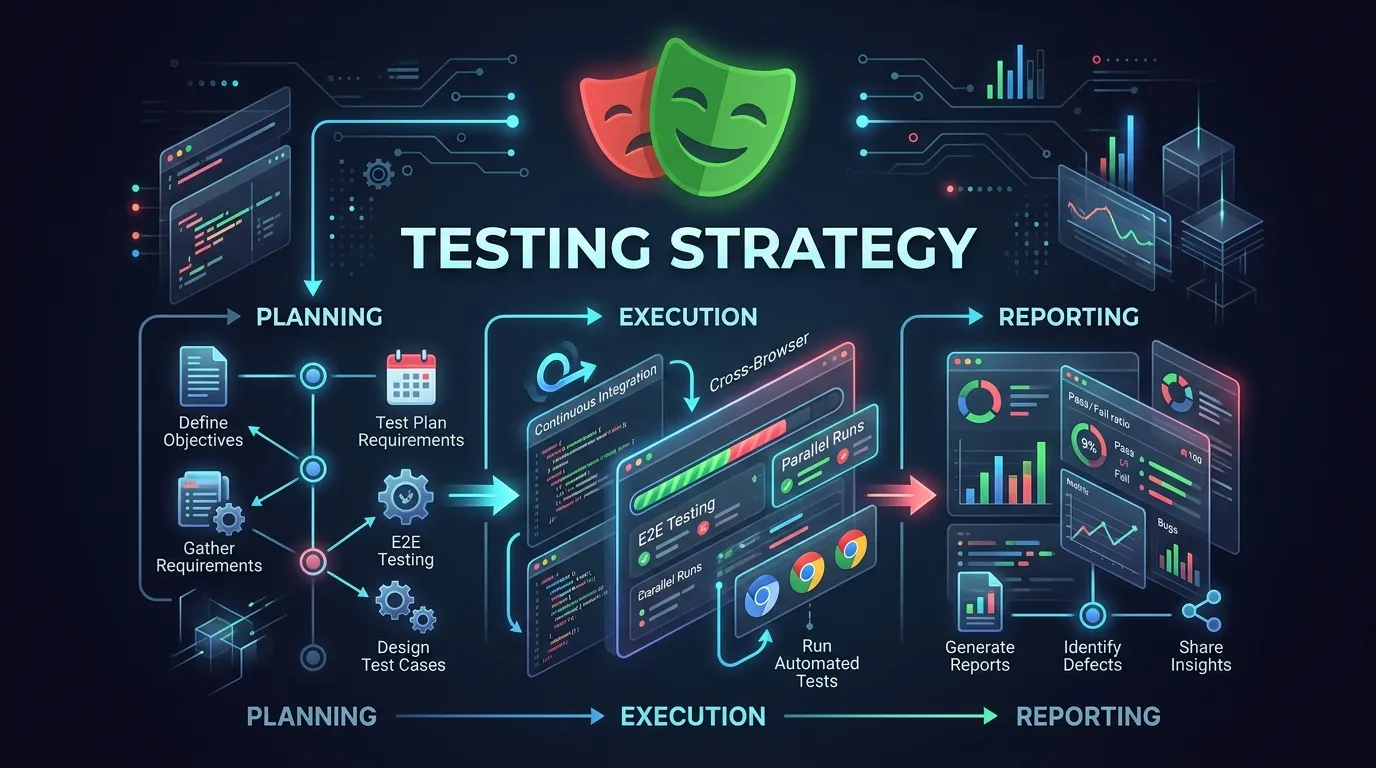
Writing a few test scripts is easy, but building a professional testing strategy that can support a large-scale project is a strategic challenge. A testing strategy is more than just code; it's a structural approach to identifying risks, choosing the right tools, and providing consistent, actionable feedback on the health of your application.
As organizations scale their testing in 2026, a poorly architected strategy will quickly become a liability—expensive to maintain and prone to flakiness. In this guide, we'll provide a comprehensive framework for building a world-class testing strategy using Playwright.
1. The Playwright Testing Pyramid
A successful testing strategy starts with the Testing Pyramid. The idea is to have a large base of fast, inexpensive tests and a small top of slow, comprehensive tests.
- Unit Tests: Test individual functions or components (e.g., a date formatter or a button component).
- Integration Tests: Test how different parts of your system work together (e.g., an API call and its response handling).
- Playwright E2E Tests: Test the full user journey from start to finish. These are the most expensive but provide the highest level of confidence.
2. Defining Your Critical Paths
Not every feature needs an automated test. The key to a successful strategy is Prioritization.
- Identify Risks: Which features, if broken, would cause the most damage to the business or the user?
- User Personas: Think about your typical users. What are their most frequent and most important journeys (e.g., Login, Search, Checkout)?
- Prioritize Coverage: Ensure these "Critical Paths" have 100% coverage in your Playwright suite.
3. Structural Strategy: Page Object Model (POM)
In a large project, maintainability is your biggest challenge. A professional testing strategy must be built on the Page Object Model.
- Organization: Group locators and actions by page or component.
- Reusability: Use the same Page Object methods across multiple tests to keep your code DRY (Don't Repeat Yourself).
- Single Source of Truth: When a locator changes, you only update it in one place.
4. State Management with Global Setup
Efficiency is key to a fast feedback loop. If every test spends 10 seconds logging in, you're wasting thousands of hours of CI time.
- State Warm-up: Use Playwright's Global Setup to perform expensive operations once for the entire suite.
- Storage State: Save authentication tokens and cookies and reuse them across all tests to bypass the login page.
5. Continuous Testing and CI/CD Visibility
Testing is only valuable if the results are seen and acted upon.
- Pipeline Integration: Run your full suite on every Pull Request.
- Reporting Trends: Use tools like Allure or ReportPortal to visualize your suite's pass rate and execution time over months of development.
- Actionable Artifacts: Ensure your CI system automatically stores Traces and Videos for every failed test.
6. Managing Flakiness Through Retries and Isolation
Flakiness is the ultimate enemy of any testing strategy.
- Test Isolation: Every test must start with a fresh context or clean session.
- Automatic Retries: Enable a small number of retries (e.g., 2) for failed tests in CI to handle environmental blips.
- Quarantine Flaky Tests: Identify and remove flaky tests from the main pipeline until they can be properly debugged.
Conclusion
A Playwright testing strategy is a strategic investment in the future of your application. By focusing on prioritization, structural maintainability, and CI/CD integration, you build a system that can handle growth without breaking under its own weight. In 2026, where the speed of deployment is everything, a robust testing strategy is your most powerful tool for maintaining quality at scale.
Frequently Asked Questions
Both are essential. Unit tests are faster and cheaper to find small bugs, while E2E tests provide the ultimate verification that the whole system works together.


