
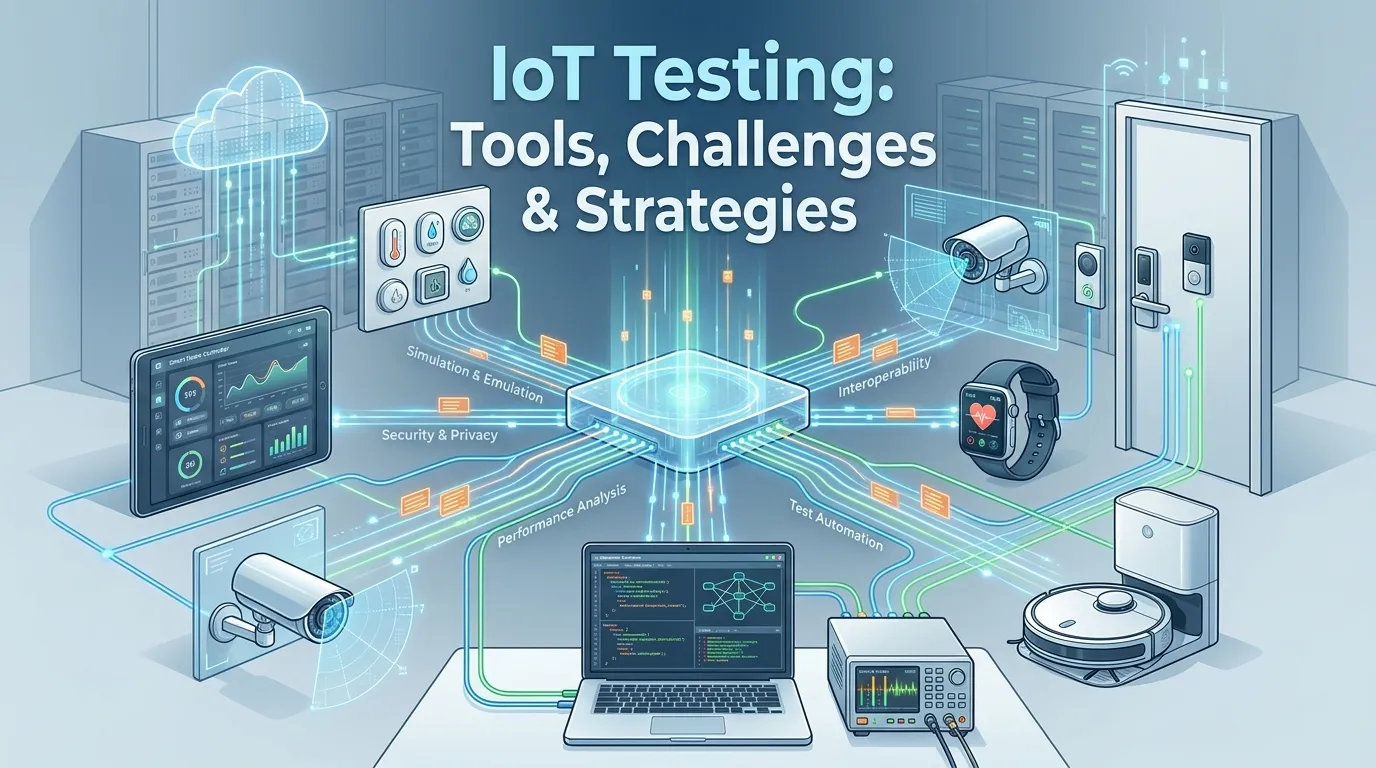
IoT Testing: Tools, Challenges & Strategies
By 2026, the Internet of Things (IoT) has expanded far beyond smart thermostats and fitness trackers. It encompasses massive industrial sensor networks, autonomous agricultural drone fleets, automated smart-city grids, and highly sensitive biometric healthcare monitors. As these devices integrate deeper into critical physical infrastructure, a software failure is no longer just an inconvenience on a screen—it can cause a factory shutdown, a grid blackout, or a medical emergency.
Ensuring the reliability of these systems requires navigating an incredibly complex intersection of physical hardware, volatile networks, edge computing logic, and cloud data aggregation. Traditional software testing methodologies are simply inadequate for this multidimensional environments. In this comprehensive guide, we will analyze the unique friction points of IoT testing, explore the essential IoT testing tools used by modern engineering teams, and detail the strategies required to validate systems from the extreme edge to the central cloud.
The Massive Scale of IoT Testing Challenges
Testing a web application usually involves three layers: the browser, the server, and the database. Testing an IoT ecosystem introduces explosive complexity across physical and digital boundaries.
Hardware and Environmental Unpredictability
Unlike a server sitting in a climate-controlled data center, IoT devices exist in chaotic physical environments. A sensor on an oil rig might face extreme temperatures, corrosive salt, and highly intermittent 5G or satellite connectivity. You cannot simply test the device's firmware in a perfect laboratory setting and assume it will function correctly when its physical memory is freezing or its battery is dying due to poor signal hunting.
Protocol Fragmentation
Web applications speak a highly standardized language (HTTP/HTTPS). IoT devices, however, are deeply fragmented. They communicate using dozens of specialized, low-bandwidth protocols like MQTT, CoAP, Zigbee, LoRaWAN, and Thread. Testing requires ensuring that a Zigbee sensor can seamlessly transmit data to a gateway, which accurately translates that payload into MQTT to be digested by an AWS cloud backend, without introducing latency or dropping crucial telemetry packets.
The Security Nightmare at the Edge
IoT devices are notoriously vulnerable. They often run light operating systems with minimal security overhead, relying on default passwords or unpatched legacy firmware. In 2026, automated botnets constantly scan the internet looking for unprotected IoT devices to hijack. Security testing cannot be an afterthought; penetrating testing, fuzzing the communication protocols, and ensuring strict Zero Trust identity certificates on every single device is mandatory for survival.
Hardware Simulation vs. Field Testing
How do you run an automated CI/CD pipeline when your code needs to be tested on 10,000 physical tractors scattered across the Midwest? You must combine high-scale simulation with targeted physical validation.
Digital Twins and Simulation Platforms (IoTIFY)
To test scalability and cloud integration, engineers rely on simulation platforms like IoTIFY or Bevywise. These IoT testing tools create highly accurate "Digital Twins"—virtual replicas of the physical devices. If an agriculture company wants to test an update to its cloud dashboard, it doesn't need to drive 10,000 physical tractors into a field. IoTIFY can simulate 10,000 virtual node endpoints, all simultaneously generating realistic, telemetry payloads (like GPS coordinates and engine temperature spikes) over MQTT. This allows the team to brutally load-test the cloud backend without requiring a single piece of physical hardware.
Physical Field Testing (The "Faraday Cage")
Physical Field Testing (The "Faraday Cage")
However, simulators cannot detect hardware faults or actual radio interference. Ultimately, the firmware must be tested on the physical device. QA teams utilize Faraday cages to isolate the device's radio frequencies, intentionally injecting electromagnetic noise or dropping the Wi-Fi signal to test the device's "Offline Mode." Does the device correctly cache its telemetry data locally while offline, and seamlessly batch-upload it when the connection is restored, without corrupting the timeline timestamps?
Testing the Complete Device Lifecycle
Testing an IoT deployment is not just about observing the device while it is running; it requires validating the hardware throughout its entire physical and logical lifecycle.
Phase 1: Zero-Touch Provisioning (ZTP)
The first critical test is the "Onboarding" or provisioning phase. In massive industrial rollouts, engineers cannot manually configure passwords on 10,000 sensors. ZTP allows a device to power on, securely reach out to a provisioning server, prove its cryptographic identity, and automatically download its specific configuration profile. Testing this requires simulating rogue devices attempting to hijack the provisioning sequence, ensuring the server only distributes configurations to mathematically verified hardware.
Phase 2: Steady-State and Degradation
During the active lifecycle, tests focus on "Steady-State" performance and graceful degradation. An IoT device must be tested for resource exhaustion over time. For example, if a camera is supposed to record local video for 30 days before overwriting, the test must validate that the memory management correctly prunes the oldest files rather than crashing the operating system when the storage drive hits 100% capacity. This phase also includes rigorous battery profiling—verifying that the device correctly falls back to low-power "sleep" modes when idle.
Phase 3: Secure Decommissioning
The often-forgotten final phase is decommissioning. When an IoT device is removed from service, returned for maintenance, or sold, it must securely wipe all local data and cryptographic keys. Penetration testers often attempt to physically extract flash storage from decommissioned test devices to ensure the automated wipe mechanism successfully rendered all sensitive data irrecoverable.
Edge Computing: Validating Local Logic
In the early days of IoT, devices were "dumb" sensors that sent raw data to the cloud for processing. Today, due to bandwidth costs and latency constraints, processing has moved to the "Edge."
Testing the Smart Gateway
A modern IoT gateway might receive thousands of data points per second from localized sensors. It must filter the noise, aggregate the data, run an internal machine learning model, and only send critical alerts to the central cloud. Testing this Edge Logic is highly complex. If a robotic arm detects a physical obstruction, the Edge controller must issue a "Halt" command in 5 milliseconds. If it waits 200 milliseconds for a cloud server in Virginia to process the command, the robot will crash.
Testing the Edge requires specialized performance profiling to ensure the local CPU and memory of the gateway device are not exhausted by the local processing algorithms. Tools like MATLAB and sophisticated Python frameworks are often deployed locally onto the test gateways to calculate exactly how fast the Edge decision-making loop is firing under maximal sensor input.
Security Vulnerabilities at the Edge
A compromised web server might leak data; a compromised IoT medical device is a physical threat to life.
Protocol Fuzzing and Penetration Testing
Security testing involves aggressively attacking the communication layers. Engineers use tools like Wireshark to capture packets and ensure sensitive data is not being transmitted in plain text. They utilize Fuzzers against MQTT brokers, sending malformed payloads to see if they can trigger a buffer overflow in the device's firmware and execute remote code.
Over-The-Air (OTA) Update Validation
The most dangerous moment in an IoT device's lifecycle is the OTA firmware update. Testing this mechanism is paramount. What happens if the device's battery dies exactly halfway through an OTA download? Does it "brick" the device permanently, or does it correctly roll back to the previous stable firmware partition? Automated hardware-in-the-loop (HIL) tests forcefully cut power during simulated updates to guarantee fail-safe rollback mechanisms.
Step-by-Step: End-to-End Edge-to-Cloud Validation
To conquer the complexity of IoT, organizations must implement a layered testing strategy.
Step 1: Unit and API Testing
Test the cloud endpoints in isolation. Use standard API validation tools (like Postman or Rest-Assured) to ensure the cloud backend correctly processes generic JSON payloads, completely independently of the hardware.
Step 2: Protocol Validation
Wrap those JSON payloads in actual IoT protocols. Use a tool like MQTT.fx to manually publish messages to the cloud broker. Verify that the cloud correctly authenticates the MQTT client and routes the data to the correct storage buckets.
Step 3: Massive Virtual Simulation
Utilize a simulator (like IoTIFY) to spin up 50,000 virtual devices. Run sustained load tests to ensure the cloud provider's ingress points (e.g., AWS IoT Core) don't throttle or drop massive telemetry dumps during a "stampede" event (where all offline devices suddenly reconnect simultaneously).
Step 4: Hardware-in-the-Loop (HIL) Testing
Connect a handful of real, physical devices to an automated test rig. Use physical actuators (robotic fingers pressing buttons, variable power supplies simulating battery drain) combined with scripts to validate that the physical hardware behaves correctly under physical duress and seamlessly integrates with the cloud backend.
Step 5: The Field Trial
Deploy 100 devices into the real-world operational environment. Monitor them via Observability tools (like Datadog) for four weeks to catch the bizarre edge cases—like condensation affecting the sensor accuracy or local Wi-Fi interference—that simulators simply cannot replicate.
Summary
IoT testing is not a single discipline; it is an orchestrated campaign across hardware, network, and cloud.
- Acknowledge The Environment: Real-world testing requires handling chaotic networks, offline states, and battery-drain scenarios.
- Use Digital Twins: Leverage scale simulators to crush the cloud backend without amassing a warehouse of physical hardware.
- Validate the Edge: Ensure local gateways can process logic quickly without relying on distant, high-latency cloud servers.
- Harden Security Continuously: Execute strict penetration tests on MQTT brokers and forcefully test OTA rollback capabilities.
- Unify the Toolchain: Combine physical Faraday testing with virtual simulators for comprehensive End-to-End coverage.
Conclusion
The Internet of Things promises a world of unprecedented automation and insight, but the bridge between digital architecture and physical reality is incredibly fragile. A failure in an IoT deployment is rarely isolated; it cascades across networks, disrupts physical operations, and deeply compromises security. By adopting a rigorous, multi-layered approach to testing—blending extreme virtual scalability with brutal physical hardware validation—engineering teams can ensure their IoT testing tools and strategies are robust enough to secure the sprawling, connected, and critical environments of 2026.
FAQs
1. Can we just use Selenium or Appium to test IoT devices? Generally, no. Selenium tests web browsers, and Appium tests mobile UI apps. While you can use them to test the Consumer App that controls the IoT device, they cannot test the device's firmware, the C++ Edge logic, or the MQTT protocol transmission itself.
2. What is Zero Trust in IoT? Zero Trust means the network never inherently trusts a device just because it connected. Testing Zero Trust involves verifying that every single device uses a unique, hardware-backed cryptographic certificate (like a TPM chip) to authenticate every single message it sends.
3. Why do we need custom protocols like MQTT? Why not just use HTTP? HTTP is "heavy" and requires constant, open connections. MQTT is incredibly lightweight with tiny headers, making it perfect for battery-powered sensors transmitting tiny packets of data over highly unreliable, slow cell networks.
4. How do we test an IoT system if the physical sensors aren't manufactured yet? By using API Contracts and Digital Twins. Software teams define the exact JSON payload the sensor will emit, and then use tools like IoTIFY to generate simulated data, allowing backend cloud development to proceed months before the factory delivers the hardware.
5. What is the most common cause of IoT failures in production? The "Reconnection Panic" or "Stampede." If a cellular tower goes offline, 10,000 devices lose signal. When the tower comes back, all 10,000 devices try to dump their cached, offline data to the cloud at the exact same millisecond, instantly overloading the cloud ingress and crashing the system. Load testing must specifically simulate this event.
6. Do we need specialized SDETs for IoT? Yes. Traditional software testers often lack the electrical engineering or firmware knowledge required to debug C++ code, analyze radio frequencies, or wire up Hardware-in-the-Loop test rigs using Raspberry Pis and oscilloscopes.
7. How do cloud providers like AWS or Azure help with testing? Both providers offer "Device Shadows"—a cloud-based representation of the device's last known state. This makes testing easier because you can test the cloud logic against the "Shadow" database instantly, even if the physical device is currently asleep to save battery.


