
Introduction
Modern software applications are becoming more complex and dynamic. With frequent updates, rapid deployments, and continuous integration pipelines, testing applications manually is no longer enough. This is why automation testing has become an essential part of modern software development.
Among the many automation testing tools available today, Selenium is one of the most widely used frameworks for web application testing. However, writing automation scripts alone is not enough. Testers also need a powerful testing framework to organize test cases, manage test execution, and generate reports.
This is where TestNG comes in.
TestNG is a popular testing framework used with Selenium to make automation testing more structured and efficient. It provides features such as test annotations, parallel execution, test grouping, and detailed reporting.
In this TestNG Selenium tutorial, you will learn:
- What TestNG is and why it is used with Selenium
- Key features of TestNG for automation testing
- How TestNG works with Selenium WebDriver
- Step-by-step instructions for integrating TestNG with Selenium
- Real-world examples of TestNG Selenium test scripts
- Best practices for building scalable automation frameworks
Whether you are a beginner learning Selenium automation or an experienced tester building robust frameworks, this guide will help you understand how to use TestNG with Selenium effectively.
What is TestNG?
TestNG is a testing framework inspired by JUnit and NUnit but designed to provide more advanced testing capabilities.
The name TestNG stands for Test Next Generation.
It is widely used in Selenium automation frameworks to manage test execution and improve testing efficiency.
Why Use TestNG with Selenium?
While Selenium automates browser actions, TestNG helps organize and manage test cases.
TestNG provides features such as:
- test annotations
- parallel test execution
- test grouping
- dependency management
- detailed test reports
These features make Selenium test automation more powerful and maintainable.
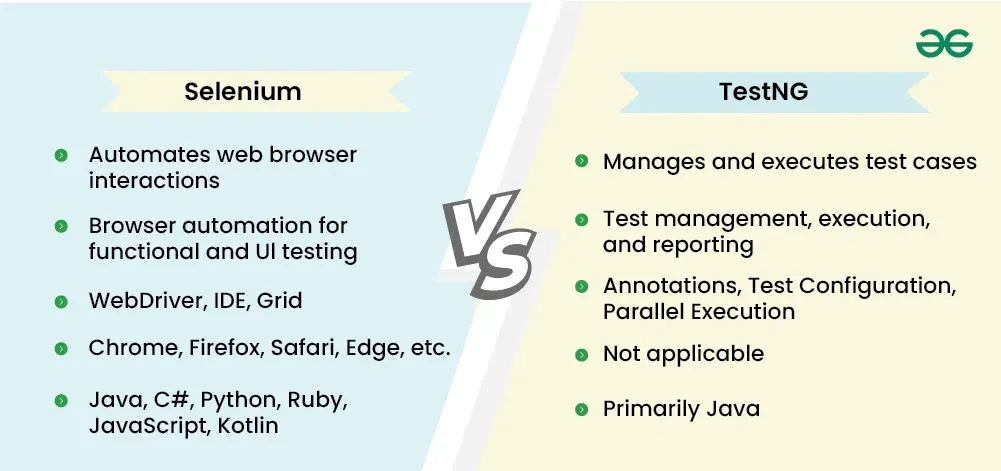
Selenium vs TestNG Understanding Their Roles
Many beginners confuse Selenium and TestNG, but they serve different purposes.
| Feature | Selenium | TestNG |
|---|---|---|
| Purpose | Browser automation | Test execution framework |
| Language Support | Multiple languages | Primarily Java |
| Reporting | Limited | Detailed reports |
| Test Management | Basic | Advanced |
Selenium performs automation tasks, while TestNG manages test execution.
Writing Your First TestNG Selenium Test
After setup, you can create your first TestNG Selenium test script.
Example Selenium TestNG script:
import org.openqa.selenium.WebDriver;
import org.openqa.selenium.chrome.ChromeDriver;
import org.testng.annotations.Test;

public class LoginTest {

@Test
public void openWebsite() {

WebDriver driver = new ChromeDriver();
driver.get("https://example.com");

}
}
This script launches a browser and opens a website.
Running Selenium Tests Using TestNG
After writing test scripts, TestNG allows easy execution.
Steps to run tests:
- Right-click the TestNG class
- Select Run As TestNG Test
- View results in the TestNG report
TestNG automatically generates test execution reports.
Real World Example of TestNG Selenium Automation
Consider testing an e-commerce website login feature.
Test scenarios may include:
- valid login
- invalid password
- empty username
Using TestNG, testers can organize these scenarios into test groups and execute them automatically.
This improves testing efficiency and coverage.
Best Practices for TestNG Selenium Automation
To build effective automation frameworks, follow these best practices.
Use Page Object Model
Page Object Model improves code maintainability.
Separate Test Data
Store test data separately for better management.
Use Data Providers
Data driven testing improves test coverage.
Maintain Test Reports
Regularly analyze reports to identify test failures.
Conclusion
Automation testing plays a crucial role in modern software development. Selenium provides powerful browser automation capabilities, but managing test execution requires a structured framework.
TestNG enhances Selenium automation by providing annotations, parallel execution, data driven testing, and detailed reporting features.
By learning how to use TestNG with Selenium, testers can build scalable automation frameworks that improve test efficiency and maintainability.
As organizations continue adopting DevOps and continuous testing practices, mastering Selenium and TestNG together will remain an essential skill for automation testers.


