
Introduction
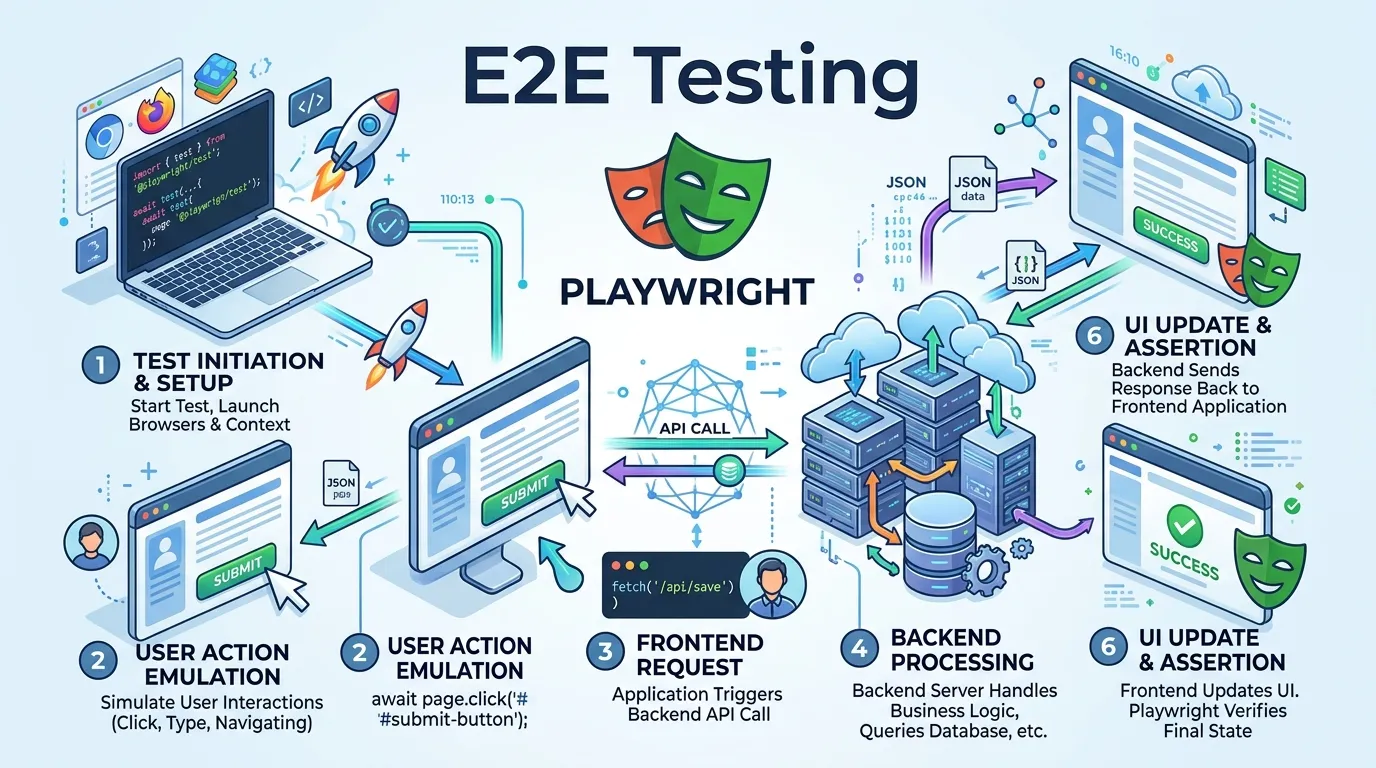
In the world of software development, End-to-End (E2E) testing is the ultimate safety net. While unit and integration tests ensure that individual "bricks" of your application are working correctly, E2E testing ensures that the entire "building" doesn't collapse when a user walks through the front door. It simulates real user behavior, from logging in to completing a purchase, across various browsers and devices.
Playwright has emerged as the premier choice for E2E testing in 2026, offering unprecedented speed and reliability. In this guide, we'll explore why Playwright is the gold standard for E2E and how you can build a robust testing suite from scratch.
What is End-to-End Testing?
E2E testing is a methodology used to test whether the flow of an application is performing as designed from start to finish. The purpose of E2E testing is to identify system dependencies and ensure that data integrity is maintained between various system components and systems.
The Problem it Solves:
- System Integration: Ensures the frontend and backend are communicating correctly.
- Third-Party Dependencies: Validates that external payment processors, maps, or auth providers are working.
- Visual Confidence: Verifies that the UI is usable and not obscured by broken CSS or unhandled JavaScript errors.
Core Pillars of a Playwright E2E Suite
Building a great suite in Playwright relies on four key pillars:
1. Unified API across Browsers
Playwright's biggest strength is its ability to run the exact same test against Chromium, Firefox, and WebKit without any changes to your code. This ensures true cross-browser confidence.
2. Built-in Auto-Waiting
The #1 cause of flaky E2E tests is the browser moving faster than the content. Playwright's auto-waiting logic ensures that elements are visible and ready before your test interacts with them.
3. Parallel Execution
By default, Playwright runs tests in parallel. This is crucial for large E2E suites that could otherwise take hours to complete. Using multiple workers, you can get feedback in minutes instead of hours.
4. Headless and Headed Flexibility
Run tests Headless in your CI pipeline for maximum speed, and switch to Headed mode locally when you need to see exactly why a complex flow is failing.
Designing Your First E2E Test
A good E2E test should focus on a "critical path"—a flow that, if broken, would cause significant loss to the user or business.
Scenario: User completes a purchase
- Step 1: User navigates to the store.
- Step 2: User searches for "Playwright T-Shirt."
- Step 3: User adds the item to the cart.
- Step 4: User completes the checkout.
- Step 5: User sees the order ID on the confirmation page.
test('Should allow a user to complete a full purchase flow', async ({ page }) => {
  await page.goto('/shop');
  await page.getByPlaceholder('Search').fill('Playwright T-Shirt');
  await page.press('Enter');
  await page.click('text="Add to Cart"');
  await page.click('#cart-icon');
  await page.click('text="Checkout"');
  // ... fill payment details ...
  await expect(page.locator('.order-success')).toContainText('Order ID:');
});
Best Practices for Maintainable E2E Tests
- Keep Tests Atomic: Each test should verify one specific behavior. If a test fails, you should know exactly why.
- Use Page Objects: Don't repeat element locators. Store them in Page Object Model (POM) classes.
- Handle Errors Gracefully: Use Playwright's built-in assertions like
toBeVisible()which have built-in retry logic. - Clean Your Environment: Ensure your test database is reset or uses unique data for every run to avoid collisions.
E2E in the Modern DevOps Pipeline
E2E tests are most valuable when integrated into your CI/CD pipeline. In 2026, it's standard practice to run the full E2E suite on every Pull Request.
GitHub Actions Integration Example:
- name: Run Playwright Tests
  run: npx playwright test
- uses: actions/upload-artifact@v4
  if: always()
  with:
    name: playwright-report
    path: playwright-report/
This setup ensures that no broken code ever makes it to your production server.
Conclusion
End-to-End testing with Playwright provides a level of confidence that is simply impossible to achieve with manual testing alone. By automating your most critical user journeys, you allow your team to move faster, release more frequently, and deliver a more reliable product to your customers. E2E is not just a "testing task"—it's a fundamental part of the modern development lifecycle.
Frequently Asked Questions
Compared to unit tests, yes. But Playwright's parallel execution and fast browser engines make them the fastest E2E tests in the industry.


