
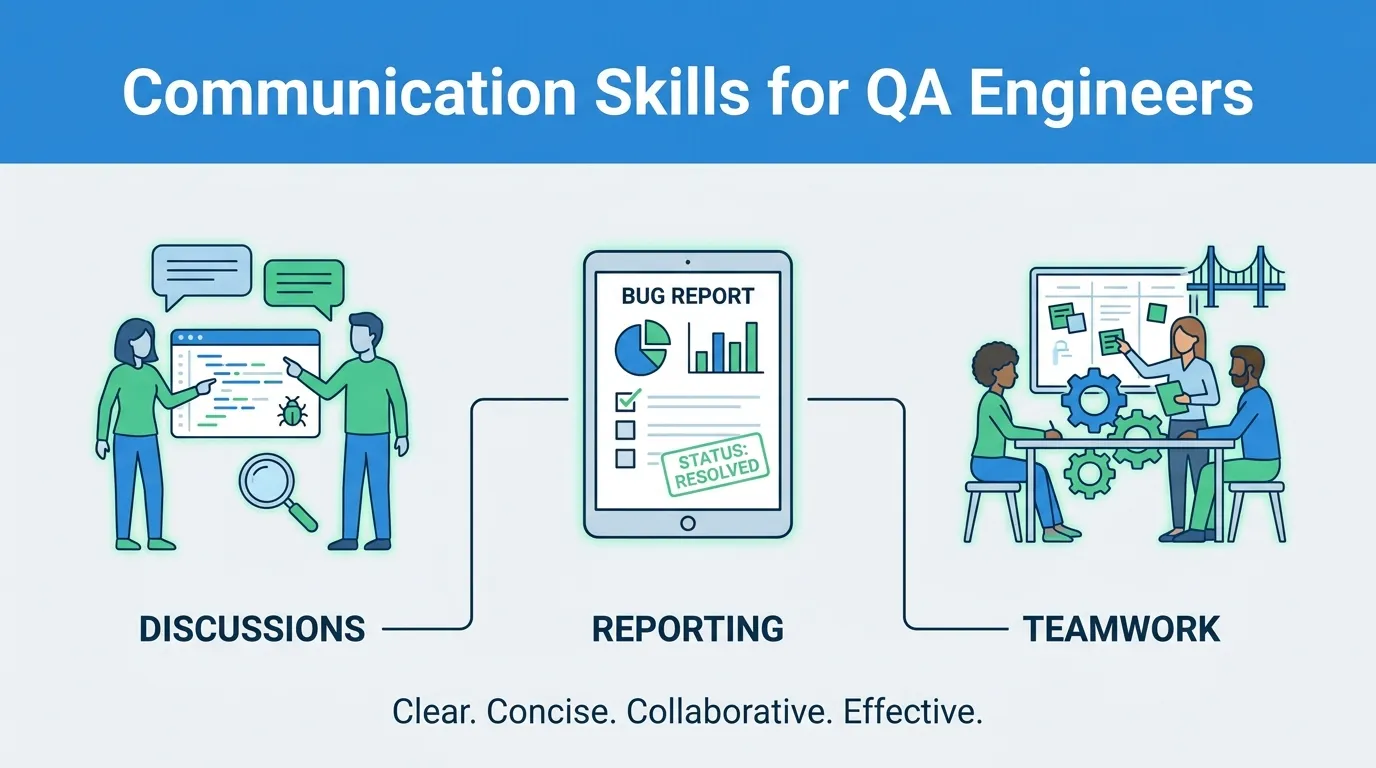
Communication Skills for QA Engineers: The Art of Technical Influence (2026)
In the high-tech landscape of 2026, a Quality Assurance (QA) engineer’s technical stack is only half of the equation. As the "Guardians of Quality," QA professionals occupy a unique, cross-functional intersection between Product, Engineering, and the End-User. No matter how many complex automation frameworks you build or how many security vulnerabilities you find, if you cannot communicate those risks effectively to stakeholders, your technical impact will be muted.
In an era of remote-first teams and AI-augmented coding, communication skills for QA engineers have transitioned from a "soft skill" to a core technical competency. This guide explores how to master the art of technical storytelling, persuasion, and conflict resolution in a fast-paced enterprise environment.
1. The Strategy: Communication as a Bridge
QA engineers are frequently the bearers of "Bad News." How that news is delivered determines whether the team pivots or simply ignores the warning.
1. The "Risk vs. Bug" Shift
Instead of saying, "We found 15 bugs," communicate the Operational Risk.
- The Narrative: "The current build has a high probability of data loss in the European region due to latencies in the New-Tax-Service. Shipping now puts 25% of our revenue at risk."
- The Outcome: This translates technical failures into business consequences that Product Owners and Executives can act upon.
2. Tailoring the Message to the Audience
- To Developers: Be precise, data-dense, and objective. Provide logs, traces, and code-level hypotheses.
- To Product Owners: Be high-level, focused on user impact, and provide clear trade-offs (e.g., "Fix this bug now or risk a 12% drop in conversion").
- To Executives: Focus on timeframe, revenue, and "Release Readiness" metrics.
2. Mastery of Technical Writing
In 2026, your "Writing" is often your primary interface with the team.
1. The "Self-Documenting" Bug Report
As explored in Title 81, a perfect bug report removes the need for a follow-up meeting.
- Structure: Title, Reproducibility State, Data Traces, Expected vs. Actual, and Business Impact.
- The Goal: The developer should be able to identify the fix solely by reading your report.
2. High-Impact Slack/Teams Communication
In a world of constant noise, brevity is power.
- The Pattern: Use clear headers, bullet points, and "TL;DR" summaries at the top of long messages.
- Example: "[URGENT] P0 Regression on Main Branch - Auth Service Failing for Guest Users. Investigation in thread ↓."
3. Managing Conflict and "No-Go" Decisions
QA is often the voice that says, "We aren't ready to ship." This is the peak of communication difficulty.
1. The "Data-First" Rejection
When a developer says, "It’s not a big deal," don't argue with opinions—argue with data.
- The Approach: "I understand the feature is important, but our performance probes show that under 1,000 concurrent users, the database CPU hits 95%. This will cause a site-wide crash in production."
2. The Psychology of Persuasion
Use the "Yes, and..." technique from improv.
- Example: "Yes, we can ship by Friday, and we need to disable the 'Advanced Search' feature because the automated coverage is only at 10% for that module."
4. Leading Quality in the "Three Amigos"
The "Three Amigos" meeting is where communication skills are most visible.
- Active Listening: Don't just wait for your turn to speak. Listen for the "Gaps" in how the developer and the PM are describing a feature.
- Questioning as a Tool: Use Socratic questioning to identify edge cases. "How does the system handle a user who disconnects their internet in the middle of this specific transaction?"
- Driving Consensus: Your goal is to ensure the team leaves the room with a single, shared definition of "Success."
5. Reporting to Non-Technical Stakeholders
Executives don't care about "Java Exception Errors"; they care about "Trust" and "Continuity."
1. The "Executive Summary"
Provide a weekly 3-bullet summary of the project's health:
- Release Readiness: "92% of core features are validated; 8% remaining."
- Top Risk: "Intermittent latency in Third-Party Payment Gateway."
- Action Needed: "Need approval for additional Cloud Device Farm budget for Android testing."
2. Visualizing Quality
Use charts and dashboards (like DORA metrics or coverage heatmaps) to provide a "Glanceable" view of quality. A dashboard that shows a "Red" status on the "Security Gate" is more powerful than a 20-page report.
6. Real-World Failure: "The Silent Staging Crash"
A senior QA engineer identified a critical memory leak in a new micro-frontend. Instead of raising a formal alarm, they posted a vague message in a busy Slack channel: "Hey, seeing some weird memory spikes in staging, might want to check it out."
- The Result: The message was ignored by developers busy with feature work. The leak made it to production, causing a holiday-weekend outage.
- The Lesson: Communication without Explicit Severity and Actionable Next Steps is useless. A better message would have been: "[P1] Critical Memory Leak in Search-Module. Recommending a 'No-Go' for today's deployment until RCA is complete."
7. Metrics of Communication Success
You can measure the "Soft" side of engineering.
| Metric | Low Skill | High Skill (2026) |
|---|---|---|
| Clarification Requests | 5-10 per bug | 0 per bug |
| Meeting "Wait Time" | High (Long, unfocused) | Low (Short, decision-driven) |
| Developer Trust | Seen as a "Check-box" | Seen as a "Strategic Partner" |
| Influence | Suggestions Ignored | Recommendations become Policy |
| Conflict Resolution | Defensive / Escalatory | Collaborative / Rational |
2026 QA Communication Checklist
- Know your Audience: Are you talking to a C-level executive or a Lead Developer?
- Business Impact: Did you link your bug/risk to revenue or user trust?
- Data-First Evidence: Did you provide traces, logs, and reproduction steps?
- Explicit Severity: Did you clearly state if this is a "Go" or a "No-Go" situation?
- Brevity: Is your Slack message or report readable in under 30 seconds?
- Actionable Suggestions: Don't just find a problem; suggest a path to a solution.
- Active Listening: Are you hearing the "Why" behind the developers' decisions?
- Visual Aids: Are you using dashboards and charts to tell the quality story?
Summary
- Communicate Risks, not just Bugs: Link technical failures to business outcomes.
- Master the Report: Your written output is your professional signature.
- Be a Risk-Advisor, not a Gatekeeper: Focus on providing the data needed for informed decisions.
- Listen for the Gaps: Use the "Three Amigos" to catch architectural misunderstandings early.
- Visualize the Data: Use automated dashboards to provide instant transparency.
- Stay Objective: Eliminate the "Personal" side of bugs; focus on the "Structural" failure.
Conclusion
Technical mastery is the "Ticket to Play," but communication skills for QA engineers are the "Ticket to Lead." In 2026, the complexity of distributed systems means that no single person can see the whole picture. The QA professional who can synthesize data from disparate sources—logs, traces, requirements, and user feedback—and present it clearly to decision-makers is the most valuable person in the room. Quality is a conversation, and those who master the language of engineering influence are those who will shape the future of software excellence.
FAQs
1. How do I give "Bad News" to a defensive developer? Focus strictly on the system state. Use "The software is behaving X" instead of "You wrote Y." Provide objective data like traces and logs to make it a shared technical puzzle.
2. What is "Technical Storytelling"? The ability to weave together separate data points (e.g., a slow API, a UI timeout, and a database spike) into a clear narrative of why a system is underperforming.
3. Why is "Active Listening" important for QA? Because half of all bugs come from misunderstood requirements. Listening carefully to the "Amigos" allows you to catch these gaps before a single line of code is written.
4. How do I report up to an Executive? Keep it ultra-concise. Focus on "Business Risk," "Release Date certainty," and "Action needed from them." Avoid jargon like "null pointer exceptions."
5. What is the "Yes, and..." technique? A communication method where you acknowledge an idea and add your own perspective, building a collaborative path forward instead of a direct "No."
6. Can AI help with my communication? Yes. You can use LLMs to proofread your bug reports for clarity, summarize long log files into human-readable text, and even draft weekly status reports based on Jira data.
7. How do I handle a "No-Go" decision that gets overruled? Document your findings clearly, state the risks professionally, and then support the team’s decision. Quality is a risk-informed decision, and sometimes businesses choose to accept the risk.
8. What is a "Self-Documenting" report? A report so thorough and clear that it requires zero follow-up questions from the developer to start the fix.
9. Why should I use bullet points in Slack? Because in a high-speed environment, people "Scan" before they "Read." Bullet points and bold text make your key information jump out.
10. How do I manage "International/Remote" communication? By relying heavily on written, asynchronous documentation (Documentation as Code) and being mindful of time zones and cultural nuances in tone.
11. What is "Socratic Questioning" in QA? Asking open-ended questions (e.g., "What happens if this input is null?") to lead the developer to realize a potential edge case on their own.
12. How does "Observability" improve communication? It provides a "Shared Truth." Instead of arguing over reproducing a bug, both sides look at the same Trace-ID and see the same reality.
13. What is an "Impact Statement"? A clear sentence in a bug report explaining exactly how the issue affects the end user or the company's revenue.
14. Should I use emojis in technical communication? Yes, but sparingly. Emojis like [URGENT] or ✅ can help provide quick visual context in chat-based environments.
15. How do I build "Influence" as a junior QA? By consistently providing high-quality, data-dense bug reports. When your reports are consistently accurate and easy to act on, your reputation and influence will naturally grow.


