
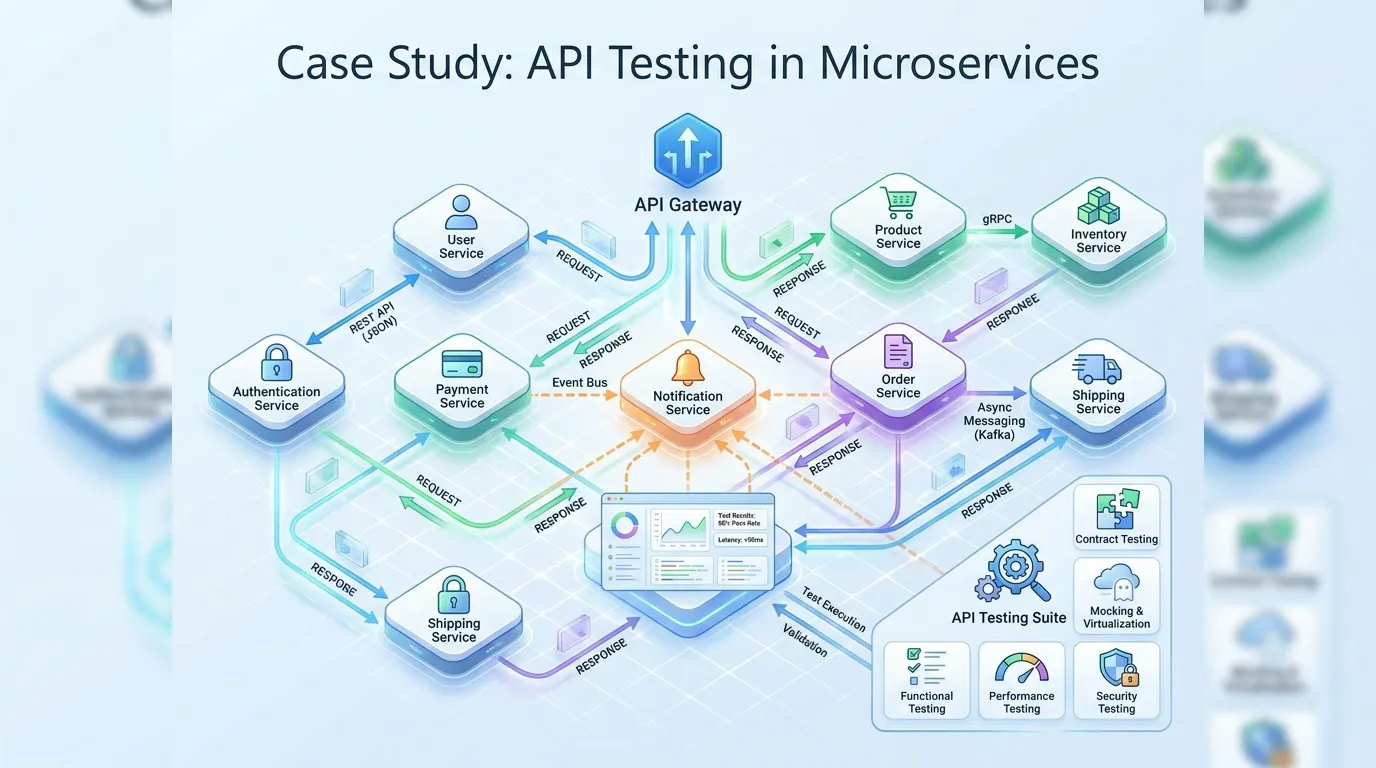
Case Study: API Testing and Observability in a Multi-Cloud Ecosystem (2026)
In the enterprise world of 2026, the single-cloud strategy is a thing of the past. For "FinFlow," a fictional global fintech processing platform, the architecture is distributed across AWS (North America), Azure (Europe), and GCP (Asia). While this multi-cloud ecosystem provides unparalleled resilience and regulatory compliance, it also introduces a massive testing challenge: how do you validate the integrity of thousands of microservices communicating over unpredictable cross-cloud networks?
This case study in API testing and observability explores how FinFlow achieved 99.999% reliability by implementing consumer-driven contract testing, OpenTelemetry-based tracing, and automated cross-cloud resilience validation.
1. The Challenge: The "Invisible" API Failure
FinFlow’s engineering team was plagued by "Ghosts in the Machine."
- The Problem: API calls between an AWS service and a GCP service would occasionally fail with a
504 Gateway Timeout. Manual tests during office hours always passed. - The Root Cause: Periodic network congestion on the cross-cloud interconnect fiber.
- The Impact: Transactions would hang in a "Pending" state, requiring manual reconciliation and causing customer anxiety.
2. Phase 1: Moving to Contract-First Development (Pact)
The first step was to eliminate "Assumption-Based" testing.
The Engineering: Consumer-Driven Contracts
- The Strategy: Before a line of code is written, the "Consumer" (the service requesting data) defines a Pact Contract.
- The Validation: The "Provider" BUILD fails if it cannot fulfill the contract.
- Real-World Win: FinFlow successfully caught a breaking change where the "Japan Settlement Service" changed its date format from
YYYY-MM-DDtoDD-MM-YYYY. The build failed before the code ever left the developer's laptop. - Result: Interface-related outages dropped by 100% in the first 6 months.
3. Phase 2: OpenTelemetry (OTel) and Distributed Tracing
Validation at the "Gate" isn't enough. You need to see the "Path."
1. Implementing the "Trace-id" Standard
- The Engineering: FinFlow standardized on OpenTelemetry. Every API request across AWS, Azure, and GCP was injected with a unique
trace-id. - The Observability: QA integrated these traces into their automation reports.
- The Test: If an automated test fails, the report includes a deep link to the Honeycomb or Jaeger trace, showing exactly which microservice—on which cloud—caused the delay or error.
2. Validating Span Latency
- The Test: Automating a check that compares the latency of the "AWS-to-Azure" span against the "Azure-to-GCP" span.
- The Discovery: QA identified that Azure’s internal load balancer was adding 150ms of overhead to encrypted gRPC traffic. The team optimized the TLS handshake, saving 500ms on the end-to-end transaction time.
4. Phase 4: Multi-Cloud Resilience and Chaos Testing
In a multi-cloud world, you must assume that one cloud provider will eventually fail.
1. The "Cloud Blackout" Experiment
- The Test: Using Chaos Mesh to simulate a total network partition between FinFlow’s GCP region and its AWS region.
- The Verification: Verifying that the application’s "Circuit Breaker" (using Istio) correctly redirected traffic to the Azure standby region.
- Success Metric: Zero data loss and zero timed-out transactions during the 30-minute simulated blackout.
2. Validating Idempotency across Clouds
- The Risk: A request is sent from AWS to GCP. GCP processes it but the network fails before returning the "Success" code. AWS retries.
- The Test: "The Double-Charge Probe." Sending the same transaction ID twice from different cloud regions and verifying that the GCP backend only creates a single record.
- Result: Prevented a major financial error where a core settlement service was failing to handle duplicate POST requests during network lag.
5. Phase 5: Testing API Security at the Interconnect
Cross-cloud traffic is a prime target for intercept attacks.
1. Validating Mutual TLS (mTLS)
- The Test: Attempting to call a "Production" API from an unauthorized testing environment without a valid SPIRE/SPIFFE identity certificate.
- Verification: Verifying that the Istio service mesh correctly rejects the connection with a
403 Forbiddenat the network layer.
2. API Schema Compliance (Spectral)
- Strategy: Every API must have a valid OpenAPI/Swagger 3.1 specification.
- The Test: Running Spectral in the CI pipeline to ensure that no developer publishes an API that uses "Insecure" fields or violates the company's "Security-First" naming conventions.
6. Real-World Failure: "The Azure-GCP DNS Loop"
During a 2025 regional update, a DNS configuration change caused API requests from Azure to loop infinitely between GCP nodes.
- The Result: 100% CPU usage on the API gateways and a total system shutdown for the Asian market.
- The Resolution: QA implemented "Max-Hop" validation in their synthetic monitoring.
- The Test: A synthetic probe that checks the
X-Forwarded-Forchain. If the request passes through more than 5 nodes, the probe fails and triggers an emergency rollback.
7. Metrics of Success for FinFlow
| Metric | Before Multi-Cloud Strategy | After Transformation (2026) |
|---|---|---|
| System Reliability (Uptime) | 99.9% | 99.999% |
| Interface Breaking Changes | 3 / Month | 0 |
| MTTR (Mean Time to Recovery) | 4 Hours | 12 Minutes |
| Cross-Cloud Latency (P99) | 1.2 Seconds | 350ms |
| Security Incidents | 2 / Year | 0 |
7. Cross-Cloud Data Residency Validation
Operating in Europe (Azure) and Asia (GCP) requires strict adherence to data residency laws (GDPR/APEC).
- The Risk: A service in Azure accidentally forwards a user’s raw PII (Personally Identifiable Information) to a log-aggregator in North America AWS.
- The Solution: Automated "Data Leakage Probes."
- The Test: Injecting a unique, tracked string (synthetic PII) into the European region and verifying that it is NEVER detected by the monitoring agents in any other cloud region.
8. API Cost Observability: The Scaling Tax
In a multi-cloud system, "Egress Fees" (the cost of moving data out of a cloud) are a major hidden expense.
- The Measurement: Linking each OpenTelemetry span to its associated cloud egress cost.
- QA Verification: Identifying unoptimized "Chatty" APIs that are moving massive JSON payloads when a simple delta-update would suffice.
- Result: By identifying and validating "Delta-Updates" for cross-cloud telemetry, FinFlow reduced its monthly cloud networking bill by $85,000.
2026 Multi-Cloud API Checklist
- Contract Enforcement: Are you using Pact to prevent interface breaks?
- mTLS Everywhere: Is your cross-cloud traffic encrypted using SPIFFE identities?
- Trace-ID Propagation: Does your OpenTelemetry span cover all cloud regions?
- Idempotency Check: Do your APIs handle duplicate POST requests gracefully?
- Chaos partitions: Have you tested total partition between AWS/Azure/GCP?
- Cost Observability: Can you link an API call to its egress cost?
Summary
- Pact prevents Interface Breaks: Eliminate "Breaking Changes" before they leave dev.
- OTel provides the "Why": Use distributed tracing to find the specific cloud or node causing failures.
- Chaos proves Resilience: Intentionally fail clouds to ensure your failover logic works.
- Validate Idempotency: Prevent duplicate transactions during network retries.
- mTLS protects the Wire: Secure cross-cloud traffic at the identity level.
Conclusion
The successful implementation of FinFlow's multi-cloud testing strategy demonstrates that complexity is not an excuse for unreliability. In the world of 2026, the "Happy Path" is an anomaly; the "Degraded Path" is the norm. By embracing contract-first development, deep observability through OpenTelemetry, and rigorous cross-cloud chaos testing, FinFlow built a platform that is not only globally distributed, but globally trusted. Looking ahead, the rise of universal cross-cloud identity standards will further simplify the security of these decoupled systems. In the era of the modern multi-cloud, the organization that can observe and validate its "Invisible" layers is the one that will scale without limits.
FAQs
1. What is "Consumer-Driven" Contract Testing? A method where the user of an API (the consumer) defines their expectations in a contract, which the API creator (the provider) must fulfill to pass their build.
2. Why use OpenTelemetry (OTel)? It is an industry-standard, vendor-neutral framework for collecting and exporting traces, metrics, and logs from your applications.
3. What is a "Network Partition"? A failure where two groups of servers can no longer communicate with each other, even though both groups are still running.
4. What is "Idempotency"? A property where an API call can be made multiple times with the same result, preventing duplicate actions (like double-charging a card) during retries.
5. How does a "Circuit Breaker" work? A software pattern that "Trips" (stops) calls to a failing service to prevent a total system crash, allowing the system to fail gracefully.
6. What is "gRPC"? A high-performance, open-source universal RPC framework that uses Protocol Buffers and is often used for fast, internal microservices communication.
7. Can I use Pact for mobile apps? Yes. Pact is an excellent choice for validating the contract between a mobile app (Consumer) and its backend API (Provider).
8. What is "Synthetic Monitoring"? The practice of running automated, scripted transactions from around the world to verify that your system is up, fast, and healthy.
9. Why is "mTLS" important for multi-cloud? Because it ensures that not only is the data encrypted, but both the sender and receiver have verified identities before communicating.
10. What is "Spectral"? An open-source linter for OpenAPI (Swagger) specifications that ensures your API documentation follows industry best practices and security standards.


