
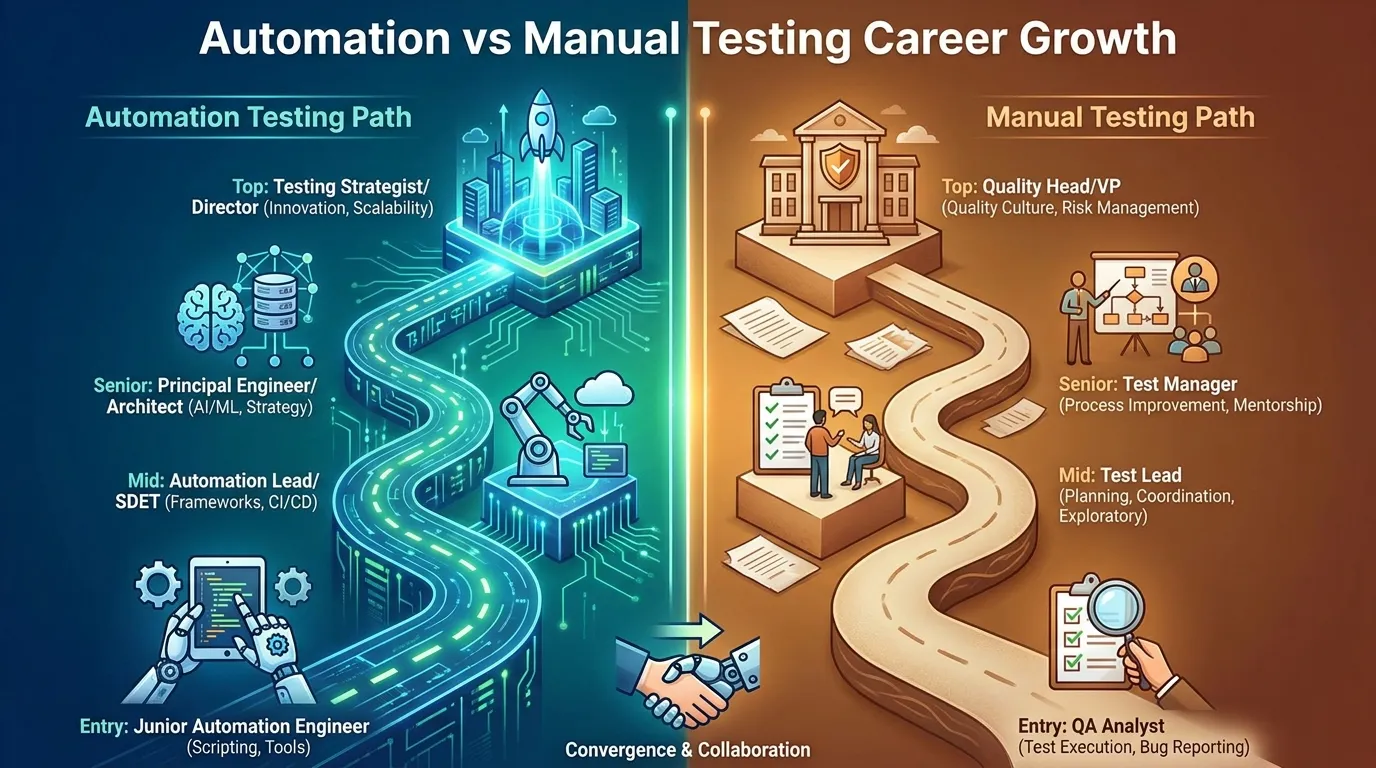
Automation vs Manual Testing Career Growth: The Strategic 2026 Roadmap
In the rapidly shifting landscape of software engineering, few debates have been as persistent—or as misunderstood—as "Automation vs. Manual Testing." For over a decade, alarmists have predicted the total extinction of the manual tester, while proponents of traditional methods have warned against the over-reliance on "flaky" scripts.
As we move through 2026, the reality is far more nuanced. The binary choice between manual and automation no longer exists. Instead, the industry has converged into a unified discipline of Quality Engineering. The testers who are seeing the most explosive career growth aren't just "writing scripts" or "clicking buttons"; they are strategic quality architects who know exactly when to leverage human intuition and when to deploy massive-scale automation.
Whether you are a seasoned manual tester looking to modernize your skills or an automation engineer aiming for a leadership role, this guide provides the definitive roadmap for career growth in the modern enterprise. We will dive deep into salary benchmarks, the skill hierarchy of 2026, and the precise steps you need to take to move from execution to strategy.
1. The Myth of the "Dead" Manual Tester (And the Rise of Strategic QA)
Let's clear the air: Manual testing is not dead. However, the role of the "Legacy Manual Tester"—someone who simply follows a list of steps in a document—is rapidly approaching obsolescence.
The Evolution of Manual Testing
In 2026, "Manual Testing" has rebranded as Strategic Exploratory Testing. High-growth organizations realize that while automation is great for finding regressions (checking if things stayed the same), it is notoriously bad at finding new, creative bugs (exploring how things could break).
Humans possess something that no LLM or automated script currently has: Context and Empathy. A "Strategic Manual Tester" in 2026 focuses on:
- User Experience (UX) Audits: Assessing how a feature feels and whether the workflow makes sense for the target demographic.
- Edge Case Discovery: Using intuition and domain knowledge to find the complex "corner cases" that automation scripts haven't been programmed for yet.
- Accessibility and Inclusivity: Ensuring that software works for everyone, regardless of their physical or cognitive abilities—a task that still requires high degrees of human sensitivity.
The Impact on Your Career
If you stay in the "Legacy" mindset, your career growth will likely plateau. But if you pivot toward "Strategic QA," you become a vital bridge between the product, the user, and the engineering team. This role is increasingly seen as a "Quality Consultant," commanding salaries that rival mid-level developers.
2. The SDET and Automation Architect: The Technical Powerhouses
On the other side of the spectrum lies the SDET (Software Development Engineer in Test) and the Automation Architect. This is where the most significant salary jumps occur.
What is an SDET in 2026?
An SDET is not just a "tester who codes." They are engineers who build the tools, frameworks, and infrastructure that enable the entire team to ship quality code faster. In 2026, an elite SDET focuses on:
- Framework Architecture: Building self-healing, decoupled testing frameworks using modern tools like Playwright or specialized AI-driven platforms.
- CI/CD Orchestration: Integrating quality gates into the DevOps pipeline so that no faulty code ever reaches production.
- Observability Integration: Linking test results with production monitoring logs to predict where the next failure might occur.
Career Growth for Automation Specialists
The path for automation specialists is clear: move from "Scripting" (writing tests for features) to "Platform Engineering" (building the infrastructure that runs those tests). The seniority of an automation professional is measured not by how many tests they write, but by how much manual effort they eliminate for the company.
3. Salary Benchmarks 2026: The Hard Numbers
Career growth is often measured by the paycheck. While location and industry (FinTech vs. Gaming) play a role, the following tiers represent the global averages for 2026 in the enterprise space.
| Role | Experience Level | Average Salary (USD) | Key Differentiator |
|---|---|---|---|
| Legacy QA Tester | 0-3 Years | $65,000 - $85,000 | Focuses on manual execution only. |
| Strategic QA Analyst | 3-7 Years | $95,000 - $130,000 | Expert in exploratory testing and UX audits. |
| Automation Engineer | 3-5 Years | $110,000 - $145,000 | Can build and maintain E2E scripts. |
| SDET / Senior Automation Eng | 5-10 Years | $150,000 - $190,000 | Builds frameworks and manages CI/CD gates. |
| QA Architect / QA Director | 10+ Years | $200,000 - $280,000 | Designs global quality strategy and manages AI ops. |
The "Automation Premium": Currently, the ability to architect an automated framework provides an immediate 25% to 40% salary boost compared to purely manual roles with the same years of experience.
4. The Skill Hierarchy of 2026: What to Learn When
To maximize your career velocity, you need a disciplined learning path. Don't try to learn everything at once. Follow this hierarchy from ground-floor to penthouse.
Level 1: Foundations (The "Must-Haves")
- SDLC/Agile Mastery: Understanding how software is made.
- SQL and Data Validation: Being able to query the database to verify that the UI matches the backend.
- API Fundamentals: Understanding how microservices communicate (REST/GraphQL).
Level 2: Engineering (The "Salary Boosters")
- Programming (Python, JS, or Java): Fluency in at least one language.
- Core Automation Tools: Mastery of Playwright, Cypress, or Selenium.
- Git/GitHub: Knowing how to branch, merge, and manage test code alongside production code.
Level 3: Architecture (The "Leadership Tier")
- Orchestration (Docker/Kubernetes): Running tests in isolated, scalable environments.
- Cloud Testing (AWS/Azure): Leveraging cloud-native tools for massive parallel execution.
- AI-Assisted Operations: Using LLMs for test case generation and log triaging.
5. Transition Roadmap: From Manual to Automation Engineer
If you are currently in a manual role and feel stuck, here is your 12-month transformation plan.
Months 1-3: The Logic Phase
Stop clicking and start thinking like a coder. Learn the basics of Python or JavaScript. Your goal isn't to build an app; it's to understand logic gates, loops, and data types.
- Action item: Automate a simple 5-minute task you do every day (like checking a specific URL) using a basic script.
Months 4-7: The Framework Phase
Choose one modern tool—Playwright is recommended for its speed and modern API. Learn how to write a script that navigates a website, fills a form, and verifies a result.
- Action item: Build a small portfolio on GitHub showing an automated "Smoke Test" for a popular site (e.g., Amazon or LinkedIn).
Months 8-12: The Integration Phase
Learn how to run your scripts in a CI/CD pipeline like GitHub Actions. This is the difference between a "Hobbyist" and an "Engineer."
- Action item: Apply for internal "Hybrid" roles where you can spend 50% of your time on manual work and 50% on building the automation suite.
6. The "Soft" Skills for Hard Growth: Leadership and Strategy
In 2026, the most successful QA professionals are also the best communicators. As a tester, you are the bearer of "bad news." How you deliver that news determines your influence.
1. The Language of Business
Stop talking about "Bugs" and start talking about "Risk" and "Revenue." Instead of saying "We found a CSS glitch," say "There is a visual regression that could reduce the conversion rate of the checkout page by 10%."
2. Quality Coaching
Instead of being a "Gatekeeper" who stops everything, become a "Coach" who helps developers write better unit tests. This "Shift-Left" leadership increases your value to the organization by reducing the overall bug count before it even reaches QA.
7. Results: Career Trajectory Comparison
| Factor | Manual Career Path | Automation Career Path |
|---|---|---|
| Initial Learning Curve | Low | High |
| Daily Activity | Execution and Observation | Engineering and Architecting |
| Scalability | Linear (1 Person = X Tests) | Exponential (1 Script = 1,000 runs) |
| Market Demand | Steady/Declining for Legacy | High/Growing |
| Salary Ceiling | Moderate ($150k range) | High ($250k+ range) |
8. 2026 QA Career Growth Checklist
- Programming Proficiency: Can you write a basic
for-loopandif-statementin JS/Python? - API Mastery: Can you use Postman or a code library to validate an API response without using a browser?
- CI/CD Knowledge: Do you know how to trigger an automated test run via a GitHub Action or Jenkins job?
- Metric Literacy: Can you calculate and explain "Defect Leakage" or "Automation ROI" to a manager?
- Certification Audit: Have you looked into the 2026 ISTQB AI Testing or Cloud Tester tracks?
- Personal Branding: Is your LinkedIn profile updated with "SDET" or "Quality Engineer" keywords rather than just "QA"?
- Portfolio Building: Do you have a Git repository that showcases your ability to build a modular automation framework?
Summary
- Manual is Strategic: The "Legacy" manual tester is being replaced by the "Strategic QA Analyst" who focuses on UX and high-value exploratory work.
- Automation is Infrastructure: The highest salaries go to those who build the frameworks and pipelines (SDETs), not just those who write test cases.
- Focus on Logic: Career growth in 2026 requires moving from "Testing the UI" to "Testing the Code/Data/Logic."
- Communication is Key: Bridge the gap between technical failures and business risks to gain influence.
- Commit to Continuous Learning: The tech stack for QA changes every 18 months. If you aren't learning, you're falling behind.
Conclusion
The future of your career in software testing is not a battle between manual and automation; it is a synthesis of both. To thrive in the enterprise space of 2026, you must become a Quality Engineering Hybrid. Master the technical tools to eliminate the mundane, but never lose the human intuition that allows you to see what an algorithm cannot. Whether you choose the path of the deeply technical SDET or the high-level Strategic QA lead, the opportunities are greater than ever for those willing to embrace the engineering side of quality. Your path to the next salary bracket starts not with a new tool, but with a new mindset: seeing quality as a product of engineering, not just a phase of discovery.
FAQs
1. Is manual testing a good career path in 2026? Yes, but only if you move toward "Strategic QA" or "User Experience Testing." Purely repetitive manual execution roles are disappearing or being handled by AI.
2. Which programming language should a tester learn first? JavaScript/TypeScript (for web automation with Playwright/Cypress) or Python (for AI/Big Data and general automation) are the top choices in 2026.
3. How long does it take to learn automation? With a disciplined approach, a manual tester can go from "zero" to writing productive automation scripts in 3-6 months and reach "SDET" status in 12-18 months.
4. What is the difference between a QA Engineer and an SDET? A QA Engineer focuses on the testing process and execution; an SDET focuses on building the code and architecture that makes testing automated and scalable.
5. Can AI replace automation testers? No, AI is a tool for automation testers. It can generate code snippets and analyze results, but it still requires a human engineer to define the strategy and maintain the framework.
6. Do I need a Computer Science degree to be an SDET? While helpful, it's not mandatory. Many elite SDETs are self-taught or come from bootcamps, provided they have a strong portfolio of actual automation projects.
7. Is ISTQB certification still relevant in 2026? Yes, specifically the advanced and specialist tracks like "AI Testing" and "Test Automation Engineering." They provide a standardized vocabulary for global enterprise teams.
8. What is "Strategic Exploratory Testing"? A structured approach to manual testing where a tester uses domain knowledge and intuition to explore the application without pre-defined scripts, focusing on high-risk areas.
9. How do I ask for a raise as a QA engineer? Focus on your ROI. Show how your automation has saved "X" hours of manual work or how your quality strategy has reduced production bugs by "Y" percent.
10. What are the best industries for high QA salaries? FinTech, Healthcare Tech, Artificial Intelligence startups, and CyberSecurity firms tend to have the highest pay for quality engineering roles.
11. Is Selenium still used in 2026? Selenium is still present in legacy enterprise environments, but modern teams have largely migrated to Playwright and Cypress for better speed and stability.
12. What is "Shift-Left" testing? The practice of involving QA and testing activities earlier in the development lifecycle (during planning and coding) rather than at the end.
13. Can a manual tester become a Product Manager? Absolutely. Specialized manual testers often have the best understanding of the user journey, making them excellent candidates for Product Management roles.
14. What is "Chaos Engineering"? A practice where testers intentionally introduce failures into a system to see if it can recover gracefully—a growing and high-paying field in 2026.
15. Where can I find the best learning resources? Platforms like Test Automation University, specialized SDET bootcamps, and documentation for tools like Playwright and Docker are the best places to start.