Introduction
A strange login attempt originates from a foreign country at 3:00 AM.
A critical database suddenly transfers unusually massive amounts of data.
An employee downloads a suspicious executable file hidden in an email.
But here’s the problem:
👉 If someone isn't watching, these silent digital triggers turn into multi-million dollar data breaches.
In the fast-paced, high-stakes world of digital defense, organizations cannot simply buy a firewall and assume they are safe. Hackers constantly adapt, writing new malware to bypass automated defenses. To protect their most sensitive data, companies rely on human intuition, technical expertise, and relentless vigilance. They rely on the frontline defenders of the digital age: Cyber Security Analysts.
Understanding the cyber security analyst role is essential if you are considering entering the industry. It is the most common entry point into information security, offering massive hiring demand, excellent salaries, and unparalleled job stability.
Instead of a Hollywood hacker typing furiously in a dark basement, the reality of the job is deeply analytical. It requires a unique blend of technical mastery, detective-like curiosity, and calm execution under extreme pressure.
In this comprehensive career breakdown, you’ll learn:
- The definitive definition of what a cyber security analyst actually does
- A detailed look at their daily core responsibilities and tasks
- The difference between Tier 1, Tier 2, and Tier 3 analysts in a SOC
- The essential technical skills and certifications required to land the job
- The crucial "soft skills" that separate great analysts from average ones
- The incredible career trajectory and earning potential for this role
By the end of this guide, you will know exactly what a day in the life of an analyst looks like, and whether you have what it takes to join the digital frontlines.
The Core Cyber Security Analyst Role defined
At the most fundamental level, a Cyber Security Analyst (often referred to as an Information Security Analyst or SOC Analyst) is responsible for protecting an organization's computer networks and digital systems from cyber attacks.
While engineers build the security infrastructure (firewalls, routers, access controls), the analyst monitors that infrastructure. They are the digital security guards patrolling the perimeter, constantly scanning for intruders, weaknesses, or suspicious behavior.
When an automated security tool (like an Intrusion Detection System) flags a potential threat, it blasts an alert to a dashboard. It is the cyber security analyst role to immediately investigate that alert, determine if it is a false alarm or a genuine, active cyber attack, and execute the appropriate incident response protocol to stop it.
A Day in the Life: Daily Responsibilities
The life of an analyst is rarely boring. While responsibilities vary heavily depending on the size of the company, a typical day revolves around four central pillars: Monitoring, Analysis, Mitigation, and Documentation.
1. Network Monitoring and Alert Triage
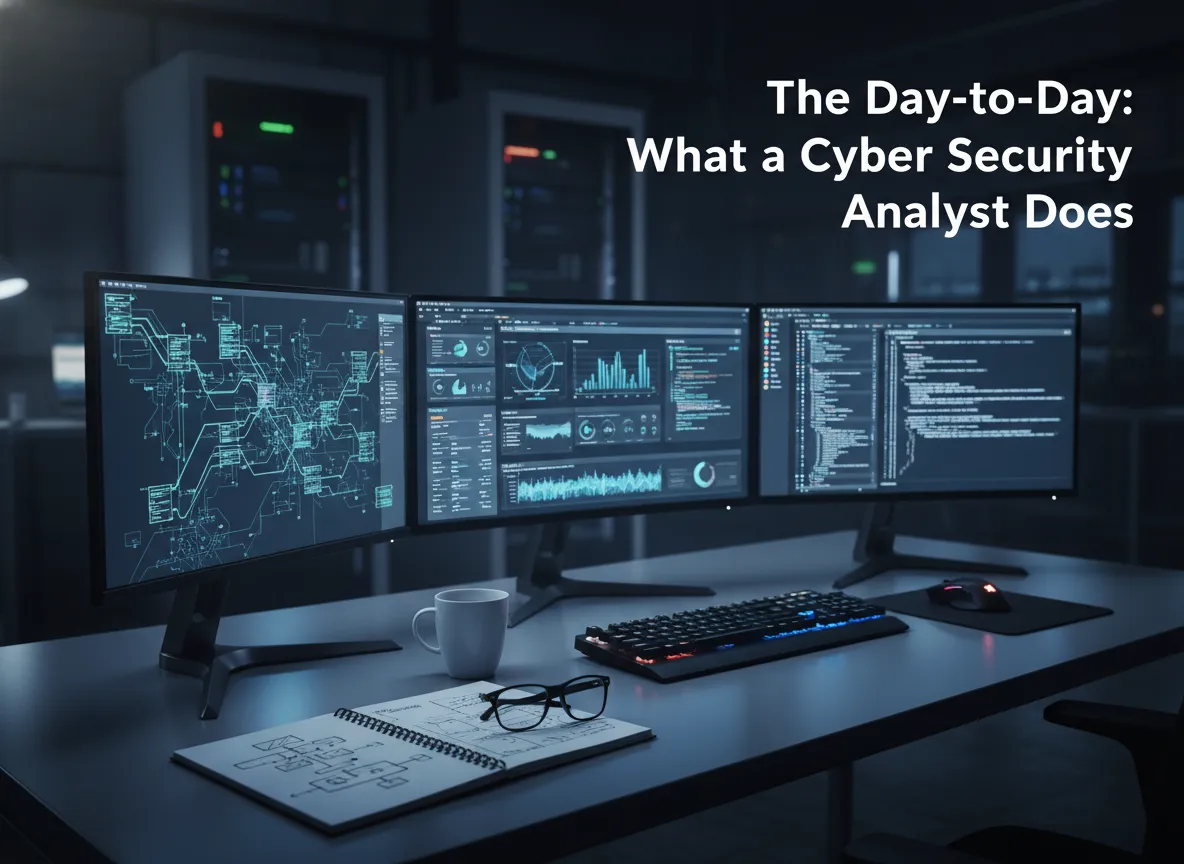
The lion's share of an entry-level analyst's day is spent inside a Security Operations Center (SOC). They sit in front of a dashboard powered by a SIEM (Security Information and Event Management) tool, such as Splunk, IBM QRadar, or Microsoft Sentinel.
The SIEM aggregate millions of logs from every server, laptop, and firewall in the company. When it detects an anomaly (e.g., an employee trying to access a restricted database 50 times in a minute), it generates an alert. The analyst must triage these alerts, prioritizing the most critical threats and clearing out the "noise" (false positives caused by normal network traffic).
2. Deep Dive Threat Analysis
When a genuine threat is suspected, the analyst transitions from monitor to digital detective. They must analyze the surrounding data to reconstruct the timeline of events.
- Did the user click a phishing link?
- What file was downloaded?
- Did the malware attempt to communicate with an external server (Command and Control)?
- Does the attack match known signatures of specific hacking groups on the dark web?
Analysts use advanced technical tools to rip apart malware, analyze network packets (via Wireshark), and perform digital forensics to understand the exact nature and scope of the breach.
3. Incident Mitigation and Eradication
If the analysis confirms a breach, the cyber security analyst role shifts to immediate action. They are the initial responders in a crisis.
- Containment: Immediately isolating the infected laptop or server from the rest of the corporate network to prevent the malware from spreading laterally.
- Eradication: Removing the malicious files, terminating unauthorized user accounts, and blocking the IP addresses the attacker is using.
- Recovery: Assisting the IT department in restoring the affected systems from clean backups and ensuring no remnants of the infection remain.
4. Vulnerability Management
When analysts aren't fighting active fires, they are proactively looking for dry brush. They use specialized software (like Nessus or Qualys) to run vulnerability scans across the entire corporate network.
These scans highlight outdated software, missing Microsoft security patches, or misconfigured servers. The analyst compiles these vulnerabilities into a priority report and works closely with the IT infrastructure team to ensure the gaps are patched before a hacker can exploit them.
The SOC Hierarchy: Tiers 1, 2, and 3
In larger organizations, the cyber security analyst role is divided into distinct tiers within the Security Operations Center (SOC), providing a clear career progression path for new hires.
Tier 1: Triage Specialist (The Frontline)
This is the quintessential entry-level role. Tier 1 analysts are the first line of defense. They monitor the SIEM dashboard, review the initial alerts, and perform basic triage. If they determine an alert is just a false positive (a user accidentally typing their password wrong 5 times), they close the ticket. If the alert looks like a genuine, complex attack, they escalate the ticket to Tier 2.
Tier 2: Incident Responder (The Detectives)
Tier 2 analysts receive the escalated tickets. They possess deeper technical knowledge and perform the heavy analytical lifting. They use threat intelligence databases to understand the attack vector, analyze the infected endpoint, and execute the containment protocols to stop the bleeding. They define the scope of the incident.
Tier 3: Threat Hunter (The Proactive Elite)
Tier 3 analysts are the most experienced veterans in the SOC. They do not wait for the SIEM dashboard to alarm. Instead, they operate under the assumption that the network has already been breached and the automated tools entirely missed the attacker. They actively "hunt" through the network, searching for incredibly subtle, advanced persistent threats (APTs) hiding in the environment.
Essential Hard Skills for Analysts
Defending a complex enterprise requires a vast array of technical, "hard" skills. If you want to excel in the cyber security analyst role, focus your education entirely on mastering these fundamentals:
1. Networking Mastery
You cannot defend what you do not understand. An analyst must have an intimate understanding of how computers communicate. You must know the OSI model, TCP/IP, subnets, routers, firewalls, and deep packet inspection. You need to read a Wireshark capture and immediately understand what normal traffic looks like versus malicious traffic.
2. Operating Systems (Linux and Windows)
You must be exceptionally comfortable navigating both Windows and Linux command-line interfaces. Analysts need to know the Windows Registry, Active Directory, Linux file permissions, and how to write basic shell scripts (Bash or PowerShell) to automate their data gathering during an investigation.
3. SIEM and Log Analysis
The ability to write complex queries in a SIEM tool (like Splunk SPL) to sift through raw server logs is the bread and butter of the job. You must know how to parse unstructured data to find the one anomalous login attempt hidden amongst a million normal ones.
4. Basic Scripting (Python)
While analysts are not software engineers, the ability to write a Python script to automate a repetitive task, parse a giant CSV file, or interact with a security tool's API will save you hundreds of hours and make you significantly more valuable to your team.
The Underrated Soft Skills
While technical skills get you the interview, soft skills dictate your success in the cyber security analyst role. Many brilliant technicians fail as analysts because they lack these critical human traits.
1. Relentless Curiosity
An outstanding analyst has an insatiable desire to understand why. When they see an anomaly, they don't just close the ticket and move on; they pull the thread until they understand exactly how the system works and why the anomaly occurred.
2. Calm Under Extreme Pressure
When a massive ransomware attack strikes at 4:45 PM on a Friday, the entire company panics. The CEO is screaming, IT is frantic, and millions of dollars are at stake. An analyst must remain icy calm, strictly follow the incident response plan, and make logical, calculated decisions without succumbing to stress.
3. Clear Technical Communication
An analyst must explain highly complex, technical threats to non-technical executives. If you discover a critical vulnerability but cannot explain the financial business risk to the CFO in plain English, your technical brilliance is useless.
Career Trajectory and Earning Potential
The cyber security analyst role is incredibly attractive because of its unparalleled earning potential and job security. The global shortage of qualified analysts means that those who prove their competence escalate through the ranks rapidly.
Salaries
According to massive global recruiting data, the field is lucrative from day one:
- Entry-Level (Tier 1 SOC Analyst): Generally starts between $70,000 to $90,000 USD annually, depending heavily on location and the specific company.
- Mid-Level (Tier 2/3 Analyst): Experienced analysts routinely push into the $100,000 to $130,000+ USD range.
- Senior/Management: Senior Incident Responders, SOC Managers, or Security Architects easily command $150,000 to over $200,000 annually.
Advancing Your Career
To accelerate your trajectory, you must continually earn industry-respected certifications.
- To obtain your first analyst job, the CompTIA Security+ is the industry standard baseline. It proves you understand the vocabulary and the concepts.
- To prove your analytical abilities, pursue the CompTIA CySA+ (Cybersecurity Analyst) or the BTL1 (Blue Team Level 1).
- If you desire a massive career boost and immense technical respect, study for the rigorous CISSP (Certified Information Systems Security Professional), often required for management roles.
Short Summary
The cyber security analyst role is the fundamental backbone of any organizational defense strategy. Operating out of a Security Operations Center (SOC), analysts monitor massive networks, investigate suspicious alerts, hunt for subtle threats, and act as the first responders during a cyber crisis. They require a rigorous technical understanding of networking, operating systems, and log analysis, coupled with intense curiosity and the ability to remain calm under extreme pressure. With soaring demand, incredible salaries, and excellent career progression paths, becoming a cyber security analyst is arguably the premier entry point into the tech industry today.
Conclusion
Protecting the digital world does not require a superhuman intellect; it requires extreme dedication to learning the fundamentals, a rigorous analytical mindset, and a refusal to give up when faced with a complex puzzle.
If you enjoy diving deep into technical logs, solving intricate mysteries, and playing a high-stakes, real-world game of digital cat-and-mouse with sophisticated adversaries, the cyber security analyst role might be the perfect fit for you.
The digital frontlines are desperately short-handed. There has never been a better time to build your technical foundation, earn a certification, and step into a career path that is not only highly lucrative but fundamentally crucial to the safety of our interconnected global society.