
Introduction
A major online gaming network launches a highly anticipated title.
Millions of legitimate players attempt to log in.
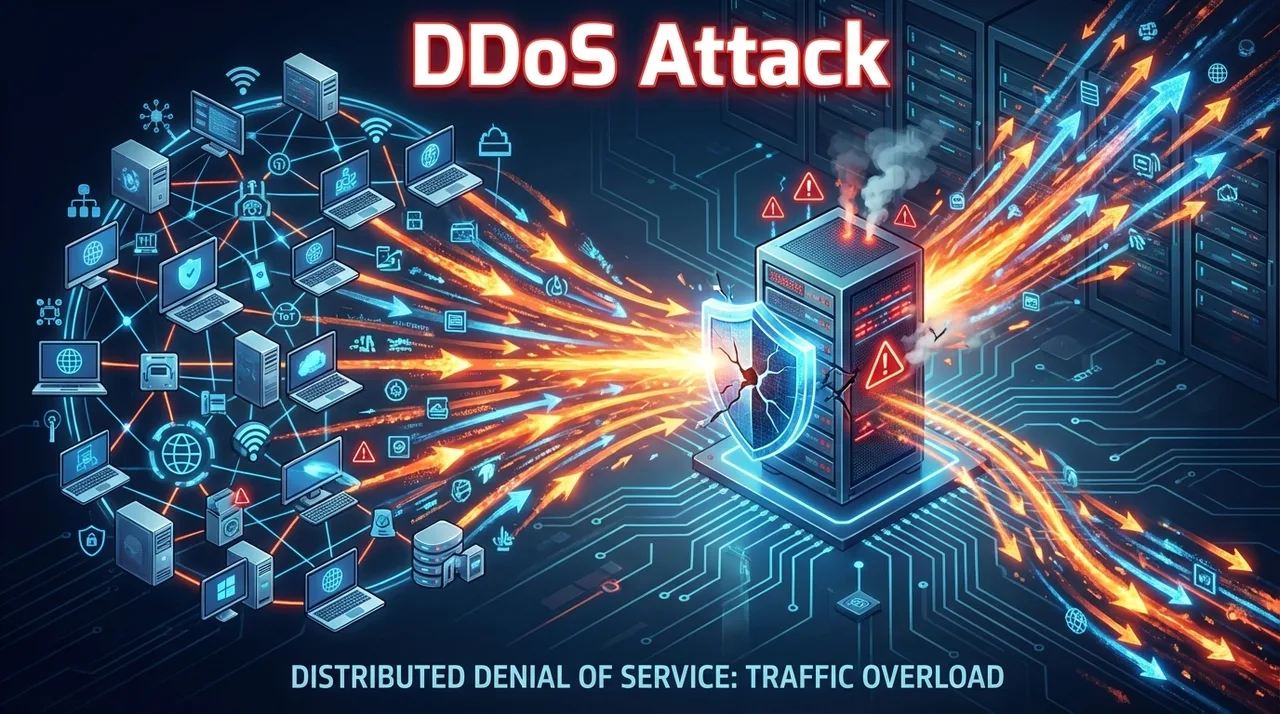
Simultaneously, a hostile network of 500,000 compromised security cameras begins bombarding the gaming servers with terabits of junk traffic. The servers collapse.
But here's the problem:
👉 The gaming company's local firewalls functioned perfectly. They blocked the IP addresses of the attackers as fast as they could. But you cannot locally block half a million completely different IP addresses attacking simultaneously before the physical internet pipe itself physically saturates. This is the brutal mathematics of a Distributed Denial of Service attack.
While a standard Denial of Service (DoS) attack relies on a single source testing a system's resilience, its distributed counterpart introduces a scale of devastating global coordination. A Distributed Denial of Service (DDoS) leverages massive armies of compromised devices—"botnets"—to overwhelm target networks, applications, and infrastructure from thousands of distinct geographic points simultaneously.
Historically used by hacktivists to protest target organizations dynamically, the Distributed Denial of Service attack has evolved into a highly commoditized, devastatingly efficient extortion and competitive sabotage weapon.
In this comprehensive guide, you'll learn:
- The critical structural differences between a simple DoS and a massive DDoS attack
- How botnets are recruited, controlled, and weaponized
- The distinction between Application layer, Protocol layer, and Volumetric DDoS
- Understanding DDoS amplification vectors (DNS, NTP)
- The global economy of "DDoS-for-Hire" (Booter/Stresser services)
- Why traditional, on-premise firewalls consistently fail against volumetric attacks
- How massive cloud mitigation platforms construct networks resilient enough to absorb terabit-scale assaults
By the end of this article, you will understand exactly how the sheer volume and global distribution of the modern botnet fundamentally alters defensive cybersecurity architecture.
DoS vs. DDoS: A Question of Scale
To understand the DDoS threat, one must first recognize its conceptual evolution from the simpler DoS.
A Denial of Service (DoS) attack originates from a single attacker (one computer, one IP address). The attacker sends malicious traffic designed to consume the target's finite resources. The defense is straightforward: identify the attacker's IP address and block it at the firewall. The attack immediately stops.
A Distributed Denial of Service attack (DDoS) originates from an orchestrated multitude of compromised devices distributed globally (thousands or millions of IP addresses). The attacker controls these devices centrally but does not send traffic from their own computer. Instead, they issue a single command, and the entire army attacks the target simultaneously.
Because the attack traffic originates from thousands of different legitimate IPs (residential routers, university networks, smart refrigerators), simple IP blocking is impossible. The volume of traffic easily exceeds the bandwidth capacity of the target's internet connection, dropping legitimate user requests into an overflowing digital void.
The Engine of Destruction: Botnets
The foundational prerequisite for executing a Distributed Denial of Service attack is the botnet.
A botnet (robot network) is a collection of internet-connected devices that have been infected with specialized malware. This malware allows the attacker (the "botmaster") to remotely control the devices without the owners' knowledge.
How Botnets are Built
- Infection: An attacker discovers a vulnerability in a widespread device—often poorly secured Internet of Things (IoT) devices like IP cameras, digital video recorders (DVRs), or consumer routers.
- Propagation: The attacker deploys a self-propagating worm (like the infamous Mirai malware) that scans the internet for vulnerable devices, infects them, and immediately compels them to scan for more victims.
- Command and Control (C2): The infected devices quietly phone home to the attacker's centralized C2 server, registering themselves as ready for deployment.
- Execution: The botmaster sends a command specifying the target IP, port, and attack duration. The entire botnet executes the attack simultaneously in coordinated unison.
The danger of IoT botnets lies not in the processing power of the individual devices (which is minimal), but in their sheer, overwhelming numerical volume and high-bandwidth internet connections.
The Three Categories of DDoS Attacks
DDoS attacks are categorized by the specific infrastructure resource they attempt to exhaust.
1. Volumetric Attacks (Bandwidth Saturation)
The primary objective of a volumetric DDoS is to consume all available bandwidth connecting the target organization to the public internet. The attacker creates a traffic jam so immense that legitimate packets simply physically cannot squeeze through the saturated pipe.
Amplification/Reflection Attacks: These are the most powerful volumetric attacks. The attacker does not send traffic directly to the target. Instead, they send a very small request to an innocent third-party server (like a public DNS or NTP server) on the internet. Crucially, the attacker spoofs (fakes) their source IP address to be the victim's IP address.
The third-party server receives the tiny request and sends a massive, amplified response back to the victim. A 64-byte DNS request can trigger a 4,000-byte response (an amplification factor of over 50x). The botnet generates massive, sustained, globally distributed amplification, generating record-breaking terabit-level attacks.
2. Protocol Attacks (State Exhaustion)
Protocol DDoS attacks target intermediate network equipment—firewalls, load balancers, and routers—rather than the endpoint web servers. They manipulate the rules of network communication to consume all available connection tracking memory ("state tables").
SYN Flood: The most common protocol DDoS. The botnet floods the target firewall with millions of spoofed TCP SYN (synchronize) requests. The firewall dutifully allocates finite memory to track these half-open connections, waiting for a final connection acknowledgment that never arrives. The state table fills, and the firewall begins ignoring ALL new connections—completely breaking the network.
3. Application-Layer Attacks (Layer 7)
Application-layer attacks are stealthy and sophisticated. They do not attempt to saturate raw bandwidth. Instead, they exploit specific applications—like web servers or backend databases—to exhaust CPU and memory resources.
HTTP Flood / Slowloris: A botnet issues millions of seemingly legitimate HTTP GET or POST requests attempting to search a complex database, repeatedly loading an uncacheable dynamic page, or keeping thousands of web server execution threads permanently frozen waiting for deliberately slow network inputs. The traffic volume is small enough to bypass standard volumetric alarms, but the web server itself collapses under the computational load.
The Economics of DDoS: Booter Services
Executing a massive Distributed Denial of Service attack historically required sophisticated technical skills to build and manage a massive botnet infrastructure. This is no longer the case.
Today, DDoS has been completely commoditized. Criminal groups rent out their massive botnet capacity through "Stresser" or "Booter" platforms on the dark web—and frequently on the clear web, hiding behind the thin pretext of offering legal "network stress testing" services.
For less than $50, an individual with zero technical knowledge can log into a user-friendly web portal, input a competitor's URL, select an attack duration and an amplification vector, and launch an attack capable of taking a mid-sized e-commerce site offline globally within minutes. This commoditization has caused an explosion in the frequency of financially motivated extortion and competitive sabotage attacks globally.
The Failure of Local Defenses and The Cloud Solution
The most painful lesson organizations learn is that their heavily fortified, incredibly expensive on-premise firewall is utterly useless against a volumetric Distributed Denial of Service attack.
If a company's internet service connection can physically handle 10 Gigabits of traffic per second, and a botnet throws 100 Gigabits at it, the internet pipe leading to the building fundamentally saturates. The company's massive firewall exists inside the building. Legitimate traffic is dropped at the ISP level before it ever reaches the organization's firewall to be filtered.
The Distributed Defense Architecture
To stop a massive distributed attack, you absolutely must possess a defense network larger and more distributed than the attacker's botnet.
Organizations rely on global Content Delivery Networks (CDNs) and dedicated DDoS mitigation platforms like Cloudflare, Akamai, or AWS Shield. These services operate massive global networks spanning hundreds of data centers worldwide, with aggregate bandwidth capacities massively exceeding standard internet capacity.
When an attack begins:
- Anycast Routing naturally distributes the massive attack traffic geographically. A botnet in Russia attacks a data center in Moscow; a botnet device in Brazil attacks a data center in São Paulo. The massive attack is chopped into manageable regional pieces.
- The distributed Cloud Scrubbing Centers intelligently analyze the traffic, drop the malformed HTTP floods, absorb the massive DNS amplification volumetric spikes, and pass perfectly clean, legitimate traffic back to the target's original, concealed web server.
Short Summary
A Distributed Denial of Service attack uses massive, globally coordinated armies of compromised devices (botnets) to direct overwhelming, simultaneous traffic against a specific target. This distributed architecture renders traditional single-source IP blocking useless. Attackers leverage Volumetric amplification (DNS/NTP), Protocol state exhaustion (SYN floods), and stealthy Application-Layer queries (HTTP Floods) to collapse targets locally. The commoditization of these capabilities via dark web "Booter" services ensures high attack frequency. Defense requires abandoning on-premise reliance in favor of massive, globally distributed cloud scrubbing networks utilizing Anycast routing to absorb and sanitize terabit-scale assaults before they reach vulnerable local infrastructure.
Conclusion
The stark reality of the modern internet is that overwhelming, distributed destruction is available for rent by the hour. A Distributed Denial of Service attack is not a sophisticated exploit requiring software flaws; it is the blunt-force weaponization of the internet protocols themselves.
As the physical world increasingly transitions to an "always-online" paradigm—from e-commerce infrastructure to critical healthcare endpoints and connected electrical grids—the availability of the service becomes as important as the confidentiality of its data.
Organizations must architect their networks anticipating the inevitable assault, strategically distancing their origin servers behind massive, globally resilient cloud mitigation structures. Because when the digital flood arrives, the only way to survive is to be geographically positioned everywhere at once.