Introduction
A company hires an expert to break into their database.
Another expert is hired to build a firewall to keep attackers out.
Both professionals are working to protect the company's data.
But here’s the problem:
👉 People often use their job titles interchangeably, assuming they do the exact same thing.
When diving into the world of digital defense, you will frequently encounter two massive buzzwords: cyber security and ethical hacking. To the untrained eye, these fields might seem identical. After all, both involve computers, networks, and battling malicious actors to protect sensitive information. However, assuming that a cyber security analyst and an ethical hacker perform the same daily tasks is a fundamental misunderstanding of the industry.
Understanding the difference between cyber security vs ethical hacking is absolutely critical, whether you are an executive trying to hire the right personnel to protect your enterprise, or a student trying to map out your future career trajectory.
Instead of lumping these distinct disciplines together, recognizing how they contrast and complement each other is the key to building a robust organizational defense-in-depth strategy.
In this exhaustive guide, you’ll learn:
- The core concepts behind cyber security vs ethical hacking
- The specific daily responsibilities of professionals in each field
- The distinct difference between defensive (Blue Team) and offensive (Red Team) strategies
- Which specific skills and certifications are required for each career path
- How these two disciplines work together to secure an organization
- Which career path might be the better fit for your personality and goals
By the end of this article, the fog surrounding these two tech fields will clear, and you will understand exactly how the defenders and the authorized attackers shape the modern digital landscape.
Breaking Down the Core Definitions
To understand how these disciplines interact, we first must define them in isolation. While their ultimate goal—protecting data—is identical, their approach and execution are entirely opposite.
What is Cyber Security?
Cyber security is the broad, encompassing practice of defending computers, servers, mobile devices, electronic systems, networks, and data from malicious attacks. It is the vast umbrella under which almost all digital defensive tactics fall.
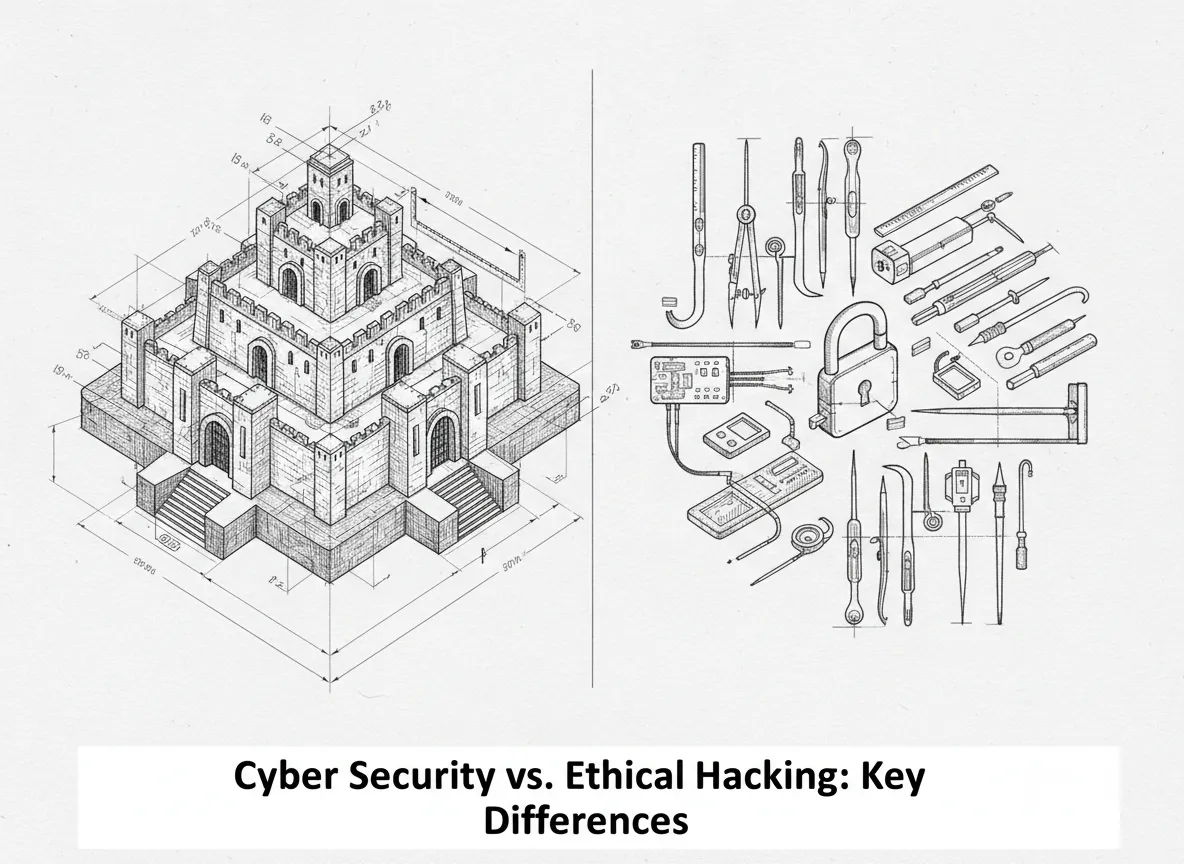
Think of cyber security as the architecture, engineering, and maintenance of a highly secure fortress. A cyber security professional is concerned with building strong walls (firewalls), installing sophisticated alarm systems (Intrusion Detection Systems), ensuring only authorized personnel have keys (Identity and Access Management), and having a plan for when disaster strikes (Disaster Recovery).
Cyber security professionals operate primarily on the defensive. Their daily focus is on risk management, compliance, monitoring, and policy enforcement. They are the guardians of the network.
What is Ethical Hacking?
Ethical hacking is a highly specialized, offensive sub-discipline within the broader field of cyber security. Ethical hackers (also known as "white hat" hackers) use exactly the same tools, techniques, and methodologies as malicious ("black hat") hackers.
However, there is one crucial difference: ethical hackers have explicit, legal permission from the organization to attack their systems.
Think of an ethical hacker as a professional lockpicker hired by the fortress owner. Their job is to try to break into the fortress using every trick in the book. By discovering where the defenses fail, the ethical hacker can tell the fortress owner exactly what needs to be fixed before a real enemy finds the same vulnerability.
Ethical hackers operate entirely on the offensive. They are the approved attackers.
The Blue Team vs. The Red Team
In the cyber security industry, the dynamic between defense and offense is often categorized using military terminology: The Blue Team and The Red Team. This framework perfectly illustrates the cyber security vs ethical hacking dynamic.
The Blue Team (Cyber Security / Defense)
The Blue Team represents the traditional cyber security professionals. They are the internal security staff tasked with defending the organization against both real-world cyber attacks and simulated attacks from the Red Team.
Blue Team Responsibilities:
- Network Monitoring: Continuously watching network traffic 24/7 in a Security Operations Center (SOC) to detect anomalies or signs of an intrusion.
- Vulnerability Patching: Ensuring all operating systems, applications, and servers are up-to-date with the latest security patches.
- Incident Response: If a breach occurs, the Blue Team is the digital fire department. They isolate the infected machines, eradicate the malware, and restore normal operations.
- Security Architecture: Designing the network layout to be inherently secure, such as segmenting critical databases away from the public-facing web servers.
The Red Team (Ethical Hacking / Offense)
The Red Team consists of ethical hackers hired to test the effectiveness of the Blue Team and the organization's overarching security posture. They simulate a real-world adversary.
Red Team Responsibilities:
- Penetration Testing (Pen Testing): Launching targeted, authorized attacks against specific applications or networks to find exploitable vulnerabilities.
- Social Engineering: Attempting to manipulate the organization’s employees. This might involve sending highly convincing phishing emails to see who clicks, or physically dressing up as a delivery person to bypass corporate security desks.
- Exploit Development: Creating custom malicious scripts to bypass specific antivirus or intrusion detection systems currently utilized by the Blue Team.
- Reporting: Writing highly detailed, technical reports outlining exactly how they breached the system and providing actionable advice on how the Blue Team should fix the flaws.
Key Differences in Approach and Mindset
The debate of cyber security vs ethical hacking extends beyond just job duties; it fundamentally involves two entirely different psychological mindsets.
The Defender's Mindset (Cyber Security)
Cyber security professionals must think systematically. They must consider the entire organization as a holistic entity.
- Risk-Averse: Their primary goal is maintaining business continuity. Therefore, any changes to the network must be carefully planned to avoid causing accidental downtime.
- Broad Knowledge: A defender needs to know a little bit about everything. They need to understand networking, databases, cloud architecture, compliance laws (like GDPR), and employee psychology.
- Process-Oriented: Defense relies heavily on repeatable processes, strict corporate policies, automated alerts, and meticulous documentation.
The Attacker's Mindset (Ethical Hacking)
Ethical hackers must think destructively. They do not care about how the system was intended to run; they only care about how the system can be manipulated to run in ways the creator never anticipated.
- Creative and Unconventional: Hackers find the "edge cases." They look for the tiny cracks in the armor that the defenders overlooked.
- Deeply Specialized: While they need a broad foundation, ethical hackers often specialize incredibly deeply in one specific area (e.g., exclusively hacking web applications or exclusively manipulating wireless hardware).
- Goal-Oriented: An ethical hacker's job is to achieve a specific objective (like stealing a simulated database file). They will use any legal means necessary to achieve that goal, requiring immense patience and out-of-the-box thinking.
Comparing Career Paths and Job Titles
If you are entering the industry, the choice between cyber security vs ethical hacking will dictate the jobs you apply for and the certifications you pursue.
Cyber Security Career Path
This is the most common route, as organizations require significantly more defenders than offensive testers. Every company needs a Blue Team; only mature companies frequently hire Red Teams.
Common Job Titles:
- SOC Analyst (Security Operations Center Analyst)
- Cyber Security Engineer / Architect
- Incident Responder
- Information Security Manager
- Digital Forensics Investigator
The Trajectory: Most professionals start as a Tier 1 SOC Analyst, monitoring alerts. As they gain experience, they move into engineering roles where they build the defenses, or incident response roles where they actively hunt threats inside the network. Eventually, they can move into management positions like Chief Information Security Officer (CISO).
Ethical Hacking Career Path
This path is generally considered more difficult to break into at the entry level. It requires a massive amount of prerequisite knowledge before you can effectively (and legally) hack a company.
Common Job Titles:
- Penetration Tester (Pen Tester)
- Vulnerability Assessor
- Red Team Operator
- Exploit Developer
- Bug Bounty Hunter (Freelance)
The Trajectory: Ethical hackers often start their careers on the Blue Team as system administrators or network engineers to understand how systems are built. Once they transition to Pen Testing, they usually specialize. Elite ethical hackers may join dedicated Red Teams for large tech corporations or work independently, hunting for flaws in massive platforms like Google or Apple for six-figure "bug bounty" payouts.
Education, Skills, and Certifications
While both fields share a foundational requirement (you must deeply understand networking, Linux, and Windows), they diverge sharply when it comes to advanced skills and industry certifications.
Skills Needed for Cyber Security (Defense)
- Log Analysis: The ability to read through thousands of lines of server logs (using tools like Splunk or Elastic) to spot anomalies.
- Network Administration: Deep knowledge of firewalls, routers, and secure architecture design.
- Policy Creation: Understanding how to write and enforce corporate security policies that balance safety with employee productivity.
- Certifications:
- CompTIA Security+ (The foundational standard)
- CompTIA CySA+ (Cybersecurity Analyst)
- CISM (Certified Information Security Manager)
- CISSP (Certified Information Systems Security Professional - The gold standard for senior roles)
Skills Needed for Ethical Hacking (Offense)
- Scripting/Programming: Expert-level knowledge of Python, Bash, and PowerShell to automate attacks and modify exploits.
- Web Architectures: Intimate knowledge of how web applications function (HTML, JavaScript, SQL) to find injection flaws.
- Tool Mastery: Proficiency with offensive tools like Metasploit, Burp Suite, Nmap, and Wireshark.
- Certifications:
- CEH (Certified Ethical Hacker - Good for HR filters, but less respected by technical peers)
- eJPT (eLearnSecurity Junior Penetration Tester - Excellent practical entry point)
- OSCP (Offensive Security Certified Professional - The brutal, highly-respected gold standard for pen testers)
The Synergy: Why Both Are Necessary
It is crucial to understand that the debate of cyber security vs ethical hacking is not about which is "better." They absolutely rely on each other to protect an organization. This is often referred to as the "Purple Team" dynamic.
A cyber security team (Blue) that never faces an ethical hacker (Red) will become complacent. They will assume their firewalls are impenetrable because they've never been truly tested. When a real, malicious attacker finally arrives, the Blue Team will be woefully unprepared.
Conversely, an ethical hacking team provides zero value if there is no cyber security team to fix the holes they find. A penetration tester can write a brilliant 100-page report detailing massive vulnerabilities, but if there are no engineers to patch the servers and update the firewalls, the company remains completely exposed.
The Red Team sharpens the skills of the Blue Team, and the Blue Team implements the findings of the Red Team to make the organization harder to hack next time. It is a continuous, symbiotic cycle of improvement.
Short Summary
The distinction between cyber security vs ethical hacking is essentially the difference between the defense and the offense. Cyber security is the broad discipline of building, monitoring, and maintaining digital defenses (The Blue Team) to ensure business continuity and data protection. Ethical hacking is a specialized sub-field focused entirely on legally breaking into those systems (The Red Team) to find exploitable vulnerabilities before the real criminals do. Both require deep technical knowledge, but they utilize entirely different mindsets, toolsets, and daily procedures to achieve the ultimate unified goal of securing the organization.
Conclusion
When planning your career or allocating your company's IT budget, recognizing the specific functions of these two disciplines is paramount.
If your personality gravitates toward building complex systems, enforcing order, solving puzzles, and keeping people safe from the shadows, you will likely thrive in a traditional defensive cyber security role. If, however, you have an insatiable curiosity for breaking things apart, analyzing how systems fail, and thinking outside the box, the challenging world of ethical hacking might be your calling.
Regardless of which path you favor, the digital world desperately needs both. As cyber threats grow more ferocious and sophisticated, the continuous battle between the dedicated defenders and the authorized attackers is the only thing standing between a functioning digital economy and absolute chaos.