Introduction
Artificial intelligence is no longer a laboratory experiment or a distant promise from tech researchers — it is woven into the fabric of everyday modern life. You encounter AI dozens of times every single day, often without realizing it.
The navigation app that reroutes you around traffic in real time? AI. The fraud alert from your bank when you use your card in an unusual location? AI. The face unlock on your smartphone? AI. The recommendations that keep you watching one more episode? AI again.
Understanding the most important AI use cases in real life helps you appreciate how deeply AI has already reshaped society — and prepares you for a world where AI's role will only grow larger.
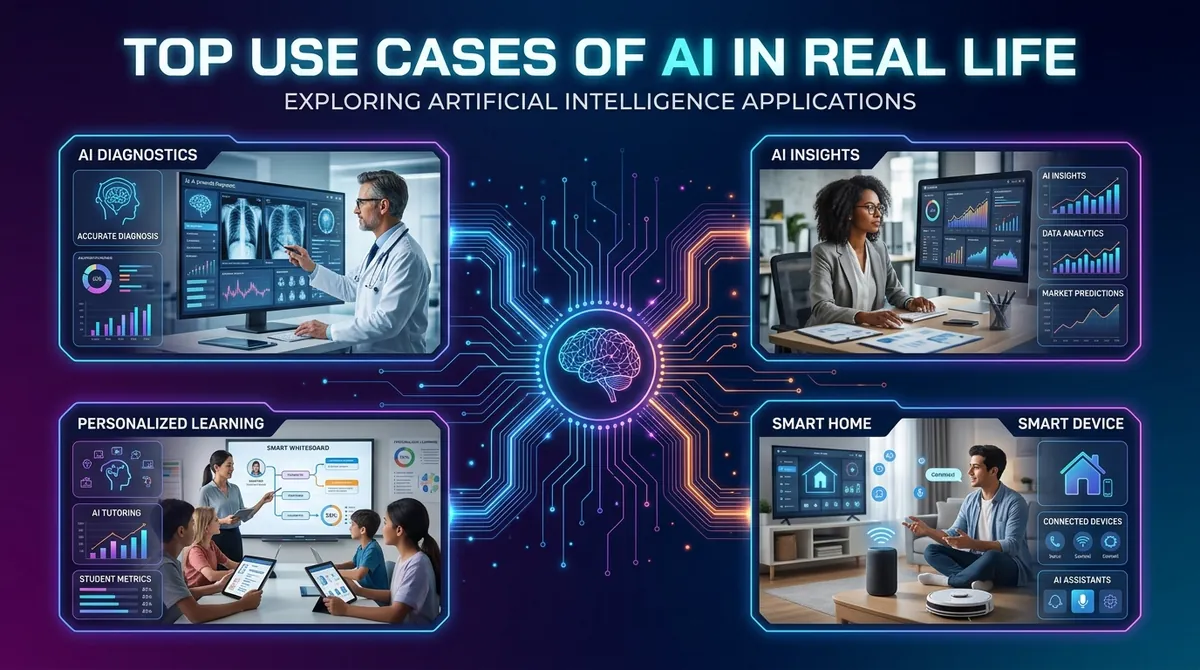
This guide explores the top AI use cases across the most important industries and everyday applications in 2026, with concrete examples that show exactly how AI is being put to work in ways that matter.
AI Use Cases in Healthcare
Healthcare may be the domain where AI has the most life-saving potential — and where it is already delivering remarkable results.
Medical Imaging and Diagnosis
AI models trained on millions of medical images can detect diseases with accuracy that rivals board-certified specialists:
- Cancer detection: Google's AI model detects breast cancer in mammograms with 89% accuracy — outperforming expert radiologists
- Diabetic retinopathy: AI scans retinal images and detects diabetes-related blindness before symptoms appear
- Pneumonia detection: AI analyzes chest X-rays to identify pneumonia faster than manual review
- Skin cancer: AI dermatology tools classify skin lesions with expert-level accuracy from smartphone photos
Drug Discovery
Traditional drug discovery takes 10–15 years and costs over $1 billion. AI is dramatically compressing this timeline:
- AlphaFold (DeepMind): Predicted the 3D structure of virtually every known protein — a breakthrough that accelerates drug design by years
- Insilico Medicine: Used AI to identify a new drug candidate for a rare lung disease in just 18 months (versus 6+ years traditionally)
Electronic Health Records and Clinical Documentation
AI tools automatically transcribe doctor-patient conversations into structured clinical notes, saving physicians 2–3 hours per day of administrative work.
Personalized Medicine
AI analyzes a patient's genetics, lifestyle, and medical history to recommend treatments and medications specifically tailored to them — moving beyond one-size-fits-all medicine.
Remote Patient Monitoring
Wearables powered by AI continuously monitor heart rate, blood oxygen, sleep patterns, and activity — alerting patients and doctors to warning signs before they become emergencies.
AI Use Cases in Finance and Banking
The financial sector was among the earliest adopters of AI, and its applications have become mission-critical:
Fraud Detection
AI systems analyze millions of credit card transactions per second, building behavioral profiles of each user. When a transaction deviates significantly from normal patterns — wrong location, unusual amount, unfamiliar merchant — the system flags or blocks it in milliseconds.
Example: Mastercard's AI-powered Decision Intelligence processes 75 billion transactions annually, identifying fraud patterns invisible to rule-based systems.
Algorithmic Trading
AI-powered trading systems execute thousands of stock trades per second based on real-time analysis of market data, news sentiment, and historical patterns. High-frequency trading powered by AI now represents a significant portion of all stock market volume.
Credit Risk Assessment
Traditional credit scoring uses limited data (payment history, debt levels). AI credit models incorporate hundreds of additional data points — spending behavior, employment stability, even social data — to produce more accurate risk profiles and extend credit to underserved populations.
Robo-Advisors
AI-powered investment platforms like Betterment and Wealthfront automatically manage diversified portfolios — rebalancing, tax-loss harvesting, and optimizing returns with minimal human intervention — at a fraction of the cost of traditional financial advisors.
Anti-Money Laundering (AML)
AI analyzes complex transaction networks to detect money laundering patterns — tracing suspicious funds through multiple accounts and jurisdictions faster than any human investigative team.
AI Use Cases in Cybersecurity
Cybersecurity is one of the most critical real-world applications of AI — because the threats it defends against are also becoming increasingly AI-powered.
Threat Detection and Incident Response
AI-powered Security Information and Event Management (SIEM) platforms analyze millions of log events per day, automatically correlating events into meaningful alerts and triggering automated response playbooks for common attack patterns.
Network Intrusion Detection
Machine learning models establish behavioral baselines of normal network traffic. When traffic patterns deviate — such as a sudden spike in outbound data or unusual port scanning — the system raises an alert and can automatically isolate the affected segment.
Phishing Email Detection
Natural Language Processing (NLP) models analyze email content, sender behavior, URL characteristics, and attachment properties to identify phishing attempts with far higher accuracy than rule-based filters.
Endpoint Protection
AI-powered antivirus tools use behavioral analysis rather than signature matching — detecting malware based on what it does (encrypting files, contacting command servers) rather than what it looks like. This enables detection of zero-day threats with no known signature.
Vulnerability Management
AI tools continuously scan code repositories, application surfaces, and infrastructure configurations for security vulnerabilities — prioritizing remediation based on exploitability and business impact, not just severity scores.
AI Use Cases in Education
AI is personalizing education and making quality learning more accessible than ever:
Adaptive Learning Platforms
AI-powered learning systems adjust the difficulty, pace, and content of lessons in real time based on how each student is performing. If a student struggles with fractions, the AI provides more examples, alternative explanations, and targeted practice — automatically.
Example: Duolingo's AI engine personalizes language learning by predicting which words you're about to forget and prioritizing them for review.
Intelligent Tutoring Systems
AI tutors like Khanmigo (Khan Academy) provide personalized, Socratic-style tutoring — guiding students to discover answers rather than simply providing them — available 24/7.
Automated Grading and Feedback
AI can grade multiple-choice questions, short answers, essays, and coding assignments — providing instant, detailed feedback that students can act on immediately rather than waiting days for a teacher's response.
Accessibility and Inclusion
- Real-time captioning: AI transcribes speech instantly for deaf and hard-of-hearing students
- Language translation: AI breaks down language barriers in diverse classrooms
- Text-to-speech: Helps students with reading difficulties
- Dyslexia support tools: AI-powered tools that adapt text presentation for better readability
AI Use Cases in Retail and E-Commerce
Retail has been transformed end-to-end by AI:
Personalized Recommendations
Every time you see "Customers who bought this also bought…" or "Recommended for you," AI is at work. Amazon's recommendation engine reportedly drives 35% of its total revenue through AI-powered personalization.
Dynamic Pricing
AI adjusts product prices in real time based on demand signals, competitor pricing, inventory levels, and user behavior. Airlines and ride-sharing platforms pioneered this; it's now standard across e-commerce.
Inventory and Supply Chain Management
AI predicts demand fluctuations based on historical sales, weather, events, and economic indicators — helping retailers maintain optimal stock levels and reduce both overstock and stockouts.
Visual Search
Upload a photo of a product and AI finds visually similar items available for purchase. Pinterest Lens and Google Lens are popular examples used by millions of shoppers daily.
Cashier-Less Stores
Amazon Go stores use computer vision AI to track what shoppers pick up and put down, automatically charging their account when they leave — no checkout queue required.
AI Use Cases in Transportation
Self-Driving Vehicles
Companies like Waymo, Tesla, and Cruise are deploying autonomous vehicles at scale. AI processes data from cameras, LiDAR, radar, and GPS to navigate complex urban environments, make split-second decisions, and respond to edge cases.
Traffic Optimization
Smart traffic management systems powered by AI adjust signal timing in real time to reduce congestion, prioritize emergency vehicles, and minimize average commute times across entire cities.
Predictive Maintenance in Aviation
Airlines use AI to analyze sensor data from aircraft engines and systems, predicting component failures days or weeks before they occur — preventing costly emergency repairs and flight cancellations.
Ride-Sharing Optimization
Platforms like Uber and Lyft use AI to match passengers with drivers, predict demand surges to position drivers optimally, and calculate dynamic surge pricing based on real-time supply and demand.
AI Use Cases in Agriculture
Precision Farming
AI-powered drones and satellite imagery analyze crop health, soil conditions, and irrigation needs at the individual plant level — enabling farmers to apply water, fertilizer, and pesticides precisely where needed, reducing waste and increasing yields.
Crop Disease Detection
AI models trained on leaf images detect plant diseases and pest infestations early — enabling farmers to treat problems before they spread and destroy harvests.
Yield Prediction
Machine learning models integrate weather forecasts, soil data, crop history, and satellite imagery to predict harvest yields months in advance — improving supply chain planning and price stability.
AI Use Cases in Customer Service
Intelligent Chatbots
AI chatbots handle the majority of routine customer service inquiries — order status, returns, account questions — 24/7 without human intervention, dramatically reducing service costs while improving response times.
Sentiment Analysis
AI analyzes customer communications (emails, reviews, social posts, call transcripts) to detect sentiment and emotional tone — flagging frustrated or churning customers for immediate human follow-up.
Voice AI and Call Center Automation
AI processes and understands natural speech, resolving common support calls entirely without human agents. When escalation is needed, AI provides the human agent with a real-time summary and suggested responses.
AI Use Cases in Creative Industries
Content Creation
AI writing assistants help marketers, journalists, and creators produce drafts, outlines, social posts, and scripts faster than ever — while AI image generators produce professional visuals without a designer or photographer.
Music and Film Production
AI composes background music, synchronizes audio to video, removes unwanted sounds, and upscales low-resolution footage — democratizing production quality for independent creators.
Game Development
AI generates vast game worlds, writes NPC dialogue, creates procedural levels, and adapts enemy behavior dynamically — enabling small teams to build experiences that previously required hundreds of developers.
Short Summary
AI use cases in real life span virtually every industry. In healthcare, AI diagnoses diseases and accelerates drug discovery. In finance, it detects fraud and manages investments. In cybersecurity, AI defends against novel threats and automates incident response. In education, it personalizes learning and enables 24/7 tutoring. In retail, AI drives recommendations and dynamic pricing. In transportation, agriculture, customer service, and creative industries, AI is delivering tangible, measurable benefits that reshape how work gets done.
Conclusion
Artificial intelligence is not one technology — it is a toolkit of capabilities being applied to virtually every human endeavor. The AI use cases explored in this guide represent only the highest-impact applications that exist today. By 2028, the list will be even longer, and the depth of impact even more profound.
Understanding where AI is being used — and how — helps you make smarter decisions as a consumer, a professional, a business owner, and a citizen. The organizations and individuals who understand AI's real-world applications are best positioned to leverage it, build on it, and contribute meaningfully to its responsible development.
Frequently Asked Questions
The most common everyday AI applications include recommendation algorithms (Netflix, YouTube, Spotify), fraud detection in banking, voice assistants (Siri, Alexa, Google), facial recognition, navigation and traffic optimization, and spam filtering in email.