
Introduction
Search Engine Optimisation has always been a discipline defined by complexity and constant change. Search engine algorithms update hundreds of times each year. Competitor content landscapes shift continuously. User search behaviour evolves with cultural, technological, and seasonal drivers. Managing an effective SEO programme at scale has traditionally required a large team of specialists combining technical expertise, content creation capability, data analysis skill, and strategic judgment.
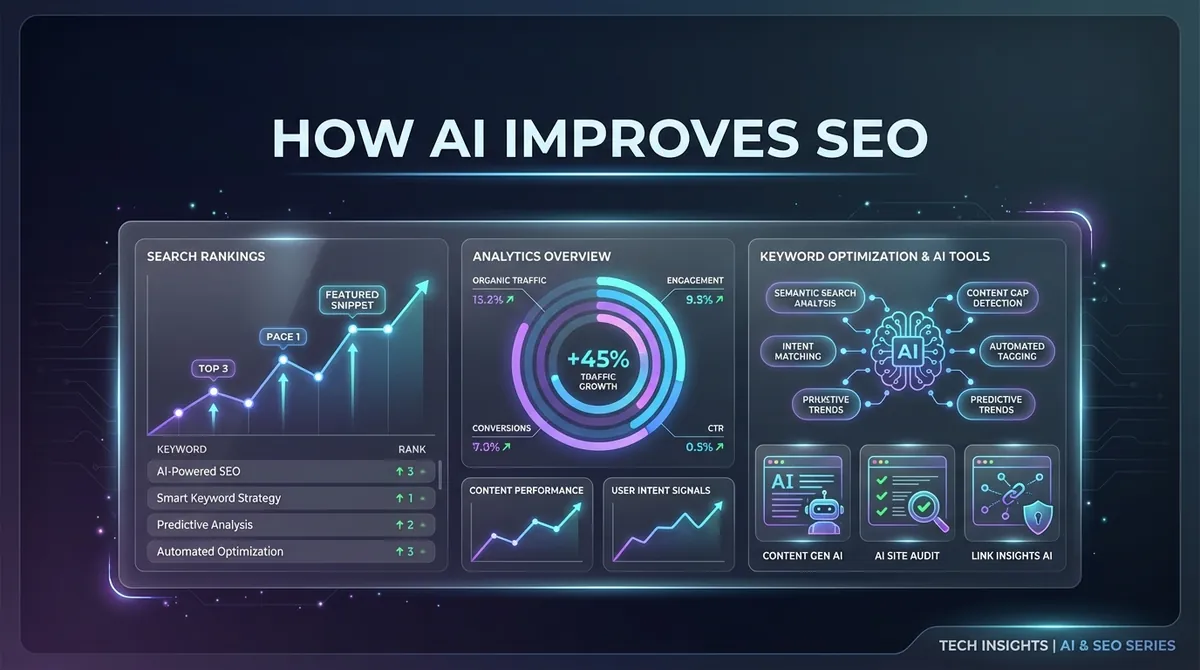
Artificial Intelligence is dramatically changing this equation in 2026. AI tools are now actively assisting and in many cases automating the most time-consuming and analytically intensive aspects of SEO, from keyword research and content creation to technical site auditing, backlink analysis, rank tracking, and search intent understanding. At the same time, Google and other search engines are themselves deploying increasingly sophisticated AI systems to evaluate content quality, understand search intent, and detect manipulative SEO tactics — making an understanding of AI essential for anyone serious about organic search performance.
This comprehensive guide explores precisely how AI is improving SEO practice in 2026, which specific capabilities are most valuable, and importantly, how the growing intersection of SEO and cybersecurity creates new risks and opportunities for digital marketers.
1. AI-Powered Keyword Research
Keyword research is the foundation of any effective SEO strategy, and AI has dramatically expanded both the depth and speed at which keyword intelligence can be gathered and interpreted.
Semantic Keyword Discovery
Traditional keyword research tools primarily identified keywords based on direct text matching with seed terms. AI-powered keyword research tools use natural language processing and semantic similarity analysis to identify thematically related keyword clusters, related long-tail variations, and semantically adjacent topics that users interested in your primary topic are also likely searching for. This semantic keyword intelligence enables content strategies that satisfy user intent more comprehensively, one of the most critical factors in modern search ranking.
Search Intent Classification
Google's ranking algorithms are increasingly sophisticated in evaluating whether a piece of content genuinely satisfies the underlying intent behind a search query — whether the user is looking for information, seeking a specific website, comparing options before a purchase, or ready to transact immediately. AI tools trained specifically on search intent patterns can automatically classify the intent behind thousands of keywords simultaneously, enabling SEO strategists to ensure their content type and format precisely matches user expectations for each target query.
Competitive Gap Analysis
AI-powered competitive analysis tools can systematically analyse the keyword rankings of multiple competitor domains simultaneously, identifying specific keyword categories where competitors rank well but your domain does not, revealing the precise content investment opportunities most likely to close competitive ranking gaps.
2. AI Content Creation and Optimisation
Content quality is the single most important long-term driver of organic search performance. AI is transforming how SEO-optimised content is created and refined.
Automated Content Brief Generation
Rather than relying on writers to manually research competitor content before writing, AI tools can automatically generate comprehensive content briefs that analyse the top-ranking pages for a target keyword and extract the key topics, subtopics, questions, entities, and semantic concepts that high-ranking content consistently covers. This intelligence ensures that newly created content is architecturally competitive from the first draft.
AI Writing Assistance
AI writing tools including ChatGPT, Claude, and Jasper are widely used to assist in drafting, expanding, and refining SEO content at a speed that would be impossible with purely human writing resources. Critically, effective AI content writing for SEO requires skilled human editorial direction and review — AI-generated content published without human refinement tends to be generic, lack genuine expertise and perspective, and is increasingly identifiable by search engine quality evaluation systems.
Content Refresh Identification
AI tools can systematically audit large content libraries to identify pages where search rankings have declined, traffic has fallen, or content freshness signals suggest the content has become outdated, prioritising the most impactful content refresh opportunities across domains with thousands of indexed pages.
3. Technical SEO Automation
Technical SEO — ensuring that a website's architecture, code, and performance meet search engine crawlability, indexability, and performance requirements — is one of the most analytically intensive and time-consuming aspects of professional SEO practice. AI is increasingly automating the most repetitive elements of technical SEO analysis.
Automated Site Auditing
AI-powered site crawling tools automatically analyse entire website architectures for hundreds of technical SEO issues simultaneously, including broken links, redirect chains, duplicate content, missing meta tags, incorrect canonical tag implementation, Core Web Vitals performance issues, mobile usability problems, structured data errors, and crawl budget inefficiencies. AI triage systems intelligently prioritise these issues by their estimated organic search ranking impact, enabling SEO teams to focus remediation efforts on the most commercially significant technical problems first.
Core Web Vitals Optimisation
Core Web Vitals — Google's standardised set of user experience performance metrics covering page loading speed, visual stability, and interactivity responsiveness — are significant ranking factors. AI-powered performance analysis tools can identify specific code-level optimisation opportunities at scale across large websites, automatically flagging render-blocking resources, unoptimised images, inefficient JavaScript execution, and other technical performance bottlenecks.
4. AI-Powered Link Building
Backlink acquisition remains one of the most powerful off-page SEO signals for search ranking in 2026. AI is improving the efficiency and targeting precision of link building operations.
Prospect Identification
AI prospecting tools systematically analyse the backlink profiles of top-ranking competitor pages to identify specific websites that link to multiple competitors in your niche but not to your domain, representing high-probability link acquisition opportunities likely to be receptive to relevant outreach.
Outreach Personalisation
AI writing tools are used to generate highly personalised outreach emails at scale, analysing individual prospect websites and crafting tailored communication that demonstrates genuine understanding of each prospect's content and audience rather than sending generic templated outreach at scale.
5. The SEO–Cybersecurity Connection
The intersection of SEO and cybersecurity is an important and often overlooked dimension of modern digital marketing operations.
SEO Attacks: Negative SEO
Negative SEO attacks involve malicious competitors building large volumes of spammy or manipulative backlinks to a target website in an attempt to trigger a Google spam penalty and suppress its organic rankings. Monitoring backlink profiles for sudden anomalous link acquisition patterns using AI-powered link analysis tools is an important defensive capability for protecting organic search visibility.
Hacked Site Content Injection
Cybercriminals routinely target vulnerable websites and inject hidden spam content — pharmaceutical keyword pages, gambling links, malware download pages — that destroys the compromised site's search engine reputation while providing the attacker with free PageRank and search traffic for their malicious purposes. Regular security scanning and search console monitoring are essential for detecting these attacks quickly.
Malicious Redirects
Website compromises are sometimes used to implement hidden redirect scripts that send some percentage of organic search traffic silently to attacker-controlled websites, siphoning commercial value from organic search without the site owner's knowledge. AI-powered site monitoring tools can detect anomalous redirect patterns that may indicate a website compromise.
Core Web Vitals and DDoS
Distributed Denial of Service attacks that degrade website response times directly impact Core Web Vitals scores, which are ranking factors. A sustained DDoS attack against a competitor's website is therefore also effectively an SEO attack — though an illegal and rare one. Robust DDoS protection infrastructure is therefore also important for protecting organic search performance.
Short Summary
AI is comprehensively transforming SEO practice in 2026, delivering productivity and strategic advantages across keyword research, content creation, technical site auditing, and link building operations. AI tools enable SEO programmes to operate at dramatically greater scale and analytical depth than purely human teams could achieve independently. The growing intersection of SEO and cybersecurity — through negative SEO attacks, hacked site content injection, and malicious redirect schemes — makes cybersecurity awareness an increasingly important competency for modern SEO professionals.
Conclusion
In 2026, effective SEO and responsible AI adoption are inseparable disciplines. Search engines themselves use increasingly sophisticated AI to evaluate content quality, detect manipulation, and understand user intent with remarkable nuance. Organisations that strategically deploy AI SEO tools to create genuinely useful, comprehensive, and technically excellent content will accumulate durable organic search advantages. Those that attempt to exploit AI for low-quality content shortcuts will find themselves on the wrong side of increasingly capable and ruthless search engine quality enforcement systems.
Frequently Asked Questions
AI is dramatically augmenting SEO professionals' capabilities rather than replacing them. AI tools automate the most repetitive and data-intensive aspects of SEO work, freeing skilled SEO practitioners to focus on strategic thinking, creative content direction, stakeholder communication, and complex technical problem-solving that still requires human expertise and judgment.