
Introduction
Two of the most transformative and frequently discussed technologies of the decade are Augmented Reality and Virtual Reality. While both technologies fall under the umbrella term "Extended Reality" (XR), they are fundamentally different in how they interact with the user's environment. Understanding the precise distinction between AR and VR is essential not only for technologists and developers but increasingly for cybersecurity professionals who must protect the unique attack surfaces each technology introduces.
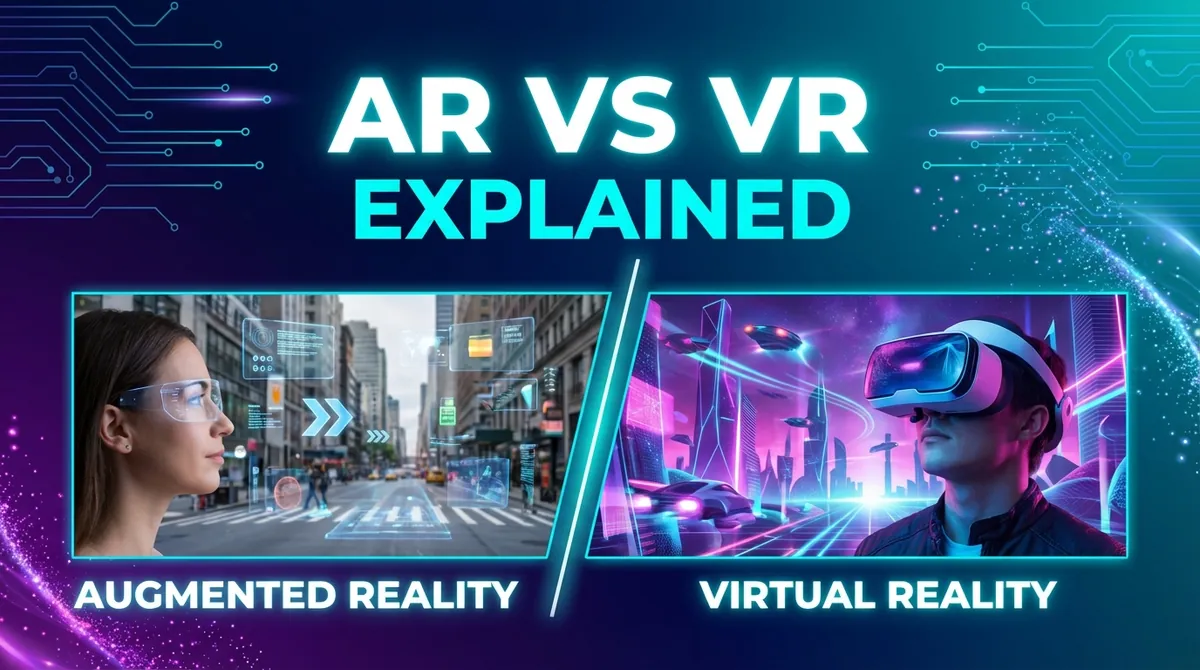
Augmented Reality (AR) enhances the real world by seamlessly layering digital information, graphics, and interactive elements onto live physical environments. Virtual Reality (VR) goes further and completely replaces the real world by immersing the user in a fully simulated, interactive digital environment. Both technologies have evolved dramatically since their initial introduction and are now being deployed across healthcare, defense, education, entertainment, retail, and enterprise environments worldwide.
This comprehensive guide will clearly and systematically break down the key differences between AR and VR, explore their respective strengths and limitations, examine their most impactful real-world use cases, and analyze the unique cybersecurity challenges each technology presents for organizations deploying them in 2026.
1. The Fundamental Difference
The single most important distinction between AR and VR centers around one concept: the relationship between reality and the digital experience.
Augmented Reality adds to reality. The user always sees and interacts with their real physical environment. Digital elements are overlaid on top of that reality, enhancing it with additional information or interactive digital objects. The real world is the primary experience; digital content is supplementary.
Virtual Reality replaces reality. The user is completely cut off from their physical environment and immersed in an entirely simulated digital world. The VR experience is the primary environment; the real world is temporarily suspended.
This fundamental difference drives every other distinction between the two technologies, including their hardware requirements, software architectures, deployment contexts, user experiences, and cybersecurity risk profiles.
2. Hardware: What Each Technology Requires
Augmented Reality Hardware
AR can run on a remarkably wide range of hardware, from consumer smartphones and tablets to sophisticated smart glasses and dedicated industrial AR headsets. This broad hardware accessibility is one of AR's greatest strengths. The hardware must include cameras to capture the real-world environment, sensors for spatial tracking, and a display to show the blended AR view. Notable AR hardware platforms include Microsoft HoloLens, Apple Vision Pro, Snap Spectacles, and standard iOS and Android smartphones running ARKit and ARCore respectively.
Virtual Reality Hardware
VR has much stricter hardware requirements because it must generate a fully immersive, high-frame-rate, low-latency 3D visual environment that convincingly replaces reality without causing motion sickness. VR requires dedicated head-mounted displays (HMDs) with high-resolution screens, wide field-of-view lenses, precise head tracking systems, hand controllers, and typically a powerful computing platform to render the complex 3D virtual world in real time. Leading VR platforms include Meta Quest, PlayStation VR2, Valve Index, and HP Reverb.
3. Use Cases: Where Each Technology Excels
Where AR Excels
Industrial Maintenance: AR is ideally suited to industrial environments where workers need to access technical information, instructions, and schematics while keeping their hands free and eyes on their physical work. AR overlays the relevant digital information directly onto the machinery or component a technician is working on.
Retail and E-Commerce: AR's ability to overlay virtual products into a real environment makes it perfect for virtual try-on experiences in fashion, cosmetics, eyewear, and furniture retail.
Emergency Services Navigation: First responders use AR to overlay building floor plans, hazardous material locations, and victim positions onto their physical view of a building during emergency response operations.
Surgical Guidance: Surgeons use AR to overlay patient imaging data directly onto their field of view during operations, enabling greater precision.
Where VR Excels
Immersive Training Simulations: VR is uniquely powerful for high-stakes training scenarios where real-world practice is dangerous or impractical. Military personnel, pilots, firefighters, and emergency surgeons all benefit enormously from VR-based training simulations that replicate real scenarios with high fidelity.
Mental Health Therapy: VR-based exposure therapy has proven highly effective for treating phobias, PTSD, and anxiety disorders by allowing patients to confront and process difficult scenarios in a safe, controlled, and fully immersive simulated environment.
Architecture and Design Visualization: VR allows architects, engineers, and interior designers to walk through photorealistic 3D models of buildings and spaces that exist only as digital files, enabling dramatically better design review and client communication.
Entertainment and Gaming: VR's ability to deliver fully immersive, interactive digital worlds makes it unparalleled for entertainment and gaming experiences that would be physically impossible in the real world.
4. Mixed Reality: The Convergence
A third and increasingly prominent category exists at the intersection of AR and VR: Mixed Reality (MR). Mixed Reality creates experiences where real and virtual worlds coexist and interact with each other in real time. Unlike basic AR, digital objects in a Mixed Reality environment genuinely interact with and respond to real physical objects. A virtual ball in an MR environment would bounce off a real physical desk. Microsoft HoloLens is the most prominent commercial example of a true Mixed Reality platform.
5. Cybersecurity Challenges of AR vs VR
AR-Specific Security Risks
Because AR continuously captures video of real physical environments, it creates substantial privacy and surveillance risks. A compromised AR device in a corporate boardroom could stream confidential meetings to an attacker. AR data injection attacks, where an adversary manipulates the digital overlay data displayed to a user, could cause workers to perform incorrect or dangerous actions. Securing AR requires end-to-end encryption of all environmental data streams, rigorous device authentication, and strict data minimization policies.
VR-Specific Security Risks
VR presents different but equally serious security challenges. The deep immersive nature of VR makes users highly susceptible to sophisticated social engineering attacks. A convincing VR simulation could be used to manipulate a user into revealing sensitive credentials or authorizing fraudulent transactions. VR environments that facilitate multiplayer interaction introduce avatar impersonation risks. The biometric data collected by VR headsets, including precise eye movement patterns, facial geometry, and hand movement signatures, represents a uniquely sensitive category of personal data that could be exploited for identity verification bypass or sophisticated behavioral profiling.
Short Summary
AR and VR are related but fundamentally different technologies. AR enhances the real world with digital overlays and runs on accessible hardware including smartphones. VR completely replaces reality with an immersive simulation and requires dedicated head-mounted displays. AR excels in industrial, retail, and medical applications where interaction with the physical world is essential. VR excels in immersive training, therapy, and entertainment applications. Both technologies introduce unique and serious cybersecurity risks that require specialized security approaches tailored to each technology's specific data handling and user interaction models.
Conclusion
Whether you are a business leader evaluating which extended reality technology to adopt, a developer building the next generation of immersive applications, or a cybersecurity professional tasked with protecting these new digital frontiers, understanding the precise distinction between AR and VR is foundational knowledge in 2026. Both technologies are maturing rapidly, their costs are falling, their capabilities are expanding enormously, and their deployment across critical industries is accelerating. The question is no longer if your organization will interact with AR or VR technology, but when, and whether your security posture will be ready.
Frequently Asked Questions
Neither is inherently better. Each technology is superior for specific use cases. AR is better when interaction with the real physical world is essential, such as in industrial maintenance or navigation. VR is better when full immersion and isolation from the real world is required, such as in training simulations or therapy. Many organizations are beginning to deploy both in complementary roles across different operational contexts.