Introduction
The global AI industry is generating one of the most significant waves of high-paying professional employment opportunities in the history of technology. In 2026, organisations across every major industry — technology, healthcare, finance, retail, manufacturing, defence, and government — are racing to build internal AI capabilities, creating massive and growing demand for professionals with AI-related skills.
However, the AI job market is enormously diverse and frequently misunderstood. "AI jobs" is not a single, monolithic professional category. It encompasses dozens of distinct roles with vastly different skill requirements, responsibilities, compensation levels, and organisational contexts. A Machine Learning Research Scientist at a leading AI laboratory has a completely different role profile from an AI Product Manager at a retail enterprise, which in turn differs fundamentally from an MLOps Engineer maintaining production AI infrastructure or an AI Security Analyst protecting AI-powered enterprise systems from cyber threats.
This comprehensive guide clearly explains the most important and in-demand AI job roles in 2026, the specific skills required for each, the organisational contexts where each role is most commonly found, and the career pathways that lead into these roles for professionals at different stages of their careers.
1. Machine Learning Engineer
Machine Learning Engineers are the core technical builders of AI systems. They design, develop, train, evaluate, and deploy machine learning models that power AI applications across every industry and use case.
Core Responsibilities
ML Engineers translate raw business requirements into machine learning problem formulations, select appropriate model architectures, prepare and engineer training data, train and evaluate model performance, optimise models for production deployment constraints, and collaborate with software engineers to integrate ML models into production applications.
Required Skills
Proficiency in Python and its core ML libraries (PyTorch, TensorFlow, scikit-learn, Hugging Face Transformers) is foundational. Strong understanding of core ML algorithms including supervised learning, unsupervised learning, and deep neural network training is essential. Production ML engineering also requires solid software engineering fundamentals including version control, testing, CI/CD pipelines, and cloud infrastructure management.
Typical Employer Profile
Technology companies, AI-first startups, large enterprises with significant ML adoption, and cloud platform providers (Google, AWS, Azure).
Salary Range (2026)
$120,000–$250,000+ annually depending on specialisation, seniority, and employer type.
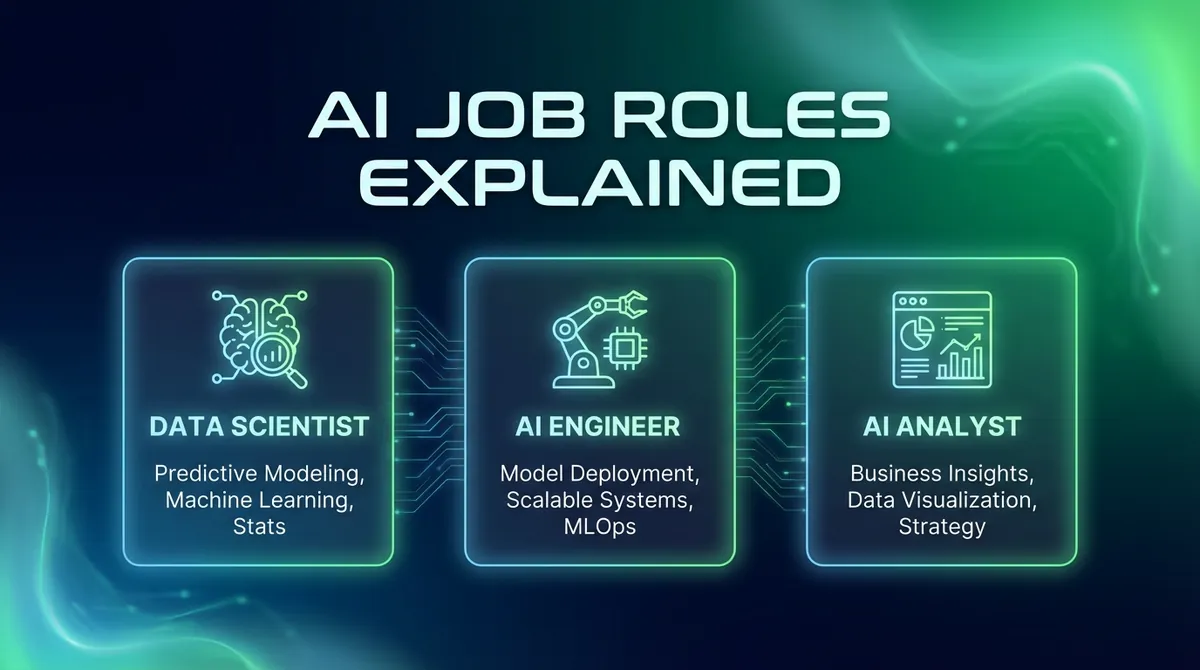
2. Data Scientist
Data Scientists apply statistical analysis, machine learning, and data visualisation techniques to extract actionable insights from complex datasets that inform business decisions and strategy.
Core Responsibilities
Data Scientists define analytical questions in collaboration with business stakeholders, collect and clean relevant data from multiple sources, apply statistical and ML methods to identify patterns and build predictive models, communicate findings through clear data visualisation and storytelling, and monitor deployed model performance over time.
Required Skills
Strong statistical foundations, proficiency in Python and R for data analysis, experience with SQL for database querying, data visualisation expertise (Tableau, Power BI, Matplotlib), and the ability to communicate quantitative insights clearly to non-technical business stakeholders.
How Data Science Differs from ML Engineering
Data Scientists focus primarily on analysis, experimentation, and insight generation. ML Engineers focus primarily on building scalable, production-ready ML systems. In practice, many organisations blend these roles, and the boundary is increasingly blurred in the modern AI stack.
3. AI / ML Research Scientist
AI Research Scientists conduct original scientific research to advance the theoretical foundations and practical capabilities of AI systems. They work primarily in AI research laboratories, university research groups, and the research divisions of technology companies.
Core Responsibilities
Developing novel ML model architectures, training procedures, or theoretical frameworks; conducting rigorous scientific experiments to validate new approaches; publishing research in peer-reviewed academic venues; collaborating with engineering teams to transfer research advances into practical production systems.
Required Skills
Strong mathematical foundations (linear algebra, calculus, probability theory, statistics), deep expertise in current ML research literature, experience designing and conducting scientific experiments, and solid programming skills for research implementation.
Typical Employer Profile
OpenAI, Google DeepMind, Anthropic, Meta AI Research, Microsoft Research, academic research universities, and national research laboratories.
4. MLOps Engineer
Machine Learning Operations (MLOps) Engineers build and maintain the production infrastructure required to deploy, monitor, scale, and reliably operate machine learning models in enterprise production environments.
Core Responsibilities
Building ML training and serving infrastructure, implementing model deployment pipelines, developing model monitoring and drift detection systems, managing ML experiment tracking and model versioning, configuring cloud infrastructure for scalable ML workloads, and ensuring ML system reliability, scalability, and security.
Required Skills
Strong cloud platform expertise (AWS SageMaker, Google Vertex AI, Azure ML), containerisation and orchestration (Docker, Kubernetes), CI/CD pipeline design, ML experiment tracking tools (MLflow, Weights & Biases), monitoring infrastructure (Prometheus, Grafana), and solid software engineering foundations.
5. AI Product Manager
AI Product Managers bridge the gap between AI technical capabilities and business product strategy, defining what AI-powered products and features should be built, for whom, and why.
Core Responsibilities
Understanding customer needs and translating them into AI product requirements, working with ML Engineers and researchers to evaluate technical feasibility, prioritising AI feature development roadmaps, managing stakeholder expectations for AI product performance and limitations, and defining success metrics for AI product deployments.
Required Skills
Strong product management fundamentals, sufficient technical literacy to engage credibly with ML Engineering teams, user research and customer empathy, data analysis capability, experience with agile development methodologies, and clear communication skills for managing diverse stakeholder groups.
6. Prompt Engineer
Prompt Engineering has emerged as a genuinely distinct professional specialisation in 2026, focused on optimising the design of inputs to large language models and generative AI systems to maximise output quality and task relevance in specific professional contexts.
Core Responsibilities
Designing, testing, and iterating on system prompts and user prompt frameworks for enterprise AI applications, developing prompt libraries and best practice guidelines, evaluating LLM output quality and consistency, identifying prompt injection vulnerabilities, and collaborating with AI product teams on LLM-powered feature development.
7. AI Security Analyst
AI Security Analysts specialise in protecting AI systems from cyberattacks and evaluating the security implications of AI technology deployments within organisational security postures.
Core Responsibilities
Assessing AI system attack surfaces including model extraction, adversarial input attacks, prompt injection, data poisoning, and training data privacy risks; conducting security testing of AI-powered applications; developing AI-specific security standards and governance frameworks; monitoring production AI systems for anomalous behaviour; and advising on secure AI architecture design.
Why This Role Matters
As AI systems become embedded in critical enterprise infrastructure, the attack surface they introduce grows proportionally. Traditional cybersecurity professionals often lack the specific ML knowledge required to understand AI-specific attack vectors. AI Security Analysts fill this critical gap at the intersection of machine learning and cybersecurity.
Short Summary
The AI job market in 2026 encompasses a rich and diverse ecosystem of specialised professional roles including Machine Learning Engineers, Data Scientists, AI Research Scientists, MLOps Engineers, AI Product Managers, Prompt Engineers, and AI Security Analysts. Each role has distinct skill requirements, responsibilities, and career pathways. The most effective career development strategy combines foundational technical skills with domain specialisation, continuous learning, and increasing proficiency in the AI tools becoming standard in every professional field.
Conclusion
Building a career in AI in 2026 offers exceptional professional and financial opportunities for those willing to invest in developing the required technical and domain-specific skills. The diversity of AI role types means that individuals with backgrounds in software engineering, statistics, product management, cybersecurity, domain expertise, and many other disciplines all have viable pathways into rewarding AI careers. The common thread across all AI roles is a commitment to continuous learning in one of the fastest-moving technical landscapes in modern professional life.
Frequently Asked Questions
A computer science or related STEM degree is a common pathway into technical AI roles like ML Engineering and Research Scientist. However, many successful AI professionals have entered the field through online courses, bootcamps, and portfolio project demonstration combined with domain expertise from prior careers. Employers increasingly value demonstrated capability and portfolio evidence alongside formal credentials.