Introduction
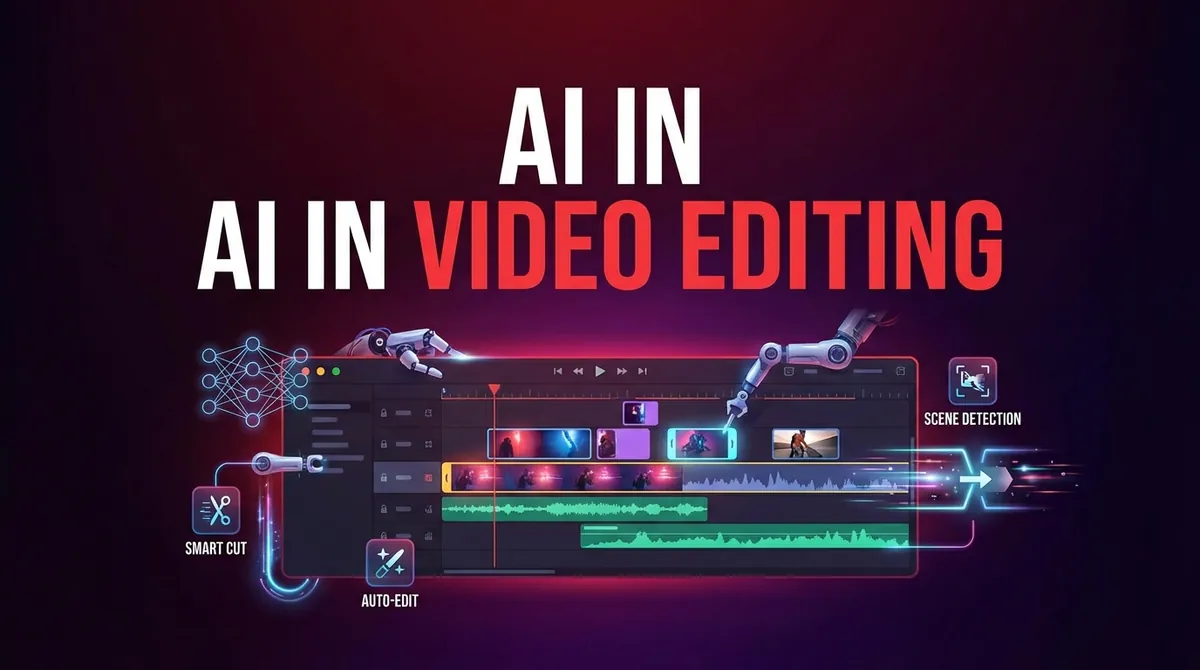
The video production industry is currently navigating its most significant technological disruption since the transition from film to digital. In 2026, Artificial Intelligence has moved from being a supplementary "plugin" to becoming the core engine of the video editing workflow. Tasks that previously required days of painstaking manual labor—rotoscoping, color matching, dialogue cleaning, and even scene extension—are now handled in seconds by intelligent algorithms.
For creators, from solo YouTubers to high-end Hollywood post-production houses, AI represents a "creative force multiplier." It democratizes high-end visual effects and professional polishing, allowing anyone with a computer to tell visually stunning stories. However, the exact same technology that enables creative brilliance is also being used to create incredibly convincing "deepfake" content, posing a massive new challenge for cybersecurity and digital trust.
This guide explores the state of AI in video editing in 2026, the specific tools and workflows that are redefining the industry, and the critical cybersecurity protocols required to verify truth in an era where seeing is no longer believing.
1. The AI Video Editing Workflow in 2026
Automated Scene Detection and "Rough Cut" Generation
AI can now watch hours of raw footage and automatically identify key moments, emotional beats, and specific dialogue prompts. Editors can simply "ask" the AI to "create a 60-second highlight reel with an upbeat tempo focusing on the outdoor shots," and the AI will generate a credible rough cut in seconds. This allows human editors to start at the 80% completion mark rather than from scratch.
Generative Visual Effects (VFX)
Traditionally, adding or removing objects from a scene required expensive specialist work. In 2026, "Generative Fill" for video allows editors to remove a distracting telephone pole from a 4K shot or "expand" the background of a scene using just a text prompt. AI can also handle complex lighting adjustments, ensuring that a person filmed in a dark room can be convincingly placed into a sun-drenched beach scene with perfect shadows and reflections.
Audio Intelligence: Beyond Noise Reduction
AI has perfected "Voice Isolation," allowing editors to take a recording from a noisy street and make it sound like it was recorded in a silent studio. Furthermore, "AI Voice Re-recording" allows creators to fix a single misspoken word by typing the correct text, which the AI then generates in the original actor's voice with matching emotional inflection—eliminating the need for expensive ADR (Automated Dialogue Replacement) sessions.
2. Leading AI Video Tools
Adobe Premiere Pro and After Effects (Firefly Integration)
Adobe has maintained its industry lead by deeply integrating its "Firefly" generative AI into its professional suite. Features like "Text-to-VFX" and "Generative Extend" allow professionals to solve production problems directly within their timeline without jumping between different specialized softwares.
DaVinci Resolve (Neural Engine)
Blackmagic Design’s DaVinci Resolve utilizes a powerful "Neural Engine" for sophisticated tasks like face refinement, object tracking, and automated "magic mask" selection. It is widely considered the gold standard for AI-assisted color grading and professional finishing.
Sora and Runway (Generative Video)
Runway and OpenAI’s Sora are the pioneers of "Video-from-Text." While these were initially seen as novelties, in 2026 they are used as "B-roll generators." If an editor needs a quick shot of a "futuristic cityscape at night" or a "slow-motion shot of coffee pouring into a cup," they can simply generate it rather than searching stock libraries or organizing a new shoot.
3. The Creator's New Skillset: "AI Direction"
The role of the video editor is shifting from a "technician" (someone who pushes the buttons) to a "Director/Editor" (someone who guides the AI). Mastery in 2026 involves:
- Prompt Engineering for Video: Learning how to describe desired visual changes or generated assets in a way the AI understands.
- Atypical Judgment: Knowing when an AI-generated effect looks "too perfect" or "uncanny" and knowing how to manually adjust it to feel authentic.
- Hybrid Workflow Management: Knowing which tasks to automate and which tasks require the "delicate human touch" of artistic pacing and emotional nuance.
4. Cyber Security: The Deepfake and Verification Crisis
As video AI becomes more powerful, the risks associated with fraudulent content have skyrocketed.
The Rise of High-Fidelity Deepfakes
In 2026, deepfakes are no longer just "obvious fakes." They are pixel-perfect, making it possible to convincingly put words into the mouths of politicians, CEOs, and celebrities. This is being used for corporate espionage, stock market manipulation, and sophisticated "voice phishing" scams.
Content Credentials and Digital Watermarking
To combat this, the industry has adopted "Content Credentials" (based on the C2PA standard). Major editing softwares now automatically embed a "digital nutrition label" into the video's metadata. This record shows exactly what part of the video is original, what was edited with AI, and which AI model was used.
AI vs. AI: Automated Deepfake Detection
Cybersecurity firms now use "Detection AI" to scan videos for subtle inconsistencies that the human eye cannot see—such as microscopic "artifacts" in skin texture or unnatural blood flow patterns in the face (photoplethysmography). For any high-stakes communication, "Verify before you View" has become the primary security protocol.
Short Summary
AI is revolutionizing video editing in 2026, automating the "grunt work" of post-production and enabling sophisticated generative VFX that were once only possible for major studios. Tools like Adobe Firefly and DaVinci Resolve are empowering a new generation of "AI-assisted" creators. However, the rise of powerful video generation also brings a crisis of trust. Implementing digital watermarking, content credentials, and advanced deepfake detection is now as critical as the creative process itself to ensure digital authenticity in the AI era.
Conclusion
Video editing in the age of AI is a balance of immense creative freedom and significant ethical responsibility. While the tools of 2026 allow us to create "impossible" visuals, we must also build the infrastructure of truth to protect our digital world from deception. For the modern editor, success means being an artist, a prompt engineer, and a guardian of authenticity all at once.
Frequently Asked Questions
In 2026, AI can create a coherent "assembly cut" of a scene, but it lacks the "artistic soul" required for final editing. Pacing, emotional resonance, and "subtext" are still deeply human skills that AI cannot replicate.