Introduction
The transportation industry is currently navigating its most profound transformation since the invention of the internal combustion engine. In 2026, Artificial Intelligence has moved beyond experimental pilots to become the operational standard across automotive, maritime, aviation, and rail sectors. We are entering an era of "Software-Defined Transportation," where the value and safety of a vehicle depend as much on its algorithms as its physical engineering.
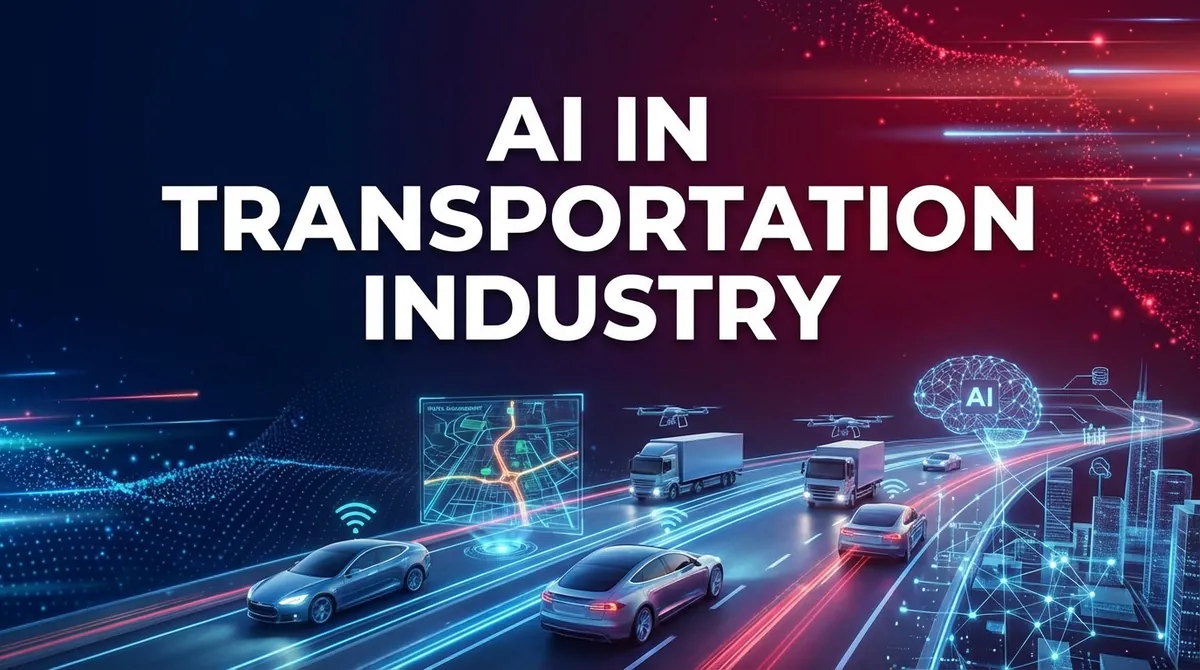
From self-driving trucks that operate 24/7 on major highways to AI-guided drones delivering medical supplies in urban centers, and autonomous cargo ships navigating the world's oceans, AI is increasing efficiency, reducing human error, and creating new economic possibilities. However, as the physical world becomes increasingly controlled by digital systems, the boundary between "Safety" and "Cybersecurity" has dissolved. In 2026, a cyberattack on a transportation network is not just a data breach—it is a direct threat to human life.
This article explores the state of AI in the transportation industry in 2026, examines the technologies driving the shift toward autonomy, and outlines the critical cybersecurity challenges that must be overcome to ensure a safe and resilient global transit network.
1. The Rise of Autonomous and Software-Defined Vehicles
Level 4 and Level 5 Autonomy in 2026
In 2026, many of the world's major highways have dedicated lanes for Level 4 autonomous trucks. These vehicles can operate without human intervention in specific conditions, significantly reducing the cost of long-haul logistics and addressing global driver shortages. In urban environments, "Robotaxi" fleets are now a common fixture in several major world cities, providing on-demand, affordable transit without a human driver.
The Software-Defined Vehicle (SDV)
Modern vehicles in 2026 are essentially "Computers on Wheels." Manufacturers now prioritize software updates over physical model changes, using AI to continuously improve battery life, engine performance, and even "Driver Monitoring Systems" that detect fatigue or distraction in real-time. This connectivity allows for "Predictive Maintenance," where the vehicle identifies a potential part failure and schedules its own repair at a local service center.
2. AI in Aviation and Maritime Logistics
AI-Enhanced Flight Safety and Operations
While fully autonomous passenger planes are still in the future, AI in 2026 handles massive amounts of "Cockpit Assistance." AI systems process data from thousands of sensors to help pilots avoid turbulence, optimize fuel consumption by finding the most efficient wind currents, and assist in emergency landings during equipment failure.
Autonomous "Ghost Ships" and Maritime Efficiency
The global shipping industry is seeing the rise of semi-autonomous cargo vessels. These "Ghost Ships" use AI and computer vision to navigate busy shipping lanes, docking themselves with centimeter-level precision. AI also optimizes the "Container Tetris" involved in loading ships, ensuring maximum cargo density and stability, which saves millions in fuel costs each year.
3. Intelligent Public Transit and Rail
Cities are using AI to revitalize public transport. AI-guided bus rapid transit (BRT) and tram systems now adjust their schedules in real-time based on actual passenger demand rather than fixed timetables. In the rail sector, AI-powered "Signal Management" allows for higher-frequency train service on existing tracks, increasing city capacity without the need for massive new construction projects.
4. Cyber Security: The Non-Negotiable Foundation
As transportation becomes autonomous and connected, it introduces a dangerous new category of cyber risk.
GPS Spoofing and Hijacking
Autonomous vehicles depend entirely on Precision Positioning, Navigation, and Timing (PNT) data. Attackers can use "GPS Spoofing" to send false signals to a vehicle, tricking it into changing its programmed route or causing it to navigate into a dangerous situation. Securing the integrity of GPS signals is now a top-tier national security concern.
Vehicle-to-Everything (V2X) Vulnerabilities
Modern vehicles communicate with each other (V2V) and with city infrastructure like traffic lights (V2I). This "V2X" network is a target for attackers who want to cause mass disruption. A single compromised communication node could theoretically trigger a chain reaction of accidents or cause city-wide gridlock. Implementing a "Zero Trust" model for V2X communications is essential.
Remote Hijacking of OT Systems
The Operational Technology (OT) systems that control the physical functions of a vehicle—braking, steering, acceleration—are now connected to the internet. If an attacker gains access to a vehicle's "CAN bus" (internal network) via an insecure entertainment system or a remote software update, they could theoretically take full control of the vehicle. "Air-gapping" critical safety systems from non-essential infotainment systems is a primary engineering requirement in 2026.
Short Summary
AI is revolutionizing the transportation industry in 2026, driving the adoption of autonomous trucks, software-defined vehicles, and intelligent maritime logistics. These advancements improve efficiency and safety across all modes of transit. However, the connectivity required for these features creates severe cybersecurity risks, including GPS spoofing, V2X network disruption, and remote vehicle hijacking. Success in the future of transport requires not just better algorithms, but a "Security-by-Design" approach where protection against digital sabotage is as fundamental as the engineering of the brakes.
Conclusion
The future of transportation is autonomous, connected, and intelligent. While the benefits to the economy and human mobility are immense, they come with a responsibility to protect these systems from unprecedented digital threats. The transportation leaders of 2026 are those who realize that in the age of AI, cybersecurity is safety.
Frequently Asked Questions
No vehicle is 100% "unhackable." However, 2026 models use sophisticated "Defense-in-Depth" architectures, including encrypted internal communications, isolated safety systems, and AI-powered intrusion detection that can identify and neutralize an attack attempt in milliseconds.