Introduction
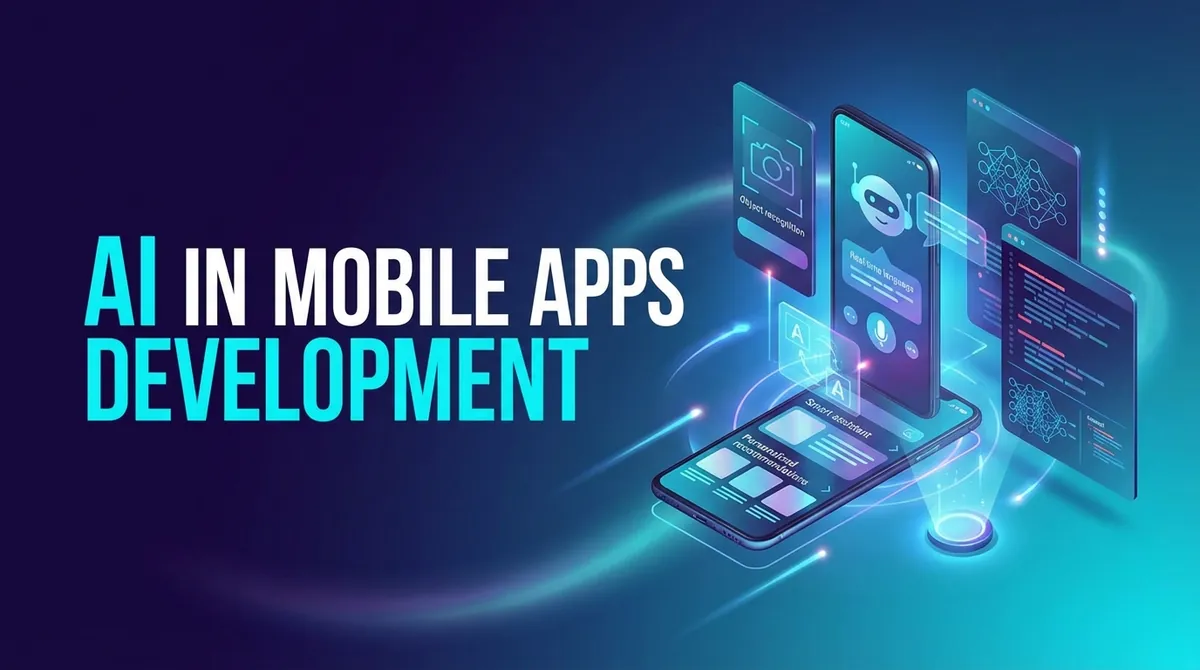
In the mid-2020s, the definition of a "mobile app" has shifted fundamentally. No longer just a static set of features on a small screen, the successful mobile applications of 2026 are dynamic, intelligent, and deeply personalised ecosystems powered by Artificial Intelligence. From predictive text and image recognition to sophisticated biometric security and real-time translation, AI is the "invisible engine" driving the next generation of the mobile user experience.
For developers and product managers, integrating AI into mobile apps is no longer a "future consideration"—it is the standard requirement for staying relevant in the App Store and Google Play. However, this shift towards AI-centric development introduces a massive new layer of technical complexity, particularly when it comes to balancing powerful features with user privacy and application security.
This guide explores the cutting-edge trends in AI-powered mobile app development in 2026, identifies the core technologies every developer must master, and addresses the critical cybersecurity vulnerabilities that come with bringing AI to the devices we carry in our pockets.
1. Key AI Features in 2026 Mobile Apps
Predictive Personalization (Anticipatory Design)
The most successful apps in 2026 don't wait for a user's command; they anticipate the user's needs. By analyzing historical behavior, location data, and even hardware sensor inputs (like heart rate or acceleration), AI-driven apps can suggest the right feature at the right moment. An e-commerce app might surface a specific product based on your morning browsing habits, or a fitness app might suggest a specific workout because it detects you've had a stressful day.
Conversational and Multimodal Interfaces
Touch screens are increasingly being supplemented by sophisticated voice and visual interfaces. Mobile AI now allows for "natural language" interactions that feel like real conversations. Furthermore, "visual search"—where a user points their phone camera at an object to identify it, translate text, or find a purchase link—has become a standard feature in everything from social media to warehouse management apps.
AI-Powered Biometric Security
While Fingerprint and FaceID were the early pioneers, mobile security in 2026 utilizes "Continuous Behavioral Biometrics." AI monitors how a person uniquely interacts with their device—their typing rhythm, their gait while walking with the phone, and even their swipe patterns. If these patterns deviate, the app can automatically trigger an extra layer of authentication, protecting sensitive banking or health data even if the phone itself is unlocked.
2. On-Device AI vs. Cloud AI: The Great Hybrid Shift
A major technical trend in 2026 is the movement towards "Edge AI" or "On-Device Processing."
The Benefits of On-Device AI
Traditionally, mobile AI required sending user data to a powerful server in the cloud, processing it, and sending the result back. This created latency and privacy risks. Modern mobile chips (from Apple, Qualcomm, and MediaTek) now include dedicated "Neural Processing Units" (NPUs) that allow complex AI models to run directly on the phone. This results in instant response times, offline functionality, and significantly better privacy as the user's data never leaves the device.
The Role of the Hybrid Cloud
For extremely large data sets or "Generative AI" tasks (like creating a 3D model or a high-res video within an app), developers still rely on the cloud. The "Hybrid AI" model allows the app to perform quick, privacy-sensitive tasks locally while offloading the "heavy lifting" to high-performance cloud GPUs only when necessary.
3. The Developer's AI Toolkit
CoreML (Apple) and TensorFlow Lite (Google)
To build AI apps, developers must be proficient in the frameworks that bridge the gap between machine learning models and mobile hardware. CoreML is Apple's framework for integrating ML models into iOS apps with high efficiency. For Android and cross-platform development, TensorFlow Lite remains the standard for lightweight, mobile-optimized machine learning.
AI Coding Assistants
It’s not just the apps that use AI; the development process has been transformed. Mobile developers now use AI agents to generate boilerplate code, identify UI bugs, and even suggest performance optimizations for specific hardware configurations, reducing development timelines by up to 50%.
4. Cyber Security: The Mobile AI Attack Surface
The integration of AI into mobile apps creates several "blind spots" that cybercriminals are actively exploiting in 2026.
Adversarial Attacks and "Fooling" the AI
Attackers can use "adversarial perturbations"—tiny, invisible changes to an image or a voice clip—that cause a mobile AI to misidentify the input. This can be used to bypass facial recognition or trick an automated mobile payment system into authorizing a fraudulent transaction. Developers must implement "Robustness Testing" to ensure their AI models aren't easily fooled.
Data Privacy in Training
If an app uses "Federated Learning"—a technique where an AI model learns from thousands of different user devices—there is a risk that sensitive user data might be "leaked" through the model's updates. Ensuring differential privacy (adding mathematical "noise" to the data to mask individual identities) is essential for any app processing sensitive medical or financial information.
Insecure API Connections
Most mobile apps connect to cloud-based AI services via APIs. If these APIs are not properly secured (e.g., lack of certificate pinning or weak encryption), an attacker can perform a "Man-in-the-Middle" (MitM) attack to intercept the powerful AI insights or, worse, inject malicious instructions into the app's AI engine.
Short Summary
AI is redefining mobile app development in 2026 through predictive personalization, multimodal interfaces, and sophisticated behavioral biometrics. The shift toward On-Device (Edge) AI is improving performance and privacy, while new frameworks like CoreML and TensorFlow Lite are becoming essential tools for every mobile developer. However, this new era also brings complex cybersecurity risks—from adversarial attacks to API vulnerabilities—that require a "Security-First" development philosophy to protect the increasingly sensitive data stored on our mobile devices.
Conclusion
The future of mobile apps is not just "smarter"—it is more proactive, more secure, and more human-centric. For developers, the challenge is to master the technical details of AI implementation while keeping the user's safety and privacy as the non-negotiable foundation of their work. Those who can successfully navigate this intersection will create the apps that define the digital experience of 2026.
Frequently Asked Questions
Not necessarily. In 2026, many AI features (like voice-to-text, image recognition, and basic personalization) run "On-Device" and do not require an active internet connection. However, more complex generative tasks will still rely on cloud connectivity.