Introduction
Healthcare is perhaps the domain where artificial intelligence has the greatest potential to transform lives — and also where the stakes of getting it wrong are highest. AI in healthcare means the difference between catching cancer early enough to treat it and missing it entirely. It means faster drug discovery for diseases that have resisted treatment for decades. It means rural patients accessing specialist-level care through digital tools rather than traveling hundreds of miles.
The promise is extraordinary. But so are the challenges.
In 2026, AI in healthcare has moved far beyond experimental pilot programs and research papers. AI systems are diagnosing diseases, recommending treatments, managing clinical workflows, supporting drug discovery, and enabling personalized medicine at institutions around the world. At the same time, critical questions around accuracy, bias, data privacy, regulation, and the changing role of human clinicians demand thoughtful answers.
This guide examines both sides of the equation — the remarkable benefits AI is delivering to healthcare today and the genuine challenges that must be overcome to realize AI's full potential in medicine.
The Current State of AI in Healthcare
The AI in healthcare market was valued at over $22 billion in 2025 and is projected to reach $188 billion by 2030 — one of the fastest-growing market segments in the global economy.
Major technology companies (Google, Microsoft, Amazon, IBM, Apple), dedicated health AI companies (Tempus, Flatiron Health, Insilico Medicine, Veracyte), and established medical device manufacturers (Siemens Healthineers, Philips, GE Healthcare) are all investing heavily in healthcare AI.
Regulatory bodies including the FDA in the United States and CE marking bodies in Europe have now approved hundreds of AI-powered medical devices across areas including radiology, pathology, cardiology, and ophthalmology.
Key Benefits of AI in Healthcare
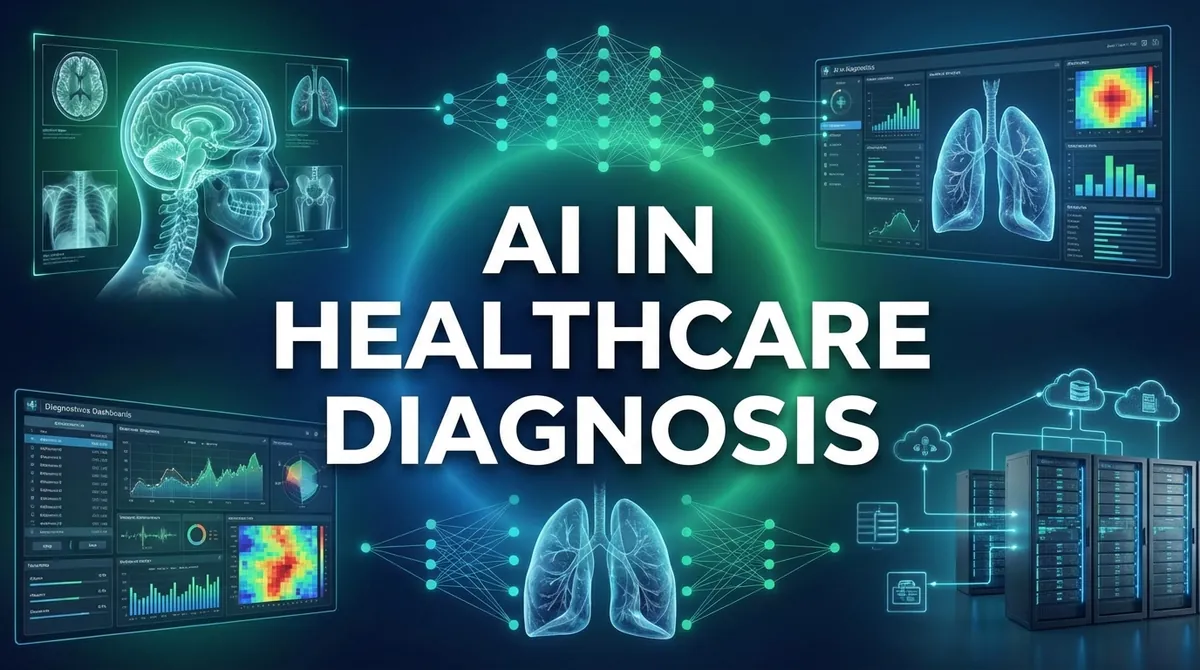
1. Medical Imaging and Diagnosis
This is arguably where AI has achieved its most dramatic clinical results:
Radiology:
- Google's AI system detected breast cancer in mammograms with fewer false positives and false negatives than expert radiologists in a landmark UK/US study
- AI reads chest X-rays for pneumonia, tuberculosis, and COVID-19 with speed and accuracy matching specialists
- AI segments and measures brain tumors in MRI scans in seconds — a process that would take a radiologist 30+ minutes
Pathology:
- AI systems analyze biopsy slides stained with H&E dye to detect cancer with accuracy comparable to experienced pathologists
- Digital pathology powered by AI can process slides at 100× human speed — critical when pathologist shortages create diagnostic backlogs
Ophthalmology:
- Google's DeepMind AI detects over 50 eye diseases from retinal scans — including diabetic retinopathy, macular degeneration, and glaucoma — with expert accuracy
- This technology enables screening programs in regions where ophthalmologists are scarce
Cardiology:
- AI analyzes ECGs to detect atrial fibrillation, heart attack, and other conditions — sometimes identifying conditions that experienced cardiologists missed
- Apple Watch's AI-powered ECG has detected undiagnosed atrial fibrillation in millions of users
2. Drug Discovery and Development
Traditional drug discovery is brutally slow and expensive:
- 10–15 years from initial discovery to market approval
- Over $1 billion in average development costs per approved drug
- Success rates below 12% in clinical trials
AI is compressing this timeline dramatically:
Protein structure prediction: DeepMind's AlphaFold has predicted the 3D structure of virtually all known proteins — a problem that stumped biochemists for 50 years. Knowing protein structure is fundamental to understanding how diseases work and how to target them with drugs.
De novo drug design: Generative AI models design novel drug molecule candidates with specific therapeutic properties — without being limited to known chemical scaffolds. Insilico Medicine used this approach to identify a drug candidate for idiopathic pulmonary fibrosis in 18 months, now in Phase II clinical trials.
Drug repurposing: AI analyzes existing approved drugs and matches them to new diseases — using knowledge graphs, biological pathway analysis, and patient data. This is how some potential treatments for rare diseases have been identified quickly.
Clinical trial optimization: AI improves clinical trial design, identifies the ideal patient populations for each trial, monitors for safety signals in real time, and predicts which trial sites will recruit patients most effectively.
3. Personalized and Precision Medicine
AI enables a shift from treating diseases to treating individual patients:
- Genomics: AI analyzes a patient's DNA to predict disease risk, drug responses, and optimal treatment protocols
- Treatment selection: AI systems match patients to the treatment protocol most likely to succeed based on molecular profile, prior treatments, and population data
- Dosage optimization: AI adjusts drug dosages based on individual pharmacokinetics, comorbidities, and real-time biomarker data
- Continuous monitoring: Wearables powered by AI continuously monitor heart rate, glucose, sleep, and activity — generating personalized insights and early warning alerts
4. Clinical Documentation and Workflow
Administrative burden is one of the leading causes of physician burnout — clinicians spend nearly half their working time on documentation rather than patient care.
AI-powered solutions are addressing this:
- Ambient clinical intelligence: AI listens to doctor-patient conversations and automatically generates structured clinical notes — saving 2–3 hours of documentation per physician per day
- NLP for EHR: AI extracts key information from unstructured clinical notes in Electronic Health Records, making patient history more accessible and reducing errors
- Automated coding: AI assigns ICD and billing codes to clinical encounters automatically — reducing errors and improving revenue cycle accuracy
- Prior authorization: AI handles the administrative process of obtaining insurance approval for treatments and procedures
5. Remote Patient Monitoring and Telemedicine
AI extends specialist-quality care beyond hospital walls:
- Remote monitoring: AI-powered devices continuously monitor patients with chronic conditions — diabetes, heart failure, hypertension — alerting care teams to deterioration before hospitalization is required
- Virtual triage: AI chatbots conduct initial symptom assessment, determine urgency, and route patients to appropriate care levels — reducing unnecessary emergency department visits
- AI-assisted telemedicine: During virtual visits, AI provides physicians with clinical decision support in real time — presenting relevant guidelines, drug interactions, and diagnostic suggestions
6. Surgical Robotics
AI-guided robotic surgery systems offer precision beyond human capability:
- Sub-millimeter accuracy in minimally invasive procedures
- Computer-assisted guidance for complex tumor removal
- AI-powered tremor filtering in neurosurgery
- Systems that learn from thousands of previous procedures to improve guidance
Significant Challenges of AI in Healthcare
Challenge 1: Data Quality and Availability
AI models are only as good as the data they are trained on. Healthcare data presents enormous challenges:
- Fragmentation: Patient data is scattered across hospitals, clinics, labs, pharmacies, and insurance companies — rarely interoperable
- Biased datasets: Most training datasets over-represent certain demographics (typically white males in Western institutions) — leading to AI systems that perform worse for underrepresented groups
- Data volume: Many rare diseases have too few cases to train reliable models
- Data quality: Clinical records contain errors, inconsistencies, and missing values that degrade model performance
Challenge 2: Algorithmic Bias
AI healthcare systems trained on biased data produce biased outcomes — often along racial, gender, and socioeconomic lines:
- Studies have shown some AI diagnostics perform less accurately for darker skin tones
- Pain management algorithms have been found to underestimate pain in Black patients
- Insurance risk models have been shown to underestimate illness severity in patients of color
Addressing algorithmic bias requires diverse training data, rigorous fairness auditing, and ongoing post-deployment monitoring.
Challenge 3: Regulatory Approval and Safety
Healthcare AI operates in a heavily regulated environment — with good reason:
- Unlike a software update that you can roll back, a diagnostic AI error could mean a patient receives the wrong treatment
- Regulatory pathways for AI as a Medical Device (AIaMD) are still evolving
- "Locked" vs. "adaptive" AI models pose different regulatory challenges — adaptive models that update after deployment require continuous validation
- International regulatory fragmentation (FDA, EMA, CDSCO, etc.) slows global deployment
Challenge 4: Explainability and Trust
Most high-performing AI models are "black boxes" — they produce outputs without explaining their reasoning in human-understandable terms.
This is a critical problem in healthcare:
- Physician adoption: Clinicians are understandably reluctant to follow AI recommendations they cannot understand or verify
- Legal liability: Who is responsible when an AI diagnostic system makes an error that harms a patient?
- Patient trust: Patients have a right to understand how decisions about their care are made
Explainable AI (XAI) research is actively addressing this, but it remains a significant challenge.
Challenge 5: Data Privacy and Cybersecurity
Healthcare data is among the most sensitive personal information in existence — and it is among the most targeted by cybercriminals:
- The healthcare sector experiences more ransomware attacks than any other industry
- Medical records sell for 10–40× more than credit card data on dark web markets
- AI systems that aggregate patient data from multiple sources create larger, more attractive attack targets
- HIPAA (USA), GDPR (Europe), and similar regulations impose strict requirements on how patient data can be collected, used, and shared for AI training
The intersection of AI and healthcare cybersecurity is one of the most critical challenges of the decade.
Challenge 6: Integration with Clinical Workflows
Even technically excellent AI tools fail if they disrupt clinical workflows or don't integrate with existing Electronic Health Record systems:
- Alert fatigue: clinicians overwhelmed by AI-generated alerts soon learn to dismiss them — missing true positives
- Poor UX: AI systems requiring disruptive data entry or multi-step processes will not be adopted
- EHR integration challenges: healthcare IT infrastructure is notoriously fragmented and interoperability is poor
Challenge 7: Physician and Staff Adoption
Technology adoption in healthcare is historically slow — and for understandable reasons:
- Clinicians bear direct responsibility for patient outcomes — they need confidence in any tool they use
- Inadequate training on AI tools leads to misuse or non-use
- Concerns about AI replacing clinical jobs contribute to resistance
- Workflow disruption during implementation affects patient safety
The Future of AI in Healthcare
Despite the challenges, the trajectory of AI in healthcare is clearly positive:
Near-Term Trends (2026–2028)
- AI-generated clinical notes becoming standard across major health systems
- FDA-approved AI diagnostics reaching primary care settings globally
- Multimodal AI systems integrating imaging, genomics, and clinical data for holistic diagnosis
- Real-time surgical AI guidance systems gaining regulatory approval
Long-Term Vision (2030+)
- Predictive medicine: AI identifying disease risk years before symptoms appear
- Continuous digital biomarkers from wearables enabling true preventive healthcare
- AI drug development pipelines reducing time to market to under 5 years
- Universal AI-assisted triage enabling specialist-quality care in resource-limited settings globally
Short Summary
AI in healthcare is delivering transformative benefits — dramatically improving diagnostic accuracy in radiology and pathology, accelerating drug discovery, enabling personalized medicine, reducing administrative burden, and extending care through remote monitoring. Significant challenges remain, including biased training data, algorithmic bias, regulatory complexity, explainability requirements, data privacy, cybersecurity risks, and clinical adoption barriers. The future of healthcare AI depends on addressing these challenges through diverse datasets, explainable models, robust regulation, strong cybersecurity practices, and clinician-centered design.
Conclusion
Artificial intelligence in healthcare represents one of the most consequential technological developments of our generation — with the potential to save millions of lives, democratize access to specialist care, and accelerate medical knowledge at a rate impossible through human effort alone.
But realizing this potential requires confronting real challenges honestly and working to solve them — particularly around fairness, privacy, explainability, and the human factors of change management in complex clinical environments.
AI in healthcare will not replace doctors — it will give doctors superhuman capabilities. The physicians, researchers, and healthcare leaders who understand and work effectively with AI will lead medicine into a new era of precision, accessibility, and prevention.
The transformation has already begun.
Frequently Asked Questions
AI is actively used in medical imaging diagnosis, drug discovery, personalized treatment planning, clinical documentation automation, remote patient monitoring, surgical robotics guidance, and treatment optimization recommendations.