Introduction
In 2026, the financial world is witnessing a high-speed arms race between artificial intelligence-powered attackers and defenders. Fraud, once a manual and slow-paced activity, has transformed into a highly automated, AI-driven global enterprise. Billions of dollars are stolen each year through sophisticated social engineering, identity theft, and transaction manipulation. However, the same technology that enables these crimes is also our most powerful shield. Artificial Intelligence has become the primary line of defense in fraud detection, operating at speeds and scales that human analysts could never match.
Modern fraud detection is no longer about checking "if a signature matches" or if a transaction comes from a "strange zip code." In 2026, it is about "Identity Intelligence" and "Predictive Behavioral Analysis." AI systems process billions of transactions in milliseconds, identifying the microscopic patterns that distinguish a legitimate user from a sophisticated bot or a malicious actor. For financial institutions, e-commerce giants, and governments, AI-powered fraud detection is the only way to maintain digital trust in an era of industrial-scale deception.
This guide explores the state of the art in AI fraud detection in 2026, analyzes the emerging threat of "Synthetic Identity" and "Deepfake Fraud," and outlines the critical cybersecurity infrastructure required to win the battle against the next generation of financial criminals.
1. How AI Powers Modern Fraud Detection
Real-Time Anomaly Detection
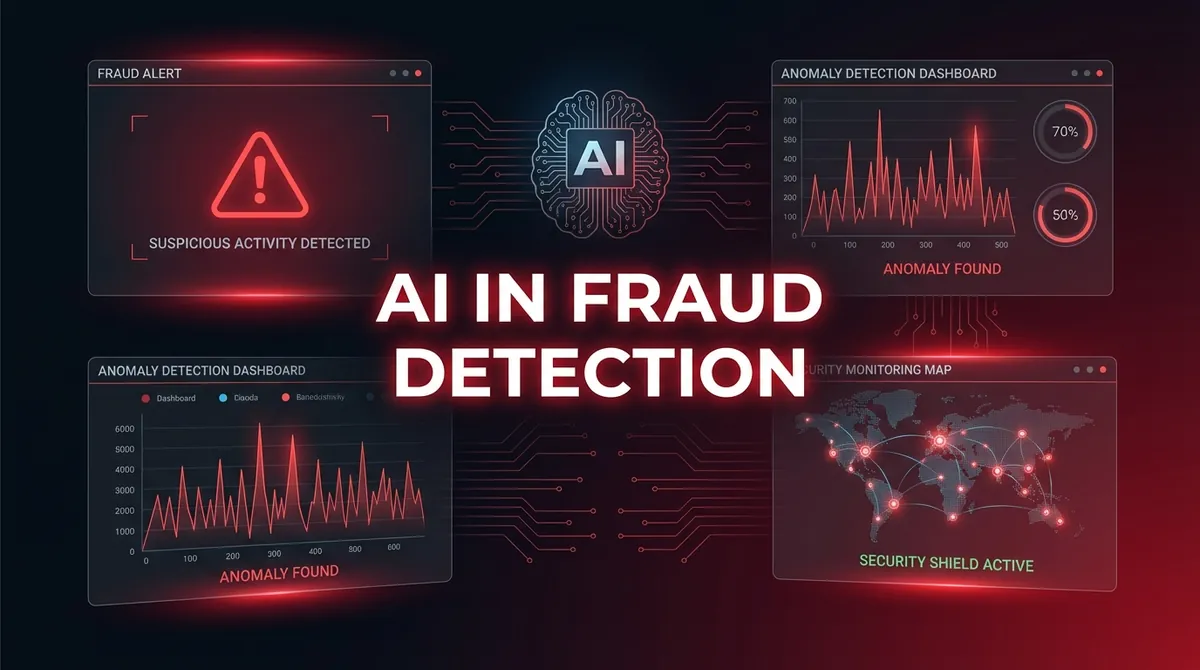
The core strength of AI in 2026 is its ability to identify "the needle in the haystack." Traditional rule-based systems (e.g., "flag any transaction over $5,000") are easily bypassed by modern criminals. AI-powered "Anomaly Detection" creates a dynamic, personalized profile for every user, analyzing thousands of variables: typing speed, swipe gestures, device orientation, location history, and historical spending patterns. If a transaction deviates even slightly from this "unique digital fingerprint," the system can trigger an instant verification step or block the activity entirely.
Graph Neural Networks (GNNs) and Network Analysis
Fraud rarely happens in isolation; it usually involves a network of connected accounts and devices. GNNs allow fraud investigators to visualize and analyze the "relationships" between data points. In 2026, these systems can detect "Fraud Rings" by identifying hidden links between seemingly unrelated accounts—such as sharing a hardware ID, an IP address, or a subtle pattern of money movement. This allows banks to shut down entire criminal infrastructures rather than just individual fraudulent accounts.
Natural Language Processing (NLP) in Claims Analysis
In sectors like insurance, AI uses NLP to analyze the text of claims and supporting documents. It can identify "Inconsistent Narratives" or detect if the same wording is being used across multiple unrelated claims, which often indicates a coordinated insurance fraud scheme.
2. Solving the "Synthetic Identity" Crisis
The most dangerous fraud trend in 2026 is "Synthetic Identity Theft," where criminals combine real data (like a stolen ID number) with fake data (a generated name and address) to create an entirely new persona. This "person" can then build a credit history and open bank accounts, which are eventually used for major fraud.
AI defenders combat this by using "Deep Document Verification." They analyze the microscopic "pixel noise" in submitted ID photos to detect AI-generated elements and use "External Data Validation"—instantly cross-referencing information against thousands of public and private databases to see if the "synthetic person" has a legitimate digital footprint.
3. The Deepfake Fraud Frontline
In 2026, "Social Engineering" has been revolutionized by AI deepfakes. Attackers can now use "Voice Cloning" to impersonate a CEO on a phone call or "Video Deepfakes" to bypass facial recognition security.
Defending Against Deepfakes
Fraud detection systems now include "Liveness Detection." When a user is asked to verify their identity via camera, the AI doesn't just look at their face; it looks for the tiny "glitches" that reveal a deepfake, such as unnatural blood flow patterns in the skin (photoplethysmography) or minute inconsistencies in how the light reflects off the eyes. AI also analyzes the "acoustic metadata" of voice calls to identify the digital artifacts left by voice cloning software.
4. Cyber Security: The "Adversarial AI" Challenge
The biggest threat to fraud detection in 2026 is the the fact that the criminals also have access to powerful AI.
Adversarial Machine Learning (AML)
Criminals use "Adversarial AI" to "probe" a bank's fraud detection system. They send thousands of tiny, low-value transactions to see which ones get flagged and which ones pass. By analyzing these responses, the attacker's AI can "learn" the boundaries of the bank's security and precisely craft fraudulent transactions that are designed to be "invisible" to the detection models.
Data Poisoning the Detection Models
If an attacker can gain access to the data used to train a bank's fraud detection AI, they can perform a "Data Poisoning" attack. By subtly injecting "bad" data into the training set, they can create "blind spots" in the model, essentially teaching the AI to ignore specific types of fraudulent activities. Securing the "Training Data Pipeline" is a critical requirement for any AI-powered financial security system.
Short Summary
AI is the primary line of defense against fraud in 2026, utilizing real-time anomaly detection, Graph Neural Networks, and deep liveness verification to combat industrial-scale deception. These systems are essential for detecting "Synthetic Identities" and deepfake-powered social engineering. However, the battle is evolving into "Adversarial AI" where criminals use their own models to probe for vulnerabilities or poison training data. Winning the war on fraud requires not just better AI, but a "Zero Trust" data pipeline and continuous "Red Teaming" of security models to defend against the next wave of AI-enhanced financial crime.
Conclusion
Fraud detection in 2026 is a game of nanoseconds and patterns. As criminals become more sophisticated, the role of AI moves from being a "useful tool" to being the "only possible solution." The financial institutions that succeed in this era will be those that treat AI security not as a static shield, but as a dynamic, evolving intelligence that is constantly learning and adapting to the threats of the tomorrow.
Frequently Asked Questions
Yes. Modern fraud detection tools analyze the "acoustic artifacts" and microscopic inconsistencies in synthesized voices that are impossible for the human ear to hear, allowing for the real-time identification of voice cloning attacks.